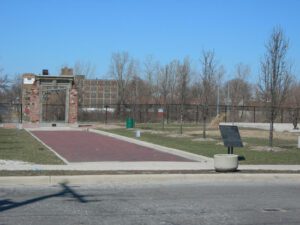
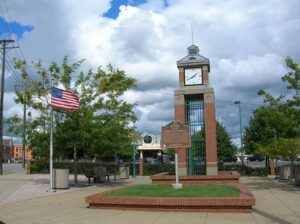
In 1934, workers at the Electric Auto-Lite Company and other automotive-related manufacturers secretly organized the Automobile Workers Federal Union Local 18384, American Federation of Labor (AFL), which became the United Auto Workers (UAW) Local 12. Anti-unionism, broken pledges by management, and abuse of workers had festered locally for generations. Workers bitterly resented the fact that management took advantage of the Depression’s high unemployment to decrease wages. In February, workers struck at Auto-Lite, Bingham Stamping, Logan Gear, and Spicer Manufacturing Company. When management refused to negotiate in good faith, the workers, including a large number of women, struck the Auto-Lite in mid-April. Auto-Lite management secured a court order limiting the number of strikers to twenty-five. The strike appeared to be lost until the Lucas County Unemployed League organized fierce resistance to the court injunction as the crowd around the plant grew to ten thousand. (continued on other side)
Raised and educated in St. Louis, author Fannie Hurst (1885-1968) was born in Hamilton at 918 Central Avenue, the home of her maternal grandparents. She was the daughter of Rose Koppel and Samuel Hurst. Already a writer as a student at Washington University (Class of 1909), Fannie moved to New York in 1910 to begin her career. Success came after repeated rejection. Stories for popular magazines brought her attention in the mid-1910s; by the mid-1920s she had become a best-selling, highly-regarded, and well-paid author. Between 1912 and 1964, Hurst wrote 18 novels, eight short story collections, and many other pieces. Hurst’s short story “Humoresque” (1919) and the novels Back Street (1931) and Imitation of Life (1933) were three of 32 films based on her writings. The film adaption of Imitation of Life received an Oscar nomination for Best Picture in 1934. (Continued on other side)
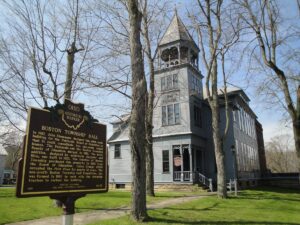
In 1887, John Eisenmann designed this stick-style building for the Peninsula Board of Education so that it could consolidate two one-room school houses. The Peninsula and the Boston Township Boards of Education merged in 1919. The brick addition, designed by architects Harpster and Bliss, was built in 1920. The trustees of Boston Township purchased this property in 1939 from the Board of Education. Union Grange #2380 occupied the first floor for nearly 50 years. The non-profit Boston Township Hall Committee, Inc. was formed in 1990 to work with the township trustees to restore the building.
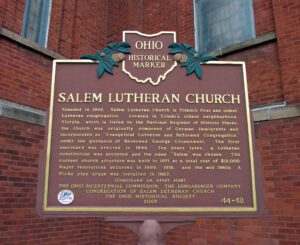
Founded in 1842, Salem Lutheran Church is Toledo’s first and oldest Lutheran congregation. Located in Toledo’s oldest neighborhood, Vistula, which is listed on the National Register of Historic Places, the church was originally composed of German immigrants and incorporated as “Evangelical Lutheran and Reformed Congregation” under the guidance of Reverend George Cronenwett. The first sanctuary was erected in 1844. Ten years later, a Lutheran constitution was accepted and the name “Salem” was chosen. The current church structure was built in 1871at a total cost of $12,000. Major renovations occurred in 1889, 1916, and the mid 1960s. A Wicks pipe organ was installed in 1967. (continued on other side)
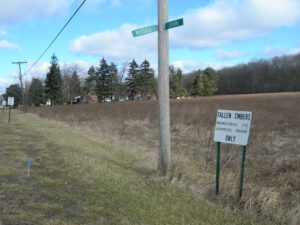
The Battle of Fallen Timbers, fought on August 20, 1794, is one of the most significant events relating to post-Revolutionary War America. Major General “Mad” Anthony Wayne led the Federal Army, known as The Legion of the United States against a confederacy of Native Americans led by Miami Chief Little Turtle and Shawnee war chief Blue Jacket. Defeat in battle and lack of help from their nearby British allies disheartened the tribes and lead to the 1795 Treaty of Greenville. The Treaty secured United States control of the Northwest Territory and ultimately resulted in the formation of five new states-Ohio, Indiana, Michigan, Illinois, and Wisconsin. (continued on other side)
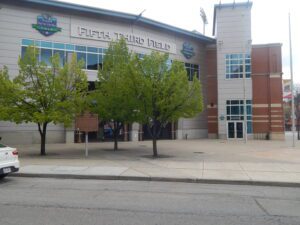
Moses Fleetwood Walker was born on October 7, 1856 in Ohio to Moses M. Walker, a physician, and Caroline, a midwife. He attended and played baseball at Oberlin College and the University of Michigan. In 1883, Walker joined the newly formed Toledo Blue Stockings and became the first African American major league ballplayer when Toledo joined the Major League-sanctioned American Association the following year. As a barehanded catcher, his biggest assets were his catching ability, powerful throwing arm, and aggressive base running. He endured racial prejudice from teammates, opponents, and baseball fans, and eventually left to become a writer, inventor, civil rights advocate, and entrepreneur. Walker was elected to the Ohio Baseball Hall of Fame in 1991. He died in 1924 and is buried in Stuebenville, Ohio in the family plot at Union Cemetery.
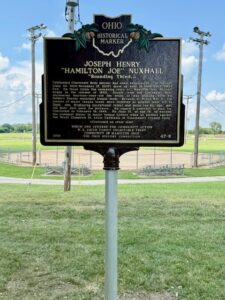
Celebrated Cincinnati Reds pitcher and radio broadcaster, Joe Nuxhall (July 30, 1928 – November 15, 2007) grew up here in Hamilton’s North End. On these fields the endearing story of “Hamilton Joe” Nuxhall began in the summer of 1943. Scouts from the Cincinnati Reds discovered fourteen-year-old Joe while he was playing with his father’s Sunday municipal league team. Because of World War II, the rosters of major league teams were depleted as players went off to fight. Joe, displaying exceptional talent and poise for his age, met the Reds’ dire need for pitchers. He signed a contract to play for Cincinnati on February 18, 1944. On June 10, at age 15, he became the youngest player in major league history when he pitched against the World Champion St. Louis Cardinals at Cincinnati’s Crosley Field. (Continued on other side)
Jerry Siegel and Joe Shuster, two Glenville High School students imbued with imagination and talent and passion for science fiction and comics, had dream become reality in 1932. They created Superman, the first of the superheroes ever to see print. The 1932 prototype was of a villainous superhero. Superman then became the hero who has been called the Action Ace, the Man of Steel, and the Man of Tomorrow. (continued on other side)