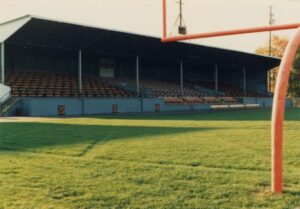
Opened in 1926, Tanks Memorial Stadium became the home of the Ironton Tanks semi-professional football team. The Tanks were formed in 1919 and through the years played other semi-professional teams as well as teams from the American Professional Football Association that became the National Football League in 1930. In twelve seasons the Tanks had a record of 85 wins, 19 losses, and 14 ties, including wins against the Chicago Bears and New York Giants. The Tanks disbanded in 1931, but five players moved on to the Portsmouth Spartans, which became the Detroit Lions, and other NFL teams picked up four other players. Tanks Memorial Stadium is one of the few remaining roofed high school football stadiums in the country.
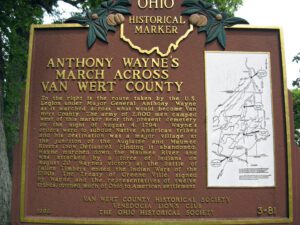
To the right is the route taken by the U.S. Legion under Major General Anthony Wayne as it marched across what would become Van Wert County. The army of 2,800 men camped west of this marker near the present cemetery on the night of August 4, 1794. Wayne’s orders were to subdue Native American tribes and his destination was a major village at the junction of the Auglaize and Maumee Rivers (now Defiance). Finding it abandoned, Wayne marched down the Maumee River and was attacked by a force of Indians on August 20. Wayne’s victory at the Battle of Fallen Timbers ended the Indian Wars of the 1790s. The Treaty of Greene Ville, signed by Wayne and the representatives of twelve tribes, opened much of Ohio to American settlement. Side one includes a map on the right hand side of the marker showing the route of Wayne’s army through the eastern third of Van Wert County.
After American militia troops forcibly ended the 1812 siege of Fort Wayne, General James Winchester’s Army of the Northwest marched down the north side of the Miami [Maumee] River to stop or retard advancing British troops sent to aid in the siege of Fort Wayne. After three days of difficult march, Ensign James Liggett of the 17th Regiment, volunteered to lead a group of four spies or scouts to the site of the old Fort Defiance. Liggett’s small force was surprised and killed on or about September 25 near here. The Americans tried twice to recover the bodies, but met with ambush from hostile Native Americans sympathetic to the British. Their bodies were finally recovered and buried in a common grave. Besides Liggett, they included Wyatt Stepp, Guy Hinton, William Bevis, and Nathaniel Mitchell of Woodford County, Kentucky, all of Captain McCracken’s Company, 1st Rifle Regiment, Kentucky Volunteer Militia.
Camp Latty was located at the corner of Riverview and Glenwood Avenues in Napoleon, Ohio and included Glenwood Cemetery in its grounds. This camp was named for Judge Alexander S. Latty, a staunch supporter of the Union. From October to December 1861 the 68th Regiment was organized. The 68th Regiment then took part in the Battles of Fort Donelson, Shiloh, the Siege of Corinth, the Battles of Hatchies’s Bridge, Port Gibson, Raymond, Champion Hill, the Siege of Vicksburg, the Meridian Campaign, the Atlanta Campaign, the Battle of Kennesaw Mountain, the Battle of Atlanta, the Siege of Atlanta, the Battle of Jonesboro, Sherman’s March to the Sea, the Carolinas Campaign, the Battle of Bentonville, the Surrender of Johnston’s Army, and the Grand Review in Washington, D.C. The 68th Regiment served in every Confederate State except Florida and Texas. (Continued on other side)
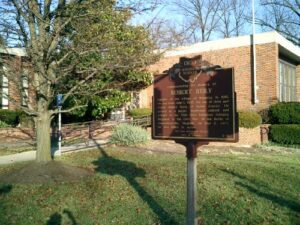
Robert Reily, founder of the village of Wyoming in 1861. He was born June 1, 1820, the son of John and Nancy Hunter Reily of Butler County. He served as a major, lieutenant colonel and colonel of the 75th Ohio Volunteer Infantry Regiment in the Civil War. At the battle of Chancellorsville, Virginia, on May 2, 1863, he was killed in action.
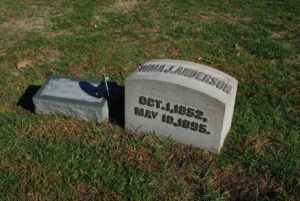
Named for Major General James B. McPherson, buried here July 29, 1864. Here also are graves of George Burton Meek, U.S.N., first American serviceman killed in the War with Spain; Congressional Medal of Honor recipients Charles H. McCleary, Civil War, and Rodger W. Young, World War II; Emma Anderson, mother of author Sherwood Anderson.
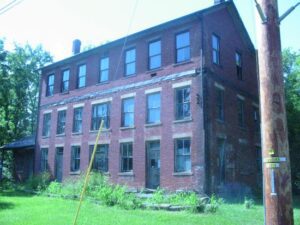
This historic inn began serving travelers on the old Portage-Columbiana stage road (now Tallmadge Road) in 1832. Two major stage lines, one from Cleveland to Wellsville (the closest Ohio River port) and the other from Cleveland to Pittsburgh, passed through Palmyra in the early 1800s. Originally a simple two-story Greek Revival-style building, it had its third story added in 1888 when it became a lodge for the Knights of Pythias fraternal organization. It served as a private residence and store for most of the 20th century. The Palmyra Center Hotel was added to the National Register of Historic Places in 1976.
Near intersection of Old Springfield Pike and US 68
Xenia
, OH
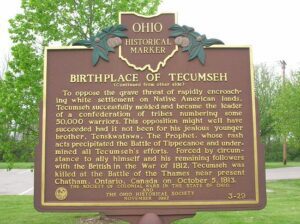
The great Native American Shawnee leader, Tecumseh, was born on the bank of a large spring at this site in 1768, at the very instant that a great meteor seared across the skies. The birth occurred while his parents, Shawnee war chief, Pucksinwah, and his wife, Methotasa, were en route from their village of Kispoko Town, on the Scioto River, to a major tribal council at the Shawnee tribal capital village of Chalahgawth (Chillicothe – now Oldtown), which was located “two arrow flights” northwest of this site. Though prohibited by tribal tradition from becoming chief of the Shawnees, Tecumseh rose to become one of the greatest warriors, orators, and military strategists of any tribe in America.