

, OH
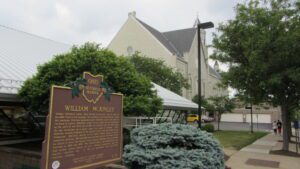
William McKinley’s house, once located at this site, was the scene of his 1896 front porch campaign for President of the United States. During the campaign McKinley addressed about 750,000 people who came to his home in Canton. McKinley’s public service began when he volunteered at the start of the Civil War in 1861 as a private with the Union Army. He was discharged as a major after four years of service. Later McKinley became President of the Canton Y.M.C.A. and the Stark County Prosecutor. McKinley served in the United States House of Representatives between 1877 and 1891 and was then elected Governor of Ohio. He helped to found the Canton Public Library. McKinley won presidential elections in 1896 and 1900. His administration was characterized by high tariffs, money backed by gold, national prosperity, and the Spanish-American War. In 1901 an anarchist shot and killed President McKinley.
, OH
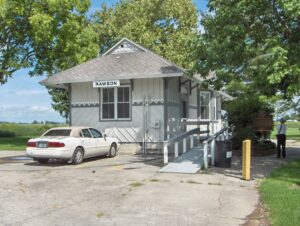
The original town plat of Rawson was filed on February 3, 1855, consisting of fifty-five lots in sections 13 and 14 of Union Township, Hancock County on the Frederick Keller and George J. Kelly farms. Several residential and business structures were built in anticipation of completion of a railroad rumored to pass from Fremont through the “Rawson” area on its way to the western boundary of Ohio. Farmers Keller and Kelly named their village Rawson after L.Q. Rawson, President of the railroad company, hoping that the name would encourage him to build through their area. Financial troubles delayed construction causing a standstill in Rawson. Seventeen years later the first locomotive arrived in Rawson, spurring new construction. At that time the railroad was called the Lake Erie and Louisville; in 1879 it was changed to the Lake Erie and Western and in 1922 became part of the Nickel Plate Railroad. (Continued on other side)
, OH
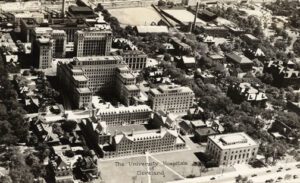
Named for the streetcar turnaround once located at Euclid Avenue and East 107th Street, University Circle is a 600-acre district that is home to many of Cleveland’s major cultural, educational, medical, and service institutions. The area was first settled in 1799 by tavernkeeper Nathaniel Doan and became known as Doan’s Corners. In 1882, Western Reserve College moved here from Hudson, followed in 1885 by the Case School of Applied Science from downtown Cleveland. These two colleges federated in 1967 to become Case Western Reserve University. (continued on other side)
, OH
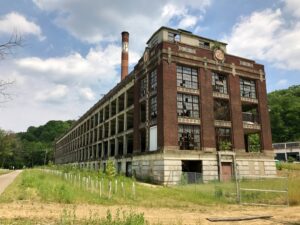
The Peters Cartridge Company was once a major employer in the region, providing munitions for Allied forces during World Wars I and II. Organized in 1887, it was the first ammunition company to produce machine-loaded shotgun shells. After an explosion in 1890 that killed 12, the factory was rebuilt at this site. By 1916, brick and reinforced concrete buildings had replaced wood structures and a taller shot tower had been erected. Sister company to the King Powder Company across the Little Miami River, 3,000 men and women at Peters produced 1,500,000 cartridges per day in 1917 to supply munitions during WWI. In 1934, Remington Arms bought the company, enlarged it, and then sold it in 1944. The shot tower and smoke stack stand as a reminder that Peters was once the leader in ammunition production.
, OH
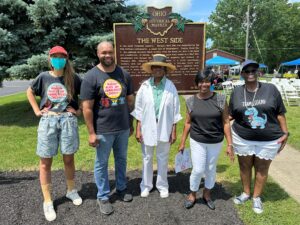
In the early twentieth century, Marion’s West Side was dominated by the Erie Railroad switchyards, a major hub of employment. During World War I, the railroad recruited Black workers from the South for jobs in its yards and roundhouses. In Marion, these workers made their homes in a West Side encampment that became the target of white suspicion and violence. In February 1919, following the unsolved murder of a white roundhouse worker’s wife and a separate alleged assault, a 300-man lynch mob smashed windows and occupied the West Side. All Black residents were ordered to leave the city by 6:00 pm the next day. Despite pleas to Governor Cox, at least 200 Black residents were forced to flee Marion. Marion’s anti-Black violence foreshadowed the nationwide “Red Summer” of 1919.
, OH
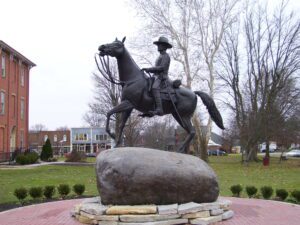
W.S. Rosecrans, soldier, engineer, architect and inventor, was born in Kingston Township in 1819. After graduation from West Point in 1842, he served in the Engineering Corps then taught at West Point. As a civilian, he engineered a river lock system and perfected lamp oil. During the Civil War, Rosecrans commanded Union Armies of the Ohio, the Cumberland, and the Missouri, and developed a popular war-time ambulance. “Old Rosy” led his troops to victory at Iuka, Corinth, Stones River and Tullahoma. He helped raise $789,000 for soldiers’ relief and designed St. Joseph’s Cathedral in Columbus. He later served as Minister to Mexico, Registrar to the U.S. Treasury and as a Congressman from California. He died in 1898 and is buried in Arlington National Cemetery. “Stand by your flag and country, my men!”- Rosecrans at the Battle of Stones River, October 4, 1862
, OH
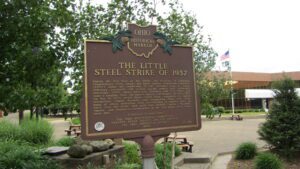
During the New Deal of the 1930s, the Congress of Industrial Organizations (CIO) formed the Steel Workers Organizing Committee (SWOC) under the leadership of CIO president John L. Lewis. Following successful CIO strikes in the rubber and automobile industries, SWOC signed hard-won contracts with U.S. Steel and Jones & Laughlin Steel, the nation’s largest steelmakers, in early 1937. On May 26 SWOC struck three “Little Steel” companies for similar recognition: Inland, Republic, and Youngstown Sheet and Tube, many of whose operations were concentrated in eastern Ohio. By early June the strike idled more than 28,000 Canton, Massillon, Warren, and Youngstown steelworkers in the first major steel strike since 1919. (continued on other side)
, OH
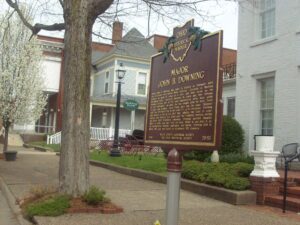
Major John B. Downing was born in Rutland in February 1834, son of Rodney and Marian Black Downing. Educated at Marietta College, he spent 27 years as a pilot and boat owner on the Mississippi River, operating between St. Louis and New Orleans. Downing became one of the most experienced river boat pilots on the Mississippi. As such, he was sought after by Mark Twain to teach him piloting. Later Twain gave him the name “Alligator Jack” and referenced him in his book Life on the Mississippi. Downing also played a role in the Civil War, piloting the fleet in cooperation with General U.S. Grant past the Vicksburg fortress during the famed 1863 Vicksburg Campaign. Downing married Romaine Miller in 1868, and they had two sons, Miller R. and John B. Jr. An accomplished violinist, marksman, and hunter, Downing died in March 1914 and was buried in Middleport Hill Cemetery.