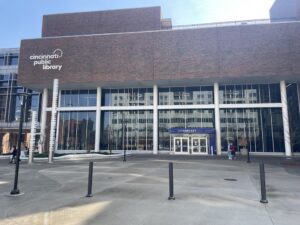
Among the first in America, Cincinnati’s public library dates from March 14, 1853. A public reading room opened in 1856, but funding remained a problem until 1867, when local school board president Rufus King II secured legislation for a renamed Cincinnati Public Library. In 1869, King lured leading librarian William Frederick Poole to organize Cincinnati as a national model for the growing public library movement. Poole designed 19th century America’s most advanced library at 629 Vine Street, which fully opened in 1874. Becoming a countywide system in 1898, the Public Library of Cincinnati and Hamilton County was a pioneer in the 20th century with special services for the blind and for children, bookmobile services, and circulation of audiovisual materials. (continued on other side)
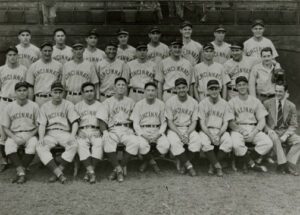
The 1869 Cincinnati Red Stockings made history not only as the most dominant baseball club of its time, but also as the first band of professional ballplayers. Cincinnati’s decision to pay players proved to be a success, and other cities soon began establishing their own professional clubs throughout America. In 1876, the Reds joined the newly formed National League. Baseball soon became one of Cincinnati’s most popular entertainment venues, aided in part by the team’s World Series titles in 1919 and 1940. Cincinnati’s “Big Red Machine,” featuring players such as Johnny Bench, Joe Morgan, and Pete Rose, dominated baseball in the 1970s, picking up additional titles in 1975 and 1976. A surprise wire-to-wire title again in 1990 strengthened the Reds’ legacy and helped ensure future generations of Reds fans.
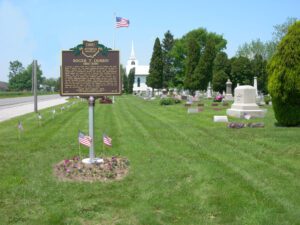
According to fellow World War II veteran and U.S. Senator Bob Dole, Roger T. Durbin was “the public persona—the beacon—of the drive to build a National World War II Memorial in our nation’s capital.” It started with a conversation between Mr. Durbin and Congresswoman Marcy Kaptur at a local fish fry in February 1987. Enlisting Kaptur’s support, the work to create the memorial began. Described as a “gentleman with a square jaw, twinkling eyes, and churlish grin,” Mr. Durbin committed himself to serving others. He was a rural letter carrier, Richfield Township trustee, and coached Little League baseball. He was a veteran of the Tenth Armored (Tiger) Division and saw action at the Battle of the Bulge. The National WWII Memorial was dedicated May 29, 2004. Although Mr. Durbin did not live to see that day, his determination is the reason it stands.
801 E. Pete Rose Way, Bicentennial Commons at Sawyer Point
Cincinnati
, OH
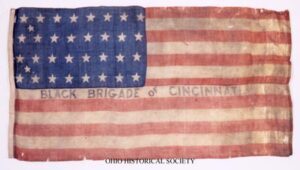
Following the success of Confederate forces in eastern Kentucky and General John Hunt Morgan’s raids there in 1862, Cincinnatians believed that Southern invasion was imminent. Anxious officials ordered Cincinnati citizens to form home guards, but black men willing to volunteer were rebuffed when they attempted to join a defense force. Instead, police serving as provost guards rounded up many and marched them by bayonet to build fortifications in Kentucky. Reacting to the shameful treatment of the blacks eager to support the Union, the commander of the Department of Ohio dispatched Major General Lewis Wallace to command the civilians and to liberate black men forced into service. (continued on other side)
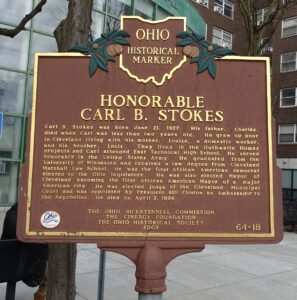
Carl B. Stokes was born June 21, 1927. His father, Charles, died when Carl was less than two years old. He grew up poor in Cleveland living with his mother, Louise, a domestic worker, and his brother, Louis. He served honorably in the United States Army. He graduated from the University of Minnesota and received a law degree from Cleveland Marshall Law School. He was the first African American democrat elected to the Ohio legislature. He was also elected Mayor of Cleveland, becoming the first African American Mayor of a major American city. He was elected judge of the Cleveland Municipal Court and was appointed by President Bill Clinton as ambassador to the Seychelles. He died on April 3, 1996.
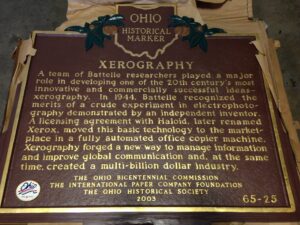
A team of Battelle researchers played a major role in developing one of the 20th century’s most innovative and commercially successful ideas–xerography. In 1944, Battelle recognized the merits of a crude experiment in electrophotography demonstrated by an independent inventor. A licensing agreement with Haloid, later renamed Xerox, moved this basic technology to the marketplace in a fully automated office copier machine. Xerography forged a new way to manage information and improve global communication and, at the same time created a multi-billion dollar industry.
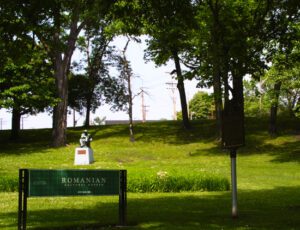
The Union and League of Romanian Societies, Incorporated was formed in 1928 from a unification of two separate fraternal organizations, the Union and the League. The Union, founded on July 4, 1906, was originally organized for the purpose of promoting the general welfare of its members through life insurance policies obtained through individual societies located in the United States and Canada. The societies of the Union and League offer social interaction within their local lodges and through the strength of the larger parent organization. The purpose of the current Union and League is to maintain and encourage Romanian cultural heritage by promoting interest in Romanian ethnic values through cultural activities and to sustain loyalty to the United States and Canada among its respective members.
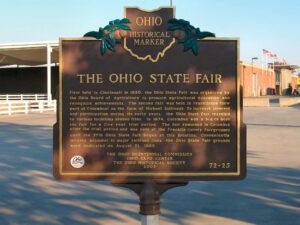
First held in Cincinnati in 1850, the Ohio State Fair was organized by the Ohio Board of Agriculture to promote agricultural education and recognize achievements. The second fair was held in Franklinton (now part of Columbus) on the farm of Michael Sullivant. To increase interest and participation during its early years, the Ohio State Fair traveled to various locations around Ohio. In 1874, Columbus won a bid to host the fair for a five-year trial period. The fair remained in Columbus after the trial period and was held at the Franklin County Fairgrounds until the 37th Ohio State Fair began at this location. Conveniently located adjacent to major railroad lines, the Ohio State Fair grounds were dedicated on August 31, 1886.