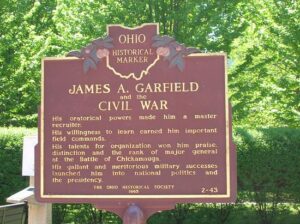
His oratorical powers made him a master recruiter. His willingness to learn earned him important field commands. His talents for organization won him praise, distinction and the rank of major general at the Battle of Chickamauga. His gallant and meritorious military successes launched him into national politics and the presidency.
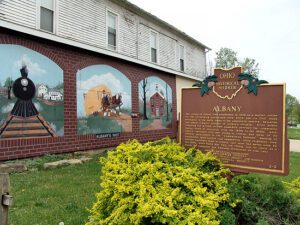
The village of Albany was established in 1838 as a market center for the surrounding agricultural area, which saw its first white settlement in the early years of the nineteenth century. Education was always a major concern of Albany’s citizens. Since public schooling was minimal, private academies provided the community various levels of education from the 1840s to the 1880s. Anti-slavery sentiment also was strong in Albany, and many of its citizens participated in the “Underground Railroad.” Because of educational opportunities and sympathetic white neighbors, free African-Americans came to Albany, but most had moved away by the 1930s. After World War Two, the village lost its status as a center for commerce and business.
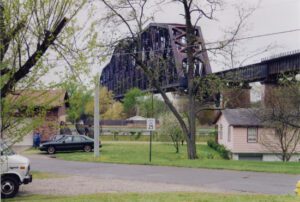
Sciotoville Bridge, 1917, designed and built by two famous American Civil Engineers, Gustav Lindenthal, D.Sc. (1850-1935), the Consulting Engineer (and) David Barnard Steinman, D.Sc. (1887-1960), the designer and stress analyst. A double track railroad bridge of twin spans each 775 feet long, it remained until 1935 the longest continuous truss bridge in the world and stands today as the prototype for continuous structures. Its construction marked a major advance in the art of bridge engineering and was a pioneer achievement in continuous truss analysis. In beauty of design, size and erection techniques it stands as a landmark of progress in man’s mastery of his environment.
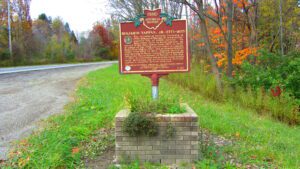
The founder of Ravenna Township in 1799, Benjamin Tappan Jr. led a distinguished life of public service. An aggressive force in local politics, he served in the Ohio Senate from 1803 to 1805, as judge of the fifth circuit court of common pleas from 1816 to 1823, and as federal district judge from 1826 to 1833. Tappan served as aide-de-camp to Major General Elijah Wadsworth following the surrender of Detroit in the War of 1812, provisioning and arming local militia units defending the northwestern frontier against a possible British invasion. (continued on other side)
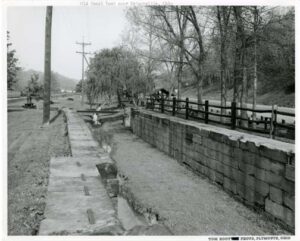
The twelfth lock on the Hocking Canal, the Sheep Pen lock underscores Southeast Ohioans’ efforts to open their region to the world during the mid-nineteenth century. Built as a guard lock, it was intended to permit slackwater navigation of the Hocking River by regulating water depths where river and canal met. Those plans were later abandoned and the mechanism was converted to a lift lock, which raised and lowered boats as required by changes in the canal’s elevation. (Continued on other side)
The landscape of northwest Ohio was formed by melting ice and the glacial lakes left behind in its wake. Because of the low gradient (3 feet fall per mile) to the northeast, the flat lacustrine plain evolved into a large swamp. A massive swamp forest with huge hardwoods, broken only sporadically with intermittent wet prairies and savannahs, dominated the landscape. Both prehistoric and historic Indians farmed the flood plains of the Maumee River and its tributaries: Auglaize, Tiffin, and Blanchard rivers. (continued on other side)
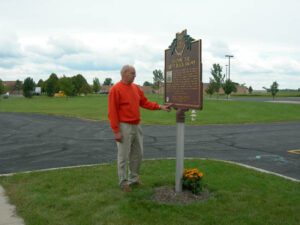
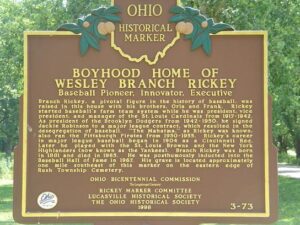
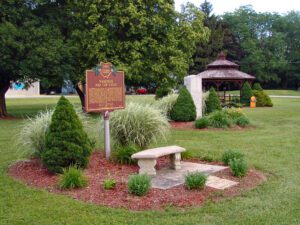
Branch Rickey, a pivotal figure in the history of baseball, was raised in this house with his brothers, Orla and Frank. Rickey started baseball’s farm team system while he was president, vice president, and manager of the St. Louis Cardinals from 1917-1942. As president of the Brooklyn Dodgers from 1942-1950, he signed Jackie Robinson to a major league contract, which resulted in the desegregation of baseball. “The Mahatma,” as Rickey was known, also ran the Pittsburgh Pirates from 1950-1955. Rickey’s career in major league baseball began in 1904 as a Cincinnati Red. Later he played with the St. Louis Browns and the New York Highlanders (now known as the Yankees). Branch Rickey was born in 1881 and died in 1965. He was posthumously inducted into the Baseball Hall of Fame in 1967. His grave is located approximately one mile southeast of this marker on the eastern edge of Rush Township Cemetery.
The Wakeman Red Caps, perhaps one of the area’s best semi-pro baseball teams during the 1930s and 40s, first played night baseball under lights installed at Wakeman Field on July 24, 1935. The Field, no longer extant, was bounded by Hyde, Clark, Pleasant, and Townsend (Ohio Route 303) streets. The game was played only two months after Franklin D. Roosevelt switched on lights at Crosley Field for the Cincinnati Reds. The Red Caps were part of the Wakeman Baseball Club, an organization which was founded in 1889 and was sponsored by Charles S. Clark, Sr., and others. For aspiring local baseball players, playing night baseball for the Red Caps was a great honor. Wakeman Field was annually graced with Abe Saperstein’s Ethipian Clowns, an African-American traveling baseball team, and also saw appearances by Tom Manning, Satchel Paige, Josh Gibson, Al Schacht, Jesse Owens, and other sports greats.