

, OH
After completing Fort Winchester, Brigadier General James Winchester ordered his troops to cross to the north side of the Maumee River. The troops occupied the new site, Camp #2, from November 3-10, 1812. An earthen fortification was built for protection. Militia soldier Elias Darnell recorded on November 4th that “The weather is very rainy, which makes our situation extremely unpleasant…. Four of this army have gone to the silent tomb to-day never more to visit their friends in Kentucky; the fever is very prevalent in camp; nearly every day there is one or more buried.” Winchester referred to a burial place for the encampment in his General Orders for November 5th. Camp #2 proved to be too wet and marshy, Winchester ordered his army to move to six miles down river to a site called Camp #3.
, OH
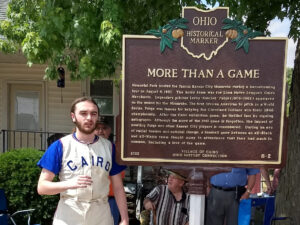
Memorial Park hosted the famous Kansas City Monarchs during a barnstorming tour on August 4, 1961. The home team was the Lima Metro League’s Cairo Merchants. Legendary pitcher Leroy “Satchel” Paige (1906-1982) appeared on the mound for the Monarchs. The first African American to pitch a World Series, Paige was famous for helping the Cleveland Indians win their 1948 championship. After the Cairo exhibition game, he thrilled fans by signing autographs. Although the score of the 1961 game is forgotten, the impact of meeting Paige and other Kansas City players is remembered. During an era of racial tension and national change, a baseball game between an all-Black and all-White team taught many in attendance that they had much in common, including a love of the game.
, OH
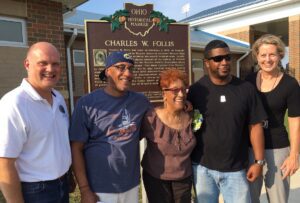
Charles W. Follis was born on February 3, 1879, in Virginia. His family moved to Wooster where he attended Wooster High School and helped establish the school’s football team. In 1901, Follis enrolled and played baseball at the College of Wooster and played football for the Wooster Athletic Association where he earned the nickname “The Black Cyclone from Wooster.” In 1904, Follis signed a contract to play football with Shelby Athletic Club, making him the first African-American professional football player. Follis faced discrimination on and off the field leading to many injuries. After a career-ending injury in 1906, Follis played baseball for the Cuban Giants of Long Island. He died of pneumonia in 1910 at the age of 31 and is buried in Wooster Cemetery.
, OH
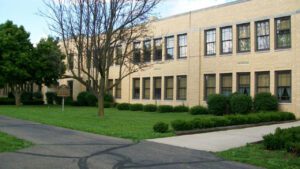
Colonel Ebenezer Zane played a major role in the development of Ohio, a role that helped place it on the path to statehood. A veteran of the Revolutionary War and experienced road builder, he received permission from Congress in 1796 to build a road into the Northwest Territory, which would be called Zane’s Trace. In exchange for his work, Zane received land grants where the trace would cross the Muskingum, Hocking, and Scioto rivers. The trace began in Wheeling, West Virginia (then Virginia) and ended at Limestone, Kentucky (present-day Maysville) on the Ohio River. Opening in 1797, it brought settlement into Ohio, including Lancaster. Its route crossed the playground area of East Elementary from the northeast corner of today’s playground to the southwest corner, lot #18, East Addition, as recorded on an 1897 map of Lancaster.
, OH
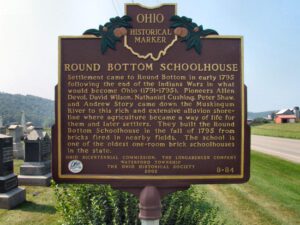
Settlement came to Round Bottom in early 1795 following the end of the Indians Wars in what would become Ohio (1791-1795). Pioneers Allen Devol, David Wilson, Nathaniel Cushing, Peter Shaw, and Andrew Story came down the Muskingum River to this rich and extensive alluvion shoreline where agriculture became a way of life for them and later settlers. They built the Round Bottom Schoolhouse in the fall of 1795 from bricks fired in nearby fields. The school is one of the oldest one-room brick schoolhouses in the state.
, OH
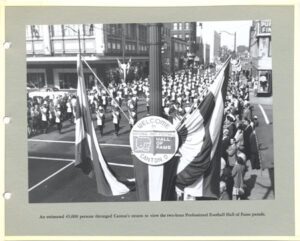
On September 17, 1920, representatives from ten professional football teams met in Canton and formed the American Professional Football Association, which in 1922 became the National Football League (NFL). Pro football evolved from club football in the 1890s, and by the early 1900s had begun to spread across the country, concentrating in the Midwest. Jim Thorpe, the first nationally prominent pro, started with the Canton Bulldogs-an early pro football power-in 1915. In 1959, Canton citizens launched a well-organized and ultimately successful effort to have their city, “the cradle of professional football,” designated as the site of a monument to the sport’s historic stars. The Professional Football Hall of Fame opened on September 7, 1963, inducting seventeen charter members. The Hall of Fame interprets and promotes the study of the role of professional football in American culture.
, OH
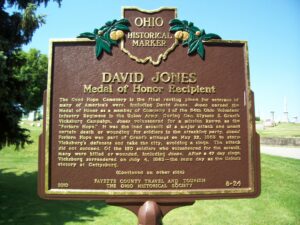
The Good Hope Cemetery is the final resting place for veterans of many of America’s wars, including David Jones. Jones earned the Medal of Honor as a member of Company I of the 54th Ohio Volunteer Infantry Regiment in the Union Army. During Gen. Ulysses S. Grant’s Vicksburg Campaign, Jones volunteered for a mission known as the “Forlorn Hope.” It was the lead assault of a major attack and meant certain death or wounding for soldiers in the attacking party. Jones’ Forlorn Hope was part of Grant’s attempt on May 22, 1863 to storm Vicksburg’s defenses and take the city, avoiding a siege. The attack did not succeed. Of the 150 soldiers who volunteered for the assault, many were killed or wounded, including Jones. After a 47 day siege, Vicksburg surrendered on July 4, 1863—the same day as the Union’s victory at Gettysburg.
, OH
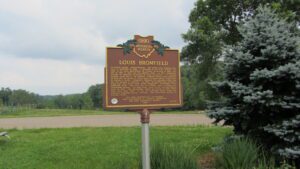
Acclaimed author, conservationist, and farmer Louis Bromfield was born in Mansfield in 1896. A graduate of the city’s schools, he went on to study agriculture at Cornell University in 1914, but left in 1915 to help run his family’s farm. In 1916, Bromfield enrolled in Columbia University to study journalism. As America entered World War I, he enlisted in United States Army Ambulance Service and saw action in seven major European battles. Determined to become a writer, Bromfield finished his education after the war and became a reporter. In 1921, he married Mary Appleton Wood and they would have three daughters. Bromfield’s first published novel, the Green Bay Tree (1924), was a critical and commercial success; his third novel, Early Autumn, won the Pulitzer Prize in 1927. The Bromfields moved to France in 1925 where they lived until 1938. In all, he published thirty books and authored numerous stories, articles, and screenplays during his writing career.