

, OH
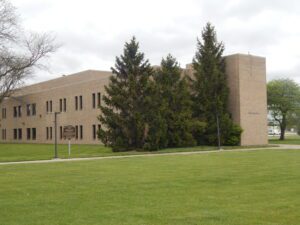
The site of Owens Community College, the Rossford Army Ordnance Depot played a supporting role in the United States’ victory in World War II and in national defense during the Cold War. From 1942 until 1945, the Rossford Ordnance Depot served as a distribution center for military vehicles during World War II. The complex also housed an ammunition storage depot. Virtually a city within itself, it featured an extensive railroad and road grid. Following World War II, the Depot remained a major site for military vehicles but expanded its mission to include tool storage and distribution. On July 1, 1963, General Orders No. 28 deactivated the facility from the United States Army Material Command.
, OH
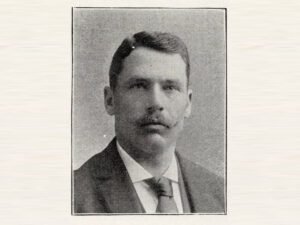
William Ellsworth “Dummy” Hoy was born in Houcktown on May 23, 1862. Although spinal meningitis as a toddler left him deaf and mute, Hoy became one of the great 19th century professional baseball players. He played centerfield for such teams as the Chicago White Stockings, Louisville Colonels, and Cincinnati Reds. In his 1888 Washington Senators season he led the league with 82 stolen bases and is one of the all-time leaders in that art. The defensive star’s record includes: 3,959 outfield putouts; 73 double plays; 2,054 hits; 40 home runs; 597 stolen bases; and, 210 strike-outs. Hoy is a member of the American Athletic Association for the Deaf Hall of Fame, as well as those of the Cincinnati Reds, Ohio Baseball, and Ohio School for the Deaf. He died in Cincinnati at the age of 99.
, OH
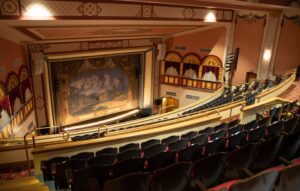
The Peoples Bank Theatre, built in 1919 and called the Hippodrome, marks an age when movies transitioned from silent films and nickelodeons into a major national industry and pastime. Designed by Columbus architect Fred Elliott for the C&M (Cambridge and Marietta) Amusement Company, the theatre featured a granite archway, 1,200 seats, a 35-by-55-foot stage, an orchestra pit, and the first air conditioning of its kind in Marietta. The Hippodrome opened May 9, 1919 with the silent film Daddy Long Legs, starring Mary Pickford. Shea Theatres of New York bought the Hippodrome and remodeled it in 1949, replacing the Hippodrome’s distinctive stone archway with a two-story southern colonial-style facade. Renamed the “Colony,” it opened June 25, 1949, showing the Esther Williams’ musical Neptune’s Daughter. (Continued on other side)
, OH
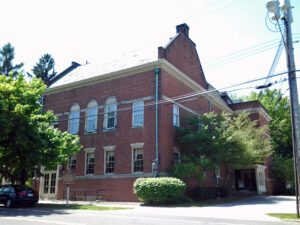
The Canfield WPA Memorial Building was constructed by the Works Progress Administration, a federal government program instituted by President Franklin D. Roosevelt as an effort to aid the United States in its recovery from the Great Depression of the late 1920s and 1930s. Local merchant Arron Weisner donated lands on the west side of Broad Street for the proposed project. A six member committee, comprised of two persons each representing the Argus Masonic Lodge, the American Legion, and the Village of Canfield, determined that the building be “a community building built around community projects.” Through local subscription and $60,000 in federal funds, the WPA project moved forward. The Youngstown architectural firm of W.H. Cook and W. Canfield designed the building in the Colonial Revival style. A ground breaking ceremony was held on December 20, 1935. During World War II, the United States government maintained offices in the building. (Continued on other side)
, OH
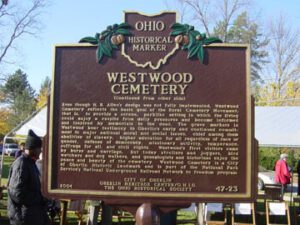
Shortly after Oberlin Colony was established in 1833, a two-acre burying ground was set aside south of Plum Creek in the area bounded by Main, Morgan, and Professor streets. By 1861, however, with the town and Oberlin College growing and the Civil War escalating, the need for a larger cemetery became clear. After an extensive search, 27.5 acres of land belonging to Henry Safford were acquired one mile west of the center of Oberlin. H.B. Allen was hired to create a design in the style of the Rural Cemetery Movement, and in July 1864 Westwood Cemetery was formally dedicated. Burials in Westwood had actually begun in August 1863, and over the next few years hundreds of remains were reinterred from Oberlin’s “Old Cemetery” and from burying grounds in surrounding communities. In the mid-1860s the cemetery was enlarged to its present 47 acres, and in 2004 burials and memorials were estimated to number almost ten thousand. (Continued on other side)
, OH
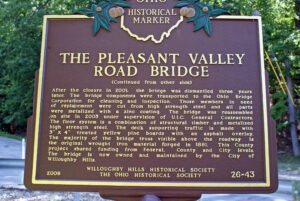
This single lane Pleasant Valley Road Bridge was constructed in 1881 by the Wrought Iron Bridge Company of Canton, Ohio, and is a 163 foot-long Whipple Truss (double intersection Pratt through truss). It replaced a wooden bridge that portaged the west branch of the Chagrin River a few hundred yards downstream. The structure, one of less than ten of its kind remaining in the state of Ohio, and possibly the longest in Lake County, was built to sustain the Euclid-Chardon Road traffic on U.S. Route 6. Known as the Grand Army of the Republic Highway, G.A.R., this major thoroughfare served this purpose until 1952 when a new high level bridge bypass was constructed to the south. The Truss bridge, pleasing to the eye with the artwork and name plates atop the overhead portals, was designed to enhance the bridge’s appearance within the valley. (Continued on other side)
, OH
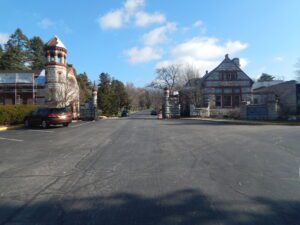
Founded in 1841, Woodland is one of the nation’s oldest rural garden cemeteries, the style of which was a dramatic departure from traditional church burial grounds at the time. Woodland’s oldest portion, including Victorian Era burial sections, a Romanesque gateway, and a Tiffany chapel, forms a district listed on the National Register of Historic Places. The Arboretum, with over 3,000 trees on more than 200 acres, completes this outdoor museum of Dayton history. Among those buried here are cemetery founder John Van Cleve, the Wright Brothers, inventors John Patterson and Charles Kettering, poet Paul Laurence Dunbar, Col. Edward Deeds, Governor James M. Cox, and humorist Erma Bombeck.
, OH
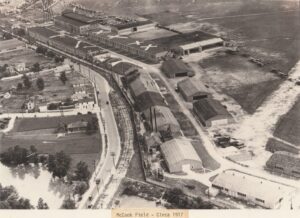
Interest in the new field of aeronautics grew dramatically when the United States entered the World War I in 1917. The army chose Dayton as the site for a research-and-development program for military aviation because of the area’s transportation links to major cities and its engineering and testing facilities. McCook Field, north of downtown between Keowee Street and the Great Miami River, was charged with researching, developing, and testing military airplanes and accessories. For nearly a decade, many advancements in aviation occurred at McCook Field. They included new aircraft, controllable-pitch propellers, bulletproof gas tanks, free-fall parachutes, and night-observation cameras. In the 1920s, larger and more-powerful aircraft overwhelmed the small field, which featured a large sign to warn pilots: “This field is small. Use it all.” In 1927, aeronautical engineering was transferred to newly-created Wright Field, now a part of Wright-Patterson Air Force Base.