

, OH
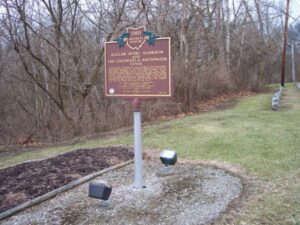
In 1837, Cincinnati merchants projected a branch canal to join the Whitewater Canal at West Harrison, Indiana, with the goal of tapping commerce from Indiana’s Whitewater Valley. The major obstacle on this route was the ridge between North Bend and Cleves, just northeast of this site. Engineer Darius Lapham designed a 1,782-foot tunnel though this barrier. Lined with brick made on site, the tunnel, 24 feet wide and 20 1/2 feet high, was the first canal tunnel in Ohio. Six workers died in its construction. The Cincinnati & Whitewater Canal opened in 1843 but was abandoned by 1856, after the main Whitewater Canal had been rendered useless by repeated flooding. The canal tunnel was subsequently used as a railroad tunnel from 1863 until 1888, illustrating the progression of transportation technology in the mid-nineteenth century.
, OH
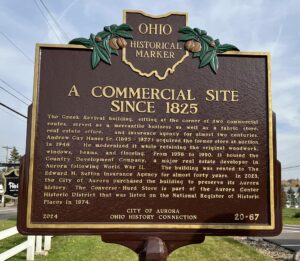
James Willard Converse (1806-1892) opened his store in 1825 at 10 South Chillicothe Road. Serving residents, merchants, and travelers, the store proved central to Aurora’s early commercial development. Converse’s Daybook survives as a glimpse into the habits of early citizens, who, along with household items, regularly purchased whiskey. Surprisingly, such sales surged on George Washington’s February 22 birthday. Converse deeded the business to employee Seth A. Gillett in 1834. Hopson Hurd Sr. (1793-1869) purchased it from Gillett in 1845. Hurd’s store was popular with local farmers who used their home made cheese as legal tender and enjoyed the barrel of whiskey kept in Hurd’s basement for customers who paid their bills. Hurd added a cheese warehouse to his store and, as a major exporter of cheese to Cleveland, Warren, and Pittsburgh, amassed a sizeable fortune.
, OH
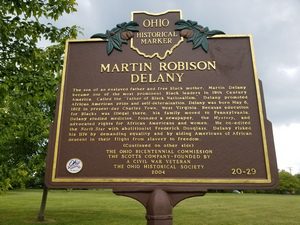
The son of an enslaved father and free Black mother, Martin Delany became one of the most prominent Black leaders in 19th Century America. Called the “Father of Black Nationalism,” Delany promoted African American pride and self-determination. Delany was born May 6, 1812 in present-day Charles Town, West Virginia. Because education for Blacks was illegal there, his family moved to Pennsylvania. Delany studied medicine, founded a newspaper, the “Mystery,” and advocated rights for African Americans and women. He co-edited the “North Star” with abolitionist Frederick Douglass. Delany risked his life by demanding equality and by aiding Americans of African descent in their fight from slavery to freedom. (Continued on other side)
, OH
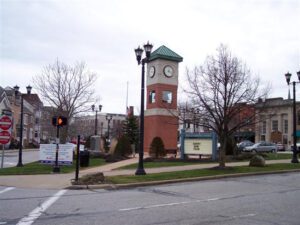
The Triangle, one of the most historic places in Berea, has been the center of the city’s civic life since the mid-19th century. Just beneath lie the solid layers of the famous Berea Sandstone that brought prosperity to Berea during its early years. Quarry owner and Berea Seminary founder John Baldwin obtained much of what is now Berea from Gideon Granger, Postmaster General under President Thomas Jefferson and original owner of Township 6, Range 14 (later Middleburg Township) of the Western Reserve. When the seminary trustees transferred the Triangle tract to the people of Berea in 1847, they designated it by deed as a public promenade. This farsighted stipulation preserved it from commercial development during the 20th century. (continued on other side)
, OH
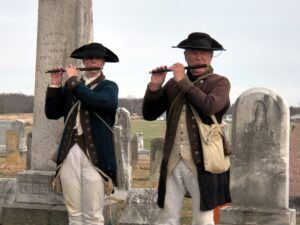
Field Musician Richard W. Thompson. Tunes played on fife and drum regulated a soldier’s life in camp and his actions on the battlefield. Heard over the roar of battle and through the haze of smoke, fifes and drums – field music – communicated orders to massed troops quickly. Richard Willoughby Thompson (c. 1742-1837), buried in Fancher Cemetery, was a field musician during the American Revolution and the War of 1812. According to his grandson Henry’s recollections from the 1920s, Thompson was born in Dublin, Ireland, and enlisted in the British army, where his service culminated in his capture while picking blackberries. He switched allegiances, joined the colonials, and was sent to Virginia. Thompson was appointed the Fife Major of the 5th Virginia Regiment and remained a Fife Major as Virginia units organized during the war. (Continued on other side)
, OH
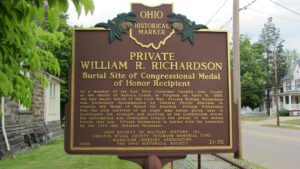
As a member of the 2nd Ohio Volunteer Cavalry that fought at the Battle of Sailor’s Creek in Virginia on April 6, 1865, the last major battle of the Civil War, Private William Richardson was personally recommended by General Phillip Sheridan to receive the Medal of Honor for bravery. Private Richardson was the only survivor of an eight man recon group sent to investigate the strength and position of the Confederate troops. His information was invaluable toward the defeat of the enemy forces that day. Private Richardson is buried with his comrades by the Civil War Soldiers Monument.
, OH
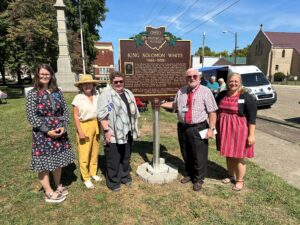
King Solomon “Sol” White was born in Bellaire on June 12, 1868. A Baseball legend, he was an all-around player, manager, and organizer in the Pre-Negro Leagues (1887-1912) and the Negro Leagues (1920-1926). White first played with integrated baseball clubs the Bellaire Globes (1884-1886) and Wheeling Green Stockings (1887). After 1887-1888 color barriers were imposed on baseball, White played on segregated minor league teams. They included: the Pittsburgh Keystones, Cuban Giants, York Colored Monarchs, Cuban X-Giants, Page Fence Giants, and Chicago Columbia Giants. As a coach, he helped organize and lead the powerhouse Philadelphia Giants to their 1904-1907 championships. White died on August 26, 1955, and was buried in an unmarked grave in Staten Island’s Frederick Douglas Memorial Cemetery. In 2006, “Sol” White was posthumously inducted into the Baseball Hall of Fame.
, OH
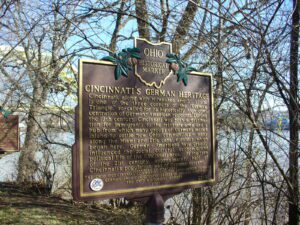
Cincinnati, along with Milwaukee and St. Louis, is one of the three corners of the “German Triangle,” so-called for its historically high concentration of German-American residents. During the 19th century, Cincinnati was both a destination for immigrants to the tri-state area and a hub from which many groups of Germans moved inland to settle new Ohio communities-many along the Miami and Erie canal corridor which began here. German-Americans have greatly influenced the social, cultural, economic and political life of the Cincinnati area. At the turn of the 21st century, approximately half of Cincinnati’s population was of German descent. (Continued on other side)