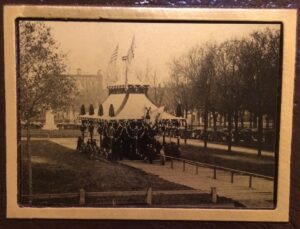
Abraham Lincoln visted Cleveland twice; once in life and the other in death. The first visit was on February 15-16, 1861, while in route to his presidential inauguration. The second, more solem visit was on April 28, 1865. Cleveland was one of twelve citiels to host a scheduled public viewing of the assassinated president’s remains. In addition to local officials, Lincoln’s cortege included a military escort of then current and former Union officers who were veterans of the Civil War. These officers would form the early membership of the organization known as the Military Order of the Loyal Legion of the United States. (continued on other side)
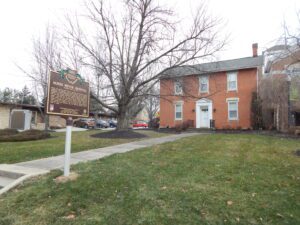
The house at this location, 110 South State Street, was the childhood home of Agnes Meyer Driscoll (1889-1971). Known as “the first lady of naval cryptology,” her career spanned from World War I to the Cold War. Driscoll attended Otterbein University before graduating from the Ohio State University, with majors in physics, math, music, and foreign languages. During World War I, she enlisted in the U.S. Navy as a chief yeoman, the highest rank possible for a woman at the time. After the war, Driscoll rose to become the chief civilian cryptanalyst for the U.S. Navy, breaking major Imperial Japanese Navy codes prior to World War II. (Continued on other side)
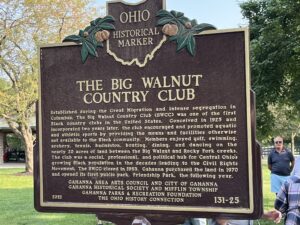
Established during the Great Migration and intense segregation in Columbus, The Big Walnut Country Club (BWCC) was one of the first Black country clubs in the United States. Conceived in 1925 and incorporated two years later, the club encouraged and promoted aquatic and athletic sports by providing the means and facilities otherwise not available to the Black community. Members enjoyed golf, swimming, archery, tennis, badminton, boating, dining, and dancing on the nearly 20 acres of land between the Big Walnut and Rocky Fork creeks. The club was a social, professional, and political hub for Central Ohio’s growing Black population in the decades leading to the Civil Rights Movement. The BWCC closed in 1963. Gahanna purchased the land in 1970 and opened its first public park, Friendship Park, the following year.
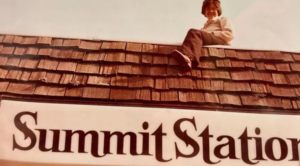
2210 Summit Street once housed one of Ohio’s longest-running lesbian bars. In 1970, a lesbian bartender at Jack’s A Go Go recognized that while Columbus had bars for gay men, it needed one geared toward lesbian clientele. Patrons knew the bar as “Jack’s,” Logan’s Off Broadway, and Summit Station. Staff welcomed women from small towns, women working in trades, women of color, butch/femme lesbians, and transgender people. Regulars recall that stepping through the door felt like finally entering a place of true belonging. Women could dance, “get together,” break up, sing karaoke, party with friends, and celebrate birthdays and holidays. Summit Station remained a safe public space, despite ongoing police harassment of its gender non-conforming regulars. A sign posted outside declared: “Ladies Night, Every Night. Men $5.” (Continued on other side)
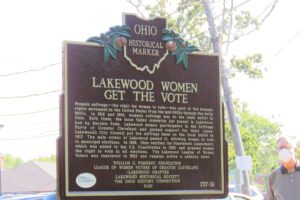
Women’s suffrage–the right for women to vote–was part of the women’s rights movement in the United States from the mid-1800s through the early 1900s. In 1912 and 1914, women’s suffrage was on the state ballot in Ohio. Both times, the issue failed statewide but passed in Lakewood. Led by Bernice Pyke, Lakewood women participated in the Suffrage Party of Greater Cleveland and gained support for their cause. Lakewood’s City Council put the suffrage issue on the local ballot in 1917. The male voters of Lakewood passed it, allowing women to vote in municipal elections. In 1919, Ohio ratified the Nineteenth Amendment, which was added to the U.S. Constitution in 1920 and granted women the right to vote in all elections. The Lakewood League of Women Voters was chartered in 1922 and remains active a century later.
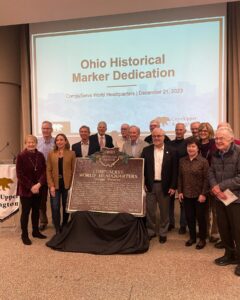
The world headquarters of CompuServe was located on the six-acre site at 5000 Arlington Centre Boulevard from 1973 to 2009. Incorporated in 1969, Compu-Serve Corporation (later CompuServe Inc.) was the first major online information services provider. Its subscribers were the first to have access to email, online newspapers and magazines, the ability to share and download files, and a variety of popular chat forums. One especially successful CompuServe innovation was the GIF graphics format. Increasing competition and a succession of corporate owners pressed CompuServe into the fate of many tech start-ups and it ran its course. It did, however, introduce millions of people to online connectivity, social networking, and laid the foundation for the widespread use of the internet.
Carl Stokes was born in Cleveland on June 21, 1927. Recognized for his trailblazing service as a public official, Stokes is one of the few American politicians whose career spanned all three branches of state government. Over 30 years, he served 3 terms as an Ohio legislator (1963-1967), 2 terms as Cleveland’s mayor (1967-1971), and 8 years as a municipal court judge (1983-1994). In 1972, he became the first Black anchorman for a television station in New York City. After a decade working in television, Stokes returned to Cleveland to work as an attorney for the United Auto Workers. In 1994, President Bill Clinton appointed him U.S. Ambassador to the Republic of Seychelles. While serving as Ambassador, he was diagnosed with cancer. Carl Stokes died, in Cleveland, on April 3, 1996.
Invited to speak at three Cleveland high schools, Dr. Martin Luther King Jr. delivered his powerful “Rise Up!” speech to students at Glenville High School on April 26, 1967. It signaled King’s opening drive to elect African Americans to prominent government positions in northern cities. Encouraging students to “develop a sense of somebodiness,” King challenged them to “work passionately and unrelentingly for first-class citizenship.” Recognizing the fear of racial unrest in the city, King underscored the significance of nonviolence. “Our power lies in our ability to say non-violently that we’re not going to take it any longer,” he asserted. Making Carl Stokes’ mayoral bid the focus of his push for Black voters to elect Black leaders, King urged Glenville’s students to join civil rights organizations and community action programs.