

, OH
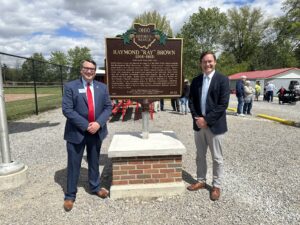
Raymond “Ray” Brown was a star in the Negro Leagues 1930-1948. Born in Alger on February 23, 1908, Brown graduated from Alger High School in 1926. He made his professional baseball debut playing for the Dayton Marcos in 1930. Brief stints with the Indianapolis ABCs and Detroit Wolves followed. In 1932, Brown joined Pittsburgh’s Homestead Grays mid-season and became a mainstay of their pitching staff for the next fourteen years. Utilizing a devastating curveball, he led the Grays to eight Negro National League pennants in a nine-year span (1937-1945). In 1938, he won the pitching triple crown and lead the league in wins, earned run average, and strikeouts. When the Negro League World Series was re-instituted in 1942, Brown’s team competed four straight years, winning twice. (Continued on other side)
, OH
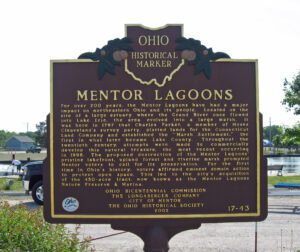
For over 200 years, the Mentor Lagoons have had a major impact on northeastern Ohio and its people. Located on the site of a large estuary where the Grand River once flowed into Lake Erie, the area evolved into a large marsh. It was here in 1797 that Charles Parker, a member of Moses Cleaveland’s survey party, platted lands for the Connecticut Land Company and established the “Marsh Settlement,” the first in what later became Lake County. Throughout the twentieth century, attempts were made to commercially develop this natural treasure, the most recent occurring in 1996. The proposed destruction of the Mentor Lagoons’ pristine lakefront, upland forest and riverine marsh prompted Mentor voters to call for its preservation. For the first time in Ohio’s history, voters affirmed eminent domain action to protect open space. This led to the city’s acquisition of the 450-acre tract, now known as the Mentor Lagoons Nature Preserve & Marina.
, OH
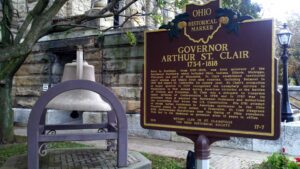
Born in Scotland. From 1787-1802, was first governor of the Northwest Territory, which included Ohio, Indiana, Illinois, Michigan, Wisconsin and part of Minnesota. St. Clair established territorial court system and Ohio’s first nine counties, including Belmont in 1801 and named St. Clairsville its county seat. St. Clair’s promotion to major general in 1777 recognized his exemplary service to Washington in New Jersey during American victories at the battles of Trenton and Princeton. St. Clair was a delegate to Congress under Articles of Confederation in 1786 and in 1787 was its president when it adopted the Northwest Ordinance and authorized the convention that wrote the U.S. Constitution. His 1791 attempt to break Indian resistance to American settlement in the Ohio Country ended in bitter defeat. A Federalist, St. Clair disagreed with Jeffersonian-Republicans over the timing of Ohio statehood. This led to his dismissal as governor after 15 years in office.
, OH
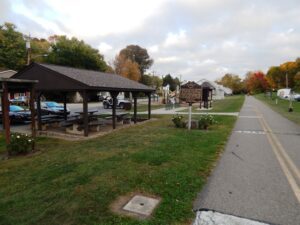
Deerfield was laid out around 1795 and in 1802 Major Benjamin Stites, his son Benjamin, Jr., and John Gano officially recorded the village’s plat. A part of the great tide of Americans moving into the Northwest Territory (and Ohio after 1803), Deerfield’s early inhabitants included Revolutionary war veteran Ephraim Kibbey as well as Andrew Lytle, Nathan Kelly, William Snook, and War of 1812 veteran David Sutton. Deerfield was so called because it was a settlement in Deerfield Township, Hamilton County in the 1790s. (Continued on other side)
, OH
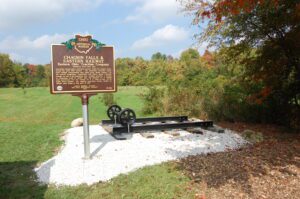
From east to west, the Chagrin Falls and Eastern Interurban Railway crossed the Muggleton Farm (now South Russell Village Park) at this location and connected the Chagrin Valley with Hiram, Garrettsville, and Middlefield. Its sister interurban, the Cleveland and Chagrin Falls Electric Railway served points west. Soon after their formation, the Everett-Moore Syndicate merged the two lines into the extensive interurban rail network, The Eastern Ohio Traction Company. The EOTC and its predecessors operated from 1899-1925, mainly moving mail, farm goods, and passengers. In 1914, the more rural line from Chagrin Falls traveling eastward became the first major interurban in the United States to cease operations. It is believed that declining use, insufficient power for the railway, and a failed line extension to Youngstown were likely factors contributing to the line’s demise.(Continued on other side)
, OH
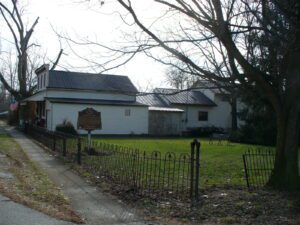
The foundation for the first Welsh settlement in Ohio was laid on June 29, 1801, when William and Morgan Gwilym purchased land in what is now Morgan Township at the Cincinnati Land Office. The Welsh, who settled in Pennsylvania beginning in the late eighteenth century, moved westward and settled here in 1802. This area was also the major terminus for the 1818 migration from Montgomeryshire and Cardiganshire in Wales. In 1803 a Congregational Church was organized and services were held in members’ homes or outdoors. A brick Meetinghouse, complete with a Welsh death door leading to the cemetery, was constructed in 1824. The building now serves as the Community House. The present brick church was built in 1854. For many years, the library, formed in 1852, was housed in the New London Special School District building that stood on this site. (Continued on other side)
, OH
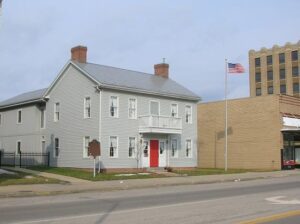
One of seven native Ohioans to serve as president of the United States, William McKinley (1843-1901) was born at this site. The original house was moved from this site and ultimately destroyed by fire. The McKinleys lived here until 1852 when they moved to Poland, Ohio, where William attended the Poland Seminary. He briefly attended Allegheny College in Pennsylvania, but poor health and family financial strain forced him to return to Ohio. As an enlistee in the 23rd Ohio Volunteer Infantry during the Civil War, McKinley rose to the rank of major. After the war, he settled in Canton and practiced law. Elected to Congress in 1876, McKinley favored high protective tariffs, a policy he continued to support as President.(Continued on other side)
, OH
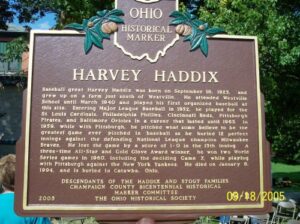
Baseball great Harvey Haddix was born on September 18, 1925, and grew up on a farm just south of Westville. He attended Westville School until March 1940 and played his first organized baseball at this site. Entering Major League Baseball in 1952, he played for the St. Louis Cardinals, Philadelphia Phillies, Cincinnati Reds, Pittsburgh Pirates, and Baltimore Orioles in a career that lasted until 1965. In 1959, while with Pittsburgh, he pitched what some believe to be the greatest game ever pitched in baseball as he hurled 12 perfect innings against the defending National League champion Milwaukee Braves. He lost the game by a score of 1-0 in the 13th inning. A three-time All-Star and Gold Glove Award winner, he won two World Series games in 1960, including the deciding Game 7, while playing with Pittsburgh against the New York Yankees. He died on January 8, 1994, and is buried in Catawba, Ohio.