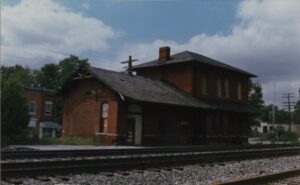
By the mid 1830s, Ohio had developed a canal system that linked Lake Erie in the north to the Ohio River in the south. Despite the success of the canals, transportation companies searched for other methods to traverse the state. They found their answer in the railroad industry, which proved to be much faster, cheaper, and more reliable than canals. Located on Lake Erie, Sandusky, Ohio was a major trading depot in the area. Plans were made to connect Sandusky to Cincinnati’s port on the Ohio River. On September 4, 1835, construction began in Sandusky on the Mad River and Lake Erie Railroad line, forming the first railroad line located entirely in Ohio. The railroad reached Tiffin by 1841 and Springfield by 1848, where it merged with the Little Miami Railroad line, connecting Lake Erie to the Ohio River.
This is the gravesite of Robert Nesbitt, an immigrant from Convoy, Ireland who named Convoy, Ohio after his home town. In 2010, the Convoy Community Foundation, Convoy Lions Club, Convoy Business Association, and Convoy Community Days, Inc. raised the funds to restore Nesbitt’s tombstone. A representative from Convoy, Ireland – Ray Bonar – attended the rededication ceremony on July 4, 2010. The Van Wert County Historical Society took over the care of the grave site, which is in the Sugar Ridge Cemetery. The cemetery has been under the care of the Tully Township Trustees since its foundation.
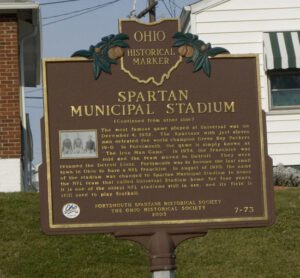
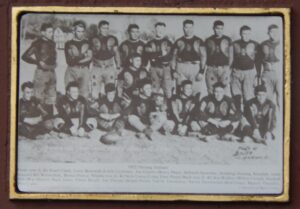
Opened in the fall of 1930, Universal Stadium became the home of the Portsmouth Spartans professional football team. Earlier that summer, the Spartans had just become a member of the National Football League (NFL). Led by a few local businessmen, the Portsmouth National Football League Corporation raised money to help build the permanent stadium for the Spartans. The stadium opened on September 14, 1930 as the Spartans defeated the Newark (New Jersey) Tornadoes for their first NFL victory. Ten days later the Spartans played one of the NFL’ s first night games against the Brooklyn Dodgers. The Portsmouth Times said, “Night football has come to stay, at least in Portsmouth.” From 1930 to 1933, the Spartans compiled a record of 19 wins 2 losses and 4 ties at Universal Stadium. (continued on other side)
The Oorang Indian football team was founded by LaRue native Walter Lingo (1890-1966), owner of the Oorang Airedale Dog Kennels. The team, comprised of Native American Indians, played in the National Football League (NFL) in 1922-23. The star player and coach was Jim Thorpe (1887-1953), a Sac and Fox Indian. Thorpe gained international fame as a two-time gold medal winner (decathlon and pentathlon) in the 1912 Olympics and was acclaimed as the “World’s Greatest Athlete.” The team gave LaRue the distinction of being the smallest community ever to have an NFL franchise.
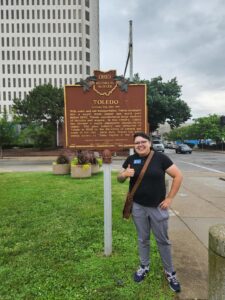
After consolidation of the villages of Fort Lawrence and Vistula, the City of Toledo was incorporated in 1837. Originally named “Toledo” in 1833, the site became part of Ohio when the “Toledo War,” a bloodless boundary conflict with Michigan, was resolved by Congress in 1836. Settlers were attracted by the commercial potential of the Maumee River, called “Miami of the Lake,” and later the Miami-Erie Canal. (Continued on other side)
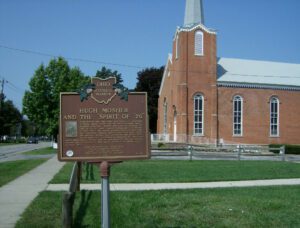
Hugh Mosher was the fifer portrayed in Archibald Willard’s “Spirit of ’76”, one of America”s most famous patriotic paintings. Mosher was born on January 29, 1819 in Perry, Lake County (then part of Geauga County), Ohio. He served as Fifer Major in the 43rd Ohio Volunteer Infantry during the Civil War. After the conflict, Mosher was considered the finest fifer in the state, and performed at veterans’ reunions and other celebrations. Always popular and noted for his generosity, Mosher died on August 15, 1896 and is buried in Brighton (Lorain County), Ohio.
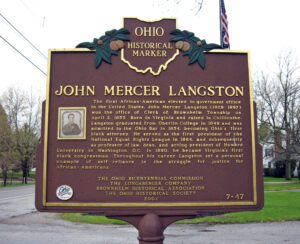
The first African-American elected to government office in the United States, John Mercer Langston (1829-1897) won the office of Clerk of Brownhelm Township on April 2, 1855. Born in Virginia and raised in Chillicothe, Langston graduated from Oberlin College in 1849 and was admitted to the Ohio Bar in 1854, becoming Ohio’s first black attorney. He served as the first president of the National Equal Rights League in 1864, and subsequently as professor of law, dean, and acting president of Howard University in Washington, D.C. In 1890, he became Virginia’s first black congressman. Throughout his career Langston set a personal example of self-reliance in the struggle for justice for African-Americans.
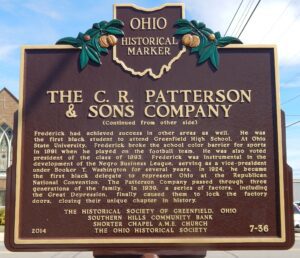
The factory of the C. R. Patterson & Sons Company once stood near here at 138 N. Washington Street. Established in the mid-nineteenth century by the black businessman Charles Richard (C. R.) Patterson and his white partner, J. P. Lowe, the business, originally known as J. P. Lowe & Company, became a successful carriage firm. Patterson became the sole owner in 1893 and changed the name to C. R. Patterson & Sons. After succeeding his father as owner, C. R.’s son, Frederick, became the first known African-American automobile manufacturer. Under his leadership, the company transitioned from building carriages to automobiles, then to trucks and buses to keep up with the changing demands of the transportation industry. (Continued on other side)