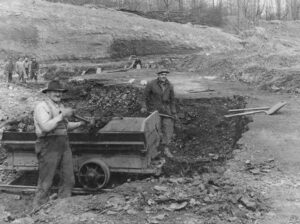
Agriculture dominated the economy of southeastern Ohio’s Morgan County until the 1940s when harvests dwindled, the population declined, and land values dropped. Surface mining the area’s rich underground coal deposits replaced agriculture as the major industry and revitalized the declining local economy. As the nation’s demand for electricity grew over the next half-century, so did the demand for coal as fuel for nearby power generation plants. During mining’s heyday in the 1960s to the late 1980s, American Electric Power’s former Central Ohio Coal Company subsidiary employed nearly 1,000 people. Nearby communities-such as Cumberland, Caldwell and Chandlersville-thrived. As time passed, however, the robust coal industry was hit hard by environmental regulations that reduced the market for the area’s high-sulfur coal. In turn, mine work forces shrank considerably and local businesses closed. (continued on other side)
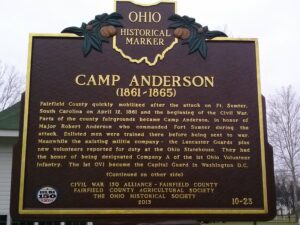
Fairfield County quickly mobilized after the attack on Ft. Sumter, South Carolina on April 12, 1861 and the beginning of the Civil War. Parts of the county fairgrounds became Camp Anderson, in honor of Major Robert Anderson who commanded Fort Sumter during the attack. Enlisted men were trained there before being sent to war. Meanwhile the existing militia company- the Lancaster Guards plus new volunteers reported for duty at the Ohio Statehouse. They had the honor of being designated Company A of the 1st Ohio Volunteer Infantry. The 1st OVI became the Capital Guard in Washington D.C.
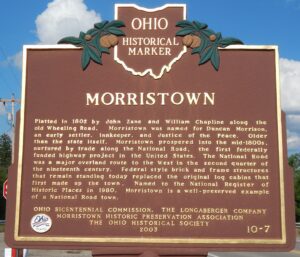
Intersection of National Road (U.S. 40) and Old National Road
Morristown
, OH
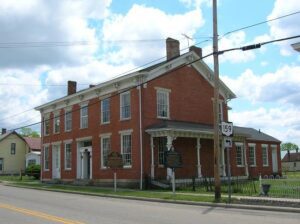
Platted in 1802 by John Zane and William Chapline along the old Wheeling Road, Morristown was named for Duncan Morrison, an early settler, innkeeper, and Justice of the Peace. Older than the state itself, Morristown prospered into the mid-1800s, nurtured by trade along the National Road, the first federally funded highway project in the United States. The National Road was a major overland route to the West in the second quarter of the nineteenth century. Federal style brick and frame structures that remain standing today replaced the original log cabins that first made up the town. Named to the National Register of Historic Places in 1980, Morristown is a well-preserved example of a National Road town.
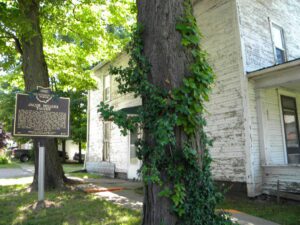
In 1805, for $1.50 an acre, Jacob Miller purchased this property in the Congressional Land Office in Chillicothe, capital of the new state of Ohio. He and Somerset co-founder John Finck then each built a tavern on either side of town along the Zane’s Trace, laid out along existing Indian trails in 1796-1797 and Ohio’s first major thoroughfare. Finck built his home and tavern in 1807 and Miller his shortly after. From 1800 to 1815, Zane’s Trace saw significant traffic between the established eastern states and the newly opened Northwest Territory. A perpetual stream of emigrants rolled westward, giving constant occupation to hundreds of tavern-keepers. Besides operating his tavern and farming, Jacob Miller was a public servant. In 1809, he was appointed Overseer of the Poor as there was a need to “bind out” poor children to families who could take care of them. [continued on other side]
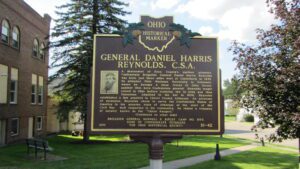
A descendent of Knox County’s earliest pioneers, Confederate Brigadier General Daniel Harris Reynolds was born just three miles west of Centerburg in 1832. He attended Ohio Wesleyan University in Delaware, where he became a close friend of Otho Strahl, another Ohio born Confederate general. Reynolds taught school in Ohio before studying law in Iowa and then Tennessee. Admitted to the bar in 1858, Reynolds established a law practice in Chicot County Arkansas. An advocate of secession, Reynolds chose to serve the Confederate States of America in his adopted state of Arkansas at the start of the Civil War. Well respected in his community, he raised a company of cavalry known as the “Chicot Rangers.” (Continued on other side)
In 1873, Tiffin’s Cronise sisters became the first women admitted to the Ohio Bar. At that time, Ohio laws did not provide for the admission of women attorneys. On April 4th 1873, Nettie Cronise applied to the district court. Despite vigorous opposition, leading local attorneys, including William Harvey Gibson and George Seney, supported Nettie’s applications. Ironically, at the same time as Nettie’s admission, the U.S. Supreme Court affirmed Illinois’ denial of admission to the bar to another woman based upon gender. Regardless, Nettie opened the door for the admission of women to the bar of Ohio. Six months later, Florence, Nettie’s younger sister, was admitted. Florence was also the first female notary public in the state. Together the sisters opened the first female-owned law practice in Ohio, N. & F. Cronise. (Continued on other side)
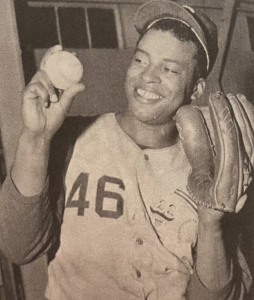
Ulysses Brooks Lawrence was born in Springfield on January 30, 1925. Nicknamed “The Bull,” he broke numerous color barriers throughout his baseball career. In 1976, Lawrence was the first Black player inducted into the Cincinnati Reds Hall of Fame. An all-around athlete at Springfield High School, Lawrence lettered in basketball, track, and football (the school’s first Black starting quarterback). After graduation in 1943, he was drafted into the U.S. Army and earned a Bronze Star in Guam during World War II. Lawrence enrolled at Ohio’s Miami University, becoming that school’s first Black baseball player (1947-1949), before signing with the Cleveland Indians. Acquired by the St. Louis Cardinals (1954), he was assigned to the Columbus Red Birds Triple-A farm team, breaking another team’s color barrier. (Continued on other side)
Major General William Sooy Smith was born in Tarlton on July 22, 1830. He attended Ohio University and supported himself throughout his college undergraduate career, graduating in 1849. He then entered the United States Military Academy at West Point to pursue engineering and graduated 6th in the class of 1853. In 1857, Smith established the private engineering firm Parkinson & Smith and made the first surveys for the international bridge across the Niagara River near Niagara Falls. At the outbreak of the Civil War, Smith joined the 13th Ohio Infantry, winning the commission of colonel in June 1861. After early victories in western Virginia, he was promoted to brigadier general in April 1862 for his gallant and meritorious service at the Battle of Shilo. (continued on other side)