

, OH
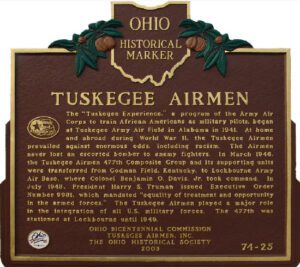
The “Tuskegee Experiment,” a program of the Army Air Corps to train African Americans as military pilots, began at Tuskegee Army Air Field in Alabama in 1941. At home and abroad during World War II, the Tuskegee Airmen prevailed against enormous odds, including racism. The Airmen never lost an escorted bomber to enemy fighters. In March 1946, the Tuskegee Airmen 477th Composite Group and its supporting units were transferred from Godman Field, Kentucky, to Lockbourne Army Air Base, where Colonel Benjamin O. Davis, Jr. took command. In July 1948, President Harry S. Truman issued Executive Order Number 9981, which mandated “equality of treatment and opportunity in the armed forces.” The Tuskegee Airmen played a major role in the integration of all U.S. military forces. The 477th was stationed at Lockbourne until 1949.
, OH
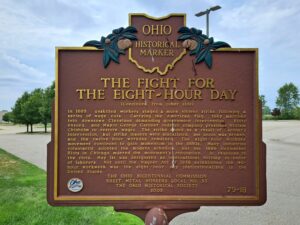
Organized efforts to establish an eight-hour workday existed as early as 1866 in the United States. The Cleveland Rolling Mills Strikes of 1882 and 1885, as part of this almost-70-year struggle, contributed to the establishment of the eight-hour workday. Both strikes challenged the two-shift, twelve-hour workday in addition to seeking recognition of the Amalgamated Association of Iron, Steel, and Tin Workers. The first strike – by English, Welsh, and Irish skilled workers – was at the Newburgh Rolling Mills, a major producer of steel rails for the rapidly expanding railroad industry that once stood near this site. It was quickly broken when unskilled Polish and Czech immigrants, unaware of the ongoing labor dispute, were hired. The strike ended when these new workers did not support the union. (continued on other side)
, OH
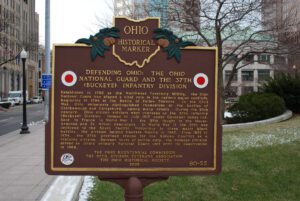
With five army camps in Columbus, Capitol Square was a military crossroads from 1861 to 1865. Ohio troops were mustered, paid, and on some occasions garrisoned at the Statehouse. Three of every five male Ohioans between the ages of 18 and 45 served in the Civil War. Ohio’s contribution to the war effort was enormous, supplying almost 320,000 soldiers to the Union Army, representing 230 regiments and 26 independent artillery batteries. More than 35,000 soldiers died during the war, and 30,000 more were disabled. One hundred forty-eight Ohio soldiers received the Congressional Medal of Honor for valor. Perhaps Ohio’s greatest contribution to the war was to the Union leadership that won it: Generals Ulysses S. Grant, William Tecumseh Sherman, Philip H. Sheridan, and James B. McPherson, as well as Secretary of War Edwin Stanton and Secretary of the Treasury Salmon Chase, were all Ohioans.
, OH
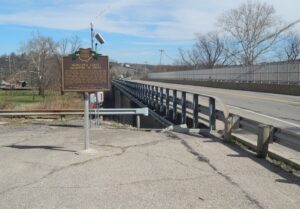
Confederate Brigadier General John Hunt Morgan’s Indiana-Ohio Raid, or Great Raid, from July 2-26, 1863 covered nearly 1,000 miles and penetrated deeper into the North than any other Confederate incursion during the Civil War. The raid was also the only significant military action of the war in Ohio. Union cavalry chased Morgan’s 2,000 cavalrymen across twenty-four Ohio counties after the troopers entered the state from Indiana. On July 13, 1863 Morgan’s main column encountered no resistance as it passed through New Haven, about five miles north from this site. (Continued on other side)
, OH
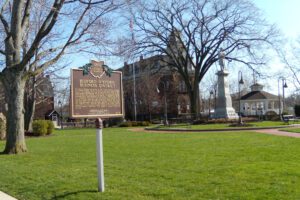
The town of Bedford was settled in 1837. Early residents, Hezekiah and Clarissa Dunham donated the land that serves as Bedford Public Square. The Dunhams built one of the area’s first homes in 1832, which stands at 729 Broadway with the letters H & D above the doorway. Early settlers were attracted to the area by the abundance of natural resources and a large waterfall for mill sites. Bedford also served as a stagecoach stop on the route from Cleveland to Pittsburgh. The road or Turnpike Road as it was called was originally part of the Mahoning Indian Trail. By 1895 the road was renamed Main Street (and later Broadway) when the Akron, Bedford, and Cleveland Railway Company (ABC) traversed the middle of the street carrying passengers. The interurban is called “America’s first high speed long distance electric interurban” with speeds in excess of 60 miles per hour. [continued on other side]
, OH
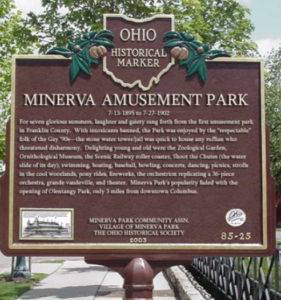
For seven glorious summers, from July 13, 1895 to July 27, 1902, laughter and gaiety rang forth from the first amusement park in Franklin County. With intoxicants banned, the Park was enjoyed by the “respectable” folk of the Gay ’90s – the stone water tower/jail was quick to house any ruffian who threatened disharmony. Delighting young and old were the Zoological Garden, Ornithological Museum, the Scenic Railway roller coaster, Shoot the Chutes (the water slide of its day), swimming, boating, baseball, bowling, concerts, dancing, picnics, strolls in the cool woodlands, pony rides, fireworks, the orchestrion replicating a 36-piece orchestra, grande vaudeville, and theater. Minerva Park’s popularity faded with the opening of Olentangy Park, only 3 miles from downtown Columbus.
, OH
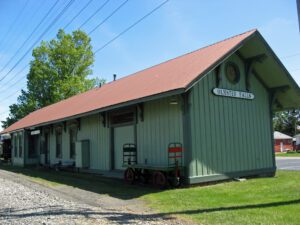
The Lakeshore and Michigan Southern Railroad built the Olmsted Falls Depot in 1876 as a part of major improvements made along the line between Cleveland and Toledo. The depot replaced a smaller flag stop station in Olmsted Falls at the Columbia Road railroad crossing. By 1909, the depot was moved from Mapleway Drive on rollers by a locomotive to this site to be closer to the heart of the village. In the early 20th century, ten trains a day stopped here. One was the “Plug,” which took commuters between Olmsted Falls and Cleveland. By mid-century, cars and planes had largely replaced train travel. The last regularly scheduled train stopped here in 1949 and service ended completely in 1960. The depot became the home of the Cuyahoga Valley and Westshore Model Railroad Club in 1977 and was listed on the National Register of Historic Places in 2000.
, OH
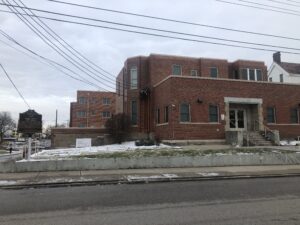
Walnut Hills has been home to a significant middle- and working-class Black community since the 1850s. In 1931, African American entrepreneur Horace Sudduth bought 1004 Chapel Street and then the row of buildings across Monfort, naming them the Manse Hotel and Annex. Throughout the 1940s, hotel dinner parties could move to the Federation of Colored Women’s Clubs house next door for dancing. A large addition to the Manse in 1950 created its own ballroom, 24-hour coffee shop, upgraded Sweetbriar Restaurant, and more guest rooms. It appeared in the Negro Motorist’s Green Book between 1940-1963, providing local, transient, and residential guests both catered meetings and top entertainment during the last decades of segregation. It closed in the late 1960s when the economic need for a first-class segregated hotel disappeared in the age of Black Power.