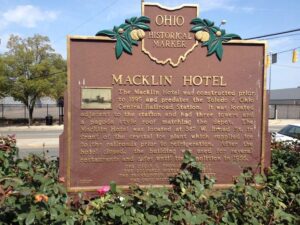
The only remaining Columbus railroad station, The Toledo & Ohio Central (T&OC) Railroad Station was constructed in 1895 and was the departure point for William McKinley when he left for Washington D.C to be sworn in as president. Designed by noted Columbus architects Joseph Warren Yost & Frank L. Packard, the pagoda style roof and tower have become Columbus icons. By 1900, the T&OC was purchased by the rival Hocking Valley Railroad and in 1911 the tracks were elevated above Broad Street. Later the New York Central Railroad gained control and used the station until 1930 when passenger service was transferred to Union Station in Columbus. Restored after the 1913 Flood and major fires in 1910 and 1975, the station was headquarters for the Central Ohio Volunteers of American from 1930 to 2003. The building was placed on the National Register of Historic Places in 1973.
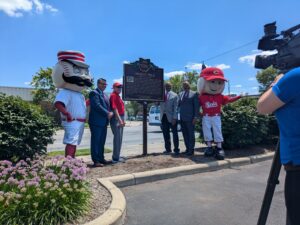
Crosley Field was the home of the Cincinnati Reds for almost 58 years. Opened in 1912 as Redland Field, the ballpark was renamed in 1934 when famed Cincinnati industrialist Powel Crosley Jr. purchased the team. Over its years of service, Crosley Field was home to Reds teams that won National League Championships in 1919, 1939, 1940, and 1961, and World Series titles in 1919 and 1940. The park also played host to the Major League Baseball All-Star Game in 1938 and 1953. Crosley Field famously held what was then acknowledged as the first night game under lights on May 24, 1935. Such visiting legends as “Shoeless” Joe Jackson, Babe Ruth, Joe DiMaggio, Willie Mays, and Jackie Robinson played at Crosley Field. (Continued on other side)
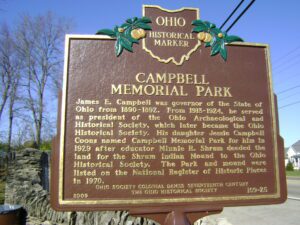
James E. Campbell was governor of the State of Ohio from 1890-1892. From 1913-1924, he served as president of the Ohio Archaeological and Historical Society, which later became the Ohio Historical Society. His daughter Jessie Campbell Coons named Campbell Memorial Park for him in 1929 after educator Minnie R. Shrum deeded the land for the Shrum Indian Mound to the Ohio Historical Society. The park and mound were listed on the National Register of Historic Places in 1970.
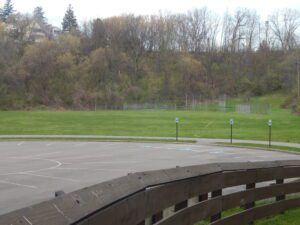
For more than 120 years, the natural amphitheater of Brookside Stadium has been a place of recreation for visitors to enjoy community events, festivals, and even a concert by John Philip Sousa. Engineered by William Stinchcomb, chief architect of the Cleveland Metroparks, Brookside Stadium officially opened as a premier space for sandlot baseball in May 1909. As amateur baseball found increased esteem, both locally and nationally, Brookside Stadium regularly became popular with thousands of spectators. On Sunday, October 10, 1915, it was host to the National Inter-City Amateur Championship, during which a crowd of an estimated 115,000 people witnessed the White Autos beat the Omaha Luxus 11 to 6. Although there was no formal ticketing system to verify the exact attendance, photographs taken that day strongly suggest that Brookside Stadium hosted the largest crowd in amateur baseball history.
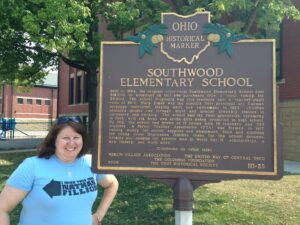
Built in 1894, the original eight-room Southwood Elementary School cost $16,000 to construct on this site purchased from a local family for $3,000. The school originally had five teachers and a teacher-pupil ratio of 50-1. Mary Esper was the school’s first principal and German language instructor, staying until her retirement in 1923. Children attended grades one through eight and special biweekly classes in carpentry and cooking. The school had its first graduation ceremony in 1896, with six boys and seven girls being promoted to high school. By 1912, the school had grown to 17 rooms with 16 teachers and 735 students. A Parent Teacher Association (PTA) was formed in 1917, raising money for school supplies and equipment, food and clothing for needy Great Depression families, trees for the school grounds, cookies and candies for service men in World War II, scholarships, a new library, and much more. [continued on other side]
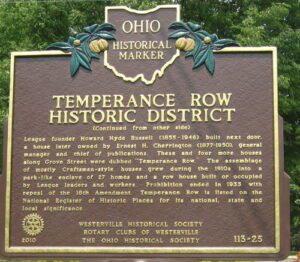
Here lived the reformers of the Anti-Saloon League of America who led the movement that turned the United States “dry” in 1920 with the 18th Amendment prohibiting the manufacture, sale or transportation of intoxicating liquor. Moving its headquarters to Westerville in 1909, the League built a publishing house that buried the liquor industry in a 10-year avalanche of books, pamphlets and periodicals that helped win Prohibition and made Westerville the “Dry Capital of the World.” Rev. Purley A. Baker (1858-1924), the League’s general superintendent, bought 11 acres and erected his rustic home at Park and Grove streets in 1910. (Continued other side)
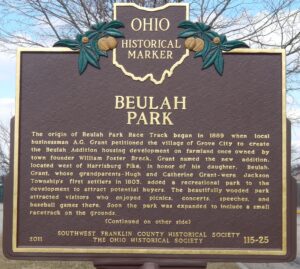
The origin of Beulah Park Race Track began in 1889 when local businessman A. G. Grant petitioned the village of Grove City to create the Beulah Addition housing development on farmland once owned by town founder William Foster Breck. Grant named the new addition, located west of Harrisburg Pike, in honor of his daughter, Beulah. Grant, whose grandparents, Hugh and Catherine Grant, were Jackson Township’s first settlers in 1803, added a recreational park to the development to attract potential buyers. The beautifully wooded park attracted visitors who enjoyed picnics, concerts, speeches, and baseball games there. Soon the park was expanded to include a small racetrack on the grounds.
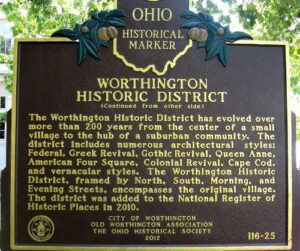
Worthington was founded in 1803 by the Scioto Company, settlers from Connecticut, and named after Thomas Worthington, a major proponent of Ohio statehood. The original plat included a 3-1/2 acre village green bounded on the east by 1-1/2 acre school and church lots. The green was surrounded by 160 residential and commercial lots, each measuring 3/4 of an acre. By 1812, Worthington was a finalist for designation as the capital of Ohio. (Continued on the other side.)