

, OH
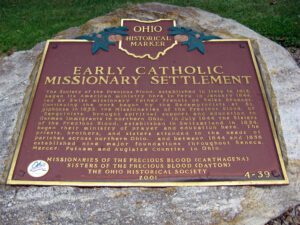
The Society of the Precious Blood, established in Italy in 1815, began its American ministry here in Peru in January 1844, led by Swiss missionary Father Francis de Sales Brunner. Continuing the work begun by the Redemptorists at St. Alphonse in 1833, the Missionaries of the Precious Blood, or “Sanguinists,” brought spiritual support and education to German immigrants in northern Ohio. In July 1844 the Sisters of the Precious Blood, established in Switzerland in 1834, began their ministry of prayer and education here. The priests, brothers, and sisters attended to the needs of parishes across northern Ohio, and between 1844 and 1856 established nine major foundations throughout Seneca, Mercer, Putnam and Auglaize Counties in Ohio.
, OH
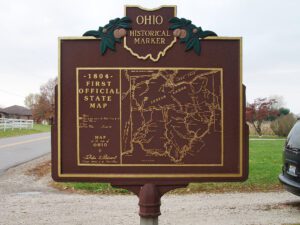
With the signing of the Treaty of Paris in 1783, England lost the American Revolution and ceded to its former colonies land from the Atlantic Ocean to the Mississippi River. By this time, pioneer settlers had reached the eastern bank of the Ohio River, but the Ohio Country, located west and north of the river, was still considered Indian Territory. The Indian tribes desperately defended their hold on this land. On August 20, 1794, United States forces led by Major General Anthony Wayne defeated an Indian alliance at the Battle of Fallen Timbers fought near modern-day Toledo. One year later, on August 3, 1795, the largest assemblage of northwestern Indian representatives at a peace settlement signed the Treaty of Greene Ville, which effectively ceded all land south of the Greene Ville Treaty line to the Americans. The Fort Laurens site was a reference point in the Treaty line. The Ohio Country was then rapidly settled, and in 1808, Tuscarawas County was organized.
, OH
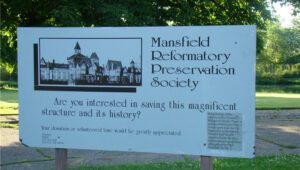
Designed by architect Levi T. Scofield, the Ohio State Reformatory opened its doors in 1896 as a facility to rehabilitate young male offenders through hard work and education. A self-sufficient institution with its own power plant and working farm, the reformatory produced goods in its workshops for other state institutions and provided opportunities for inmates to learn trades. As social attitudes towards crime hardened in the mid-twentieth century, it became a maximum-security facility. The six-tier East Cell Block is the largest known structure of its kind. Considered substandard by the 1970s, The Ohio State Reformatory closed in 1990. It has served since as a setting for several major motion pictures. This Mansfield landmark was added to the National Register of Historic Places in 1983.
, OH
Sherwood Anderson (1876-1941), author of 27 works, gave up a successful business career in Elyria, Ohio, to concentrate on writing. Born in Camden, Anderson spent his formative years (1884-1895) in Clyde, and in 1919 he published his most notable book, Winesburg, Ohio. Clyde and small-town Ohio inspired many of its tales. Critics also praised his short story collections, including The Triumph of the Egg (1921) and Death in the Woods (1933). Commercially successful as a writer, Anderson moved to rural Virginia, where in 1927 he purchased and operated two newspapers while continuing his literary career. Through his writings and encouragement he was a major influence to a younger generation of writers, including William Faulkner, Ernest Hemingway, and John Steinbeck. Sherwood Anderson is buried in Marion, Virginia.
, OH
Mary Leonore Jobe was born on January 29, 1878, near Tappan, Harrison County, Ohio. She earned a bachelor’s degree from Scio College and master’s degree from Columbia University. While studying, she began a life-long career of exploration and natural history investigation. She first explored areas of British Columbia, Canada in 1905 and in 1916 started Camp Mystic, a summer camp in Connecticut for girls. She married explorer Carl E. Akeley in 1924 and completed an expedition to Africa when Carl died in the Belgian Congo in 1926. Honors include the naming of Mount Jobe in Canada to recognize her achievements and Belgium awarding her the Cross of the Knight, Order of the Crown, for her work in the Belgian Congo. She is known for her books and contributions to the American Museum of Natural History in New York. She died on July 19, 1966, and is buried in Deersville.
, OH
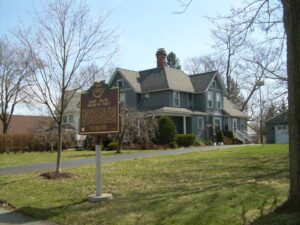
Harold Hart Crane was born at this site on July 21, 1899, to Grace Hart Crane and Clarence A. Crane, the inventor of Lifesaver Candies, and lived here until the age of three. “A born poet,” according to e.e. cummings, Crane dropped out of high school in 1916 and moved from Cleveland to New York City to focus on a literary career. Mainly self-educated, Crane drew his influence from the writings of Walt Whitman and Emily Dickinson. His major work, The Bridge (1930), uses the Brooklyn Bridge as the perfect metaphor to celebrate contemporary urban life. Uniquely lyrical in structure and full of imagery, it is considered one of the three major poetic sequences of the first half of the twentieth century along with T.S. Eliot’s The Waste Land and William Carlos Williams’ Paterson. Crane died on April 26, 1932.

, OH
The Great Geauga County Fair is the longest continuously operating county fair in Ohio. The fair is a major county gathering event each year, pulling together people from the whole county. Geauga’s settlers imported the idea of the county fair with them from New England. The fair’s parent organization, the Geauga County Agricultural and Manufacturing Society, began holding fairs on Chardon Square in 1823. Since then, the Geauga County Fair has served as a gathering place and form of education to promote local agriculture and introduce farmers to new farming developments and each other. Controversy arose between 1840 and 1854 after Lake County ceded and Chardon, Claridon, and Burton vied for the permanent fair grounds. Burton’s proposal was accepted, improvements began immediately, and the fair grew quickly. The Great Geauga County Fair continues as a time-honored tradition.
, OH
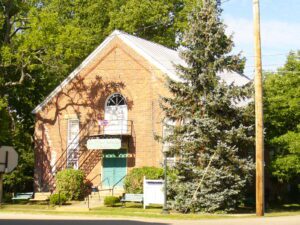
This historic village was a hub for early Ohio industry and travel. The natural geography of the area provided ideal conditions for the establishment of a variety of mills. Col. Robert Patterson, an ancestor of the founder of National Cash Register in Dayton, John Patterson, chose Clifton for the site of a woolen mill, which furnished material for the American army during the War of 1812. Davis Mill, established in 1802 and in operation today as Clifton Mill, produced meal and flour for Civil War troops. A major stop on the stagecoach trail, “The Accommodation Line,” which ran from Springfield to Cincinnati from 1827 to 1840, the village bustled with the commotion of travelers. The once flourishing industry of Clifton faded as railroad traffic bypassed the village and manufacturers left the area.