

, OH
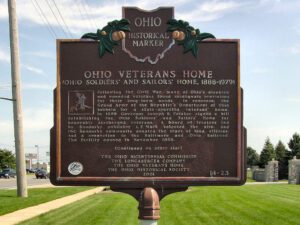
Following the Civil War, many of Ohio’s disabled and wounded veterans found inadequate provisions for their long-term needs. In response, the Grand Army of the Republic’s Department of Ohio lobbied for a state-operated veterans’ home. In 1886 Governor Joseph B. Foraker signed a bill establishing the Ohio Soldiers’ and Sailors’ Home for honorably discharged veterans. A board of trustees led by Sandusky publisher I.F. Mack selected the site, and the Sandusky community donated the tract of land, utilities, and a connection to the Baltimore and Ohio Railroad. The facility opened in November 1888. (continued on other side)
, OH
In 1810, early settlers here were Major Amos Spafford (1753-1818), his wife Olive (1756-1823), and their children Samuel, Aurora , Chloe (Mrs. Almon Gibbs), and Anna (Mrs. Richard Craw). In 1796, Spafford, a native of Connecticut, was a surveyor for the Connecticut Land Company. He drew the first map laying out Cleveland and named the city. He left there in 1810 following appointment as custom’s collector and postmaster for the new port at the foot of the Maumee River rapids, Port Miami of Lake Erie. Spafford was granted a 160 acre land patent on River Tracts #64 and #65 in Waynesfield township, signed by President James Monroe and was able to purchase it following the 1817 Treaty of the Rapids that extinguished Native American claim. Two years later, 67 families lived in the area, but most fled at the outbreak of the War of 1812.
, OH
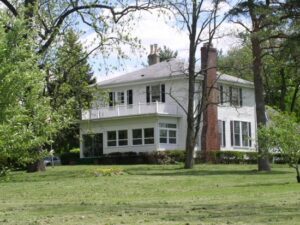
Robert L. Eichelberger was born in Urbana on March 9, 1886, the youngest of the five children of George Maley Eichelberger, an Urbana lawyer, and Emma (Ring) Eichelberger. After graduating from Urbana High School in 1903, he attended Ohio State University and then was appointed to the United States Military Academy at West Point. Graduating in 1909, he was appointed a second lieutenant of infantry. Four years later he married Emma Gudger, daughter of Judge H. A. Gudger of Asheville, North Carolina. For several years, he saw service in Panama and the Mexican border before joining the American Expeditionary Forces in Siberia. From 1918 to 1920 Major Eichelberger observed the Japanese incursion into Siberia and became aware of Japanese methods. In 1940 he was appointed Superintendent of the Military Academy at West Point where he established regular courses to include flight training for Flying Army Officers. [continued on other side]
, OH
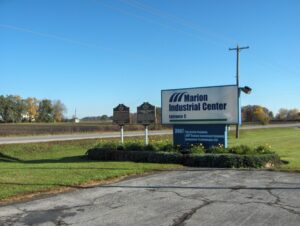
This site was once a twenty-four acre camp for Prisoners of War established on the grounds of the Marion Engineer Depot. The Depot was a major supply and logistics site of the U.S. Army Engineers during World War II. The first contingent of POWs arrived in December 1944, consisting of two hundred and fifty men, many of them Germans who had served in the Afrika Korps Panzer Division. POWs served in many capacities during their time at Camp Marion. Some worked in construction, others cooked, cleaned, and performed maintenance and office tasks around the depot. Many worked on local farms, where farmers provided food to supplement their sometimes inadequate rations so that they would have energy to be able to work a full day. By 1946 five hundred Prisoners of War could be held at Camp Marion. (Continued on other side)
, OH
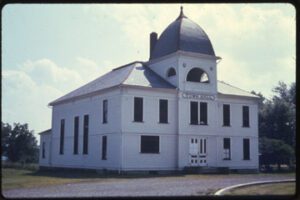
Major buildings dating from 1832 to 1898 surround the village green, the geographic center of Gustavus Township. Built in 1832 on the northwest quadrant, the George Hezlep House features Federal-Greek Revival architecture and has a closet reputedly used on the Underground Railroad. Built in 1840, the Farmers’ Exchange Store was originally a double entrance Greek Revival structure. The Storekeeper’s House, also a Greek Revival structure, was built next to the exchange store in 1840. South of this house is the Fraternal Hall, built in 1870. There were once four churches in Gustavus including the Methodist Church, built in 1856 with a temple front and a belfry, and the Congregational Church, built east of the center in 1854. The eclectic Town Hall was built in 1890 and fronts the southeast quadrant. The Gustavus Centralized School, reported as the first centralized school in the United States, was built in 1898 and was replaced by the current building in 1928.
, OH
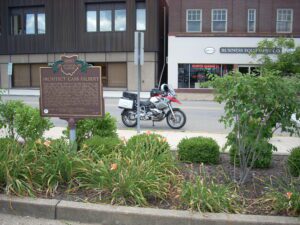
One of America’s leading architects of the early 20th century, Cass Gilbert (1859-1934), was born in a home that stood at this site. After studying at the Massachusetts Institute of Technology, Gilbert apprenticed with prominent architectural firm McKim, Mead, and White. The critical success of his first major public building, the design of the 1895 Minnesota State Capitol, established his national reputation. His influential 1912 Woolworth building, at 792 feet, was then the world’s tallest building, earning Gilbert’s nickname of “Father of the Modern Skyscraper.” Combining classical designs with modern technology, Gilbert also created the United State Supreme Court building (1932) in Washington, D.C., an enduring icon of American justice and democracy. His other achievements include the Arkansas and West Virginia capitols, the U.S. Custom House in New York, and several buildings at Oberlin College. Gilbert served as the president of the American Institute of Architects and the National Academy of Design.
, OH
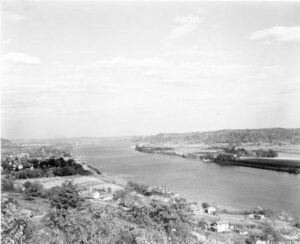
The Ohio River, the southeast border of Gallia County, played a significant role in the development of Gallipolis and Gallia County. One of the state’s first thoroughfares, this waterway enabled pioneers to settle in what was known as the Northwest Territory. On October 17, 1790, approximately 500 French immigrants arrived in Gallipolis, traveling by flatboats from Pittsburgh, and settled in log cabins in what is now City Park, in the heart of Gallipolis. This established the second oldest permanent settlement in the territory. The settlers relied on the River for communication, commerce, and transportation, and the River brought postal service to Gallipolis in 1794. As local business and river trade developed in the 1800s, Gallipolis became a thriving port. The scenic Ohio River is an important inland waterway, providing transportation for many commodities between major cities. The River also provides recreational opportunities for both visitors and residents, including water sports, fishing, and boating.
, OH
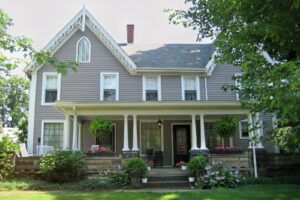
Unserheim, meaning “Our Home” in German, is the name of this ante-bellum Queen Anne style home, which was placed on the National Register of Historic Places in 1998. From 1857-1878, it was home to Daniel Howell Hise, a Quaker and ardent abolitionist. On April 8, 1849, Hise wrote, “Welcome! Welcome to the protection I can give, with or without the law.” A major stop on the Underground Railroad, Unserheim’s secret rooms and tunnel provided shelter to slaves on their flight to freedom. Hise’s belief in abolitionism was so strong that following John Brown’s Raid at Harper’s Ferry, he was instrumental in erecting the Edwin Coppock Monument at Hope Cemetery. Coppock had been executed for his participation in the raid. Hise also supported the Women’s Rights Movement and opened Unserheim to such notable guests as famed suffragists Susan B. Anthony and Sojourner Truth.