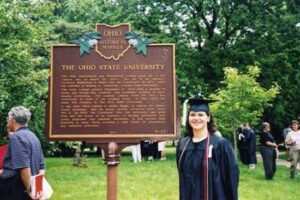
The Ohio Agricultural and Mechanical College grew out of the Cannon Act of March 22, 1870. “But let it be started,” Governor Rutherford B. Hayes told the Legislature in 1873, “with the intention of making it a great State University.” The little college opened September 17, 1873 with a faculty of seven and twenty-four students. One academic building at first housed everything. The campus, remote from the city, was surrounded by some of the original forest. In May, 1878 the name was changed to The Ohio State University. It was after 1900 before it really began to realize its educational potential, and its major growth occurred after World War II. By 1970, the Centennial Year, the university had more then met the hopes of its founders. A leading university with great manpower and physical resources, it had earned high standing in many fields covering a wide range of educational and research activities.
A farm boy with a tenth grade education, Leslie Peltier, born near Delphos in 1900, achieved fame as one of the most famous astronomers of the twentieth century. In 1916, he raised $18 dollars by picking 900 quarts of strawberries on his father’s farm in order to purchase his first telescope. His stargazing abilities led Harvard Observatory’s Dr. Harlow Shapley to proclaim him “the world’s greatest non-professional astronomer.” During his 65 years of stargazing, Leslie Peltier discovered 12 comets and two novae and made 132,000 variable star observations. Peltier made his discoveries on his homemade “merry-go-round” observatory that rotated on a child’s merry-go-round track and housed the optics from a 6-inch, f/8 telescope on loan from Princeton University. To recognize his achievements, the Astronomical League created the annual Leslie C. Peltier Award in 1980 to recognize an amateur astronomer who contributed to astronomy observations of lasting significance.
Evansport is named after brothers Amos and Albert G. Evans who, with Jacob Coy, had the village surveyed next to the Tiffin River on December 14, 1835. The “port” suffix in Evansport’s name reflects the river’s significance as a transportation thoroughfare. Evansport’s early growth was spurred by its mills powered by the Tiffin River. The mills provided settlers with lumber for buildings and supplied flour and cornmeal for sustenance and commerce. Settlers who poured into Williams County’s northern townships in the 1830s agitated debate about moving the county seat to a more centralized location. Evansport was platted as a possible site for the county seat. The Williams County seat was moved to Bryan in 1840 and in 1845 Defiance County was created, leaving Evansport on the Williams-Defiance county line.
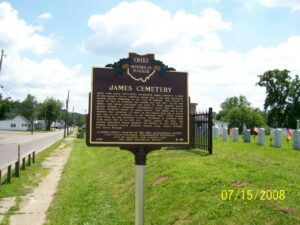
Major John James (1772-1854) established James Cemetery in 1828 on and around a Native American mound that is the only significant ancient mound remaining in the city of Jackson. The mound is about 70 feet in diameter and nearly six feet tall. In the late 1800s, this mound comprised one point of three ancient mound groups forming a triangular configuration along East Broadway Street, formerly known as James Street. One group was a few hundred feet northeast of here on the Watson farm and a second was just to the northwest on the Warnicke farm. These mounds were built by the Hopewell Culture, prominent in southern Ohio from about 100 BC to 400 AD. Major James, his wife, and several immediate family members are buried on the mound including Jackson County pioneers Andrew Long, Daniel Hoffman, and David Mitchell.
Clinton County was a major center of activity for the Shawnee, Miami, and Delaware Indians. Early traces and trails developed as Indians traveled from village to village; gathered flint, salt and gold; traded furs, mica, and feldspar; and hunted bear, deer, otters, raccoons, foxes, wild cats, turkeys, and other wildlife. Trails throughout the county connected to other trails and villages in Ohio such as Lower Shawnee Town (now Portsmouth), Hurricane Tom’s Town (now Piketon), Chillicothe, Old Town (near Xenia), and Miami Town (now Dayton). Major trails or traces in Clinton County included the Bullskin, Wayne, Chillicothe, Delaware, Fort Ancient, Kanawha, Kenton and Todds Fork Traces. These routes were the avenues the first white settlers followed. (continued on other side)
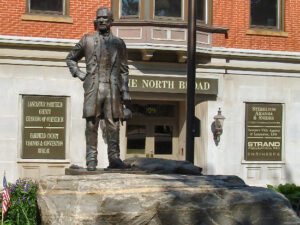
Lancaster’s native son, Civil War General William Tecumseh Sherman, was a four-star military genius. He played a major role in the Union victory during the Civil War as a brilliant commander and grand strategist who revolutionized war by incorporating psychological and economic warfare into his military tactics, culminating with the famous “March to the Sea” through Georgia. In retrospect, he declared “War is Hell.” Honoring an allegiance to the United States Constitution, he fought to preserve the Union. His self-written epitaph was “Faithful and Honorable.”
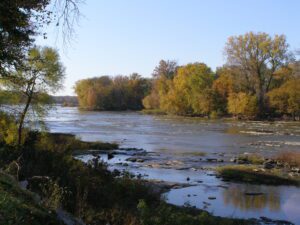
This site, at the head of the Great Rapids of the Maumee, has been a major river crossing for centuries. The village was platted in 1833 as Gilead but was overshadowed by rival Providence during the canal era. In 1868 the name Grand Rapids was adopted, and the town prospered with the arrival of the railroad in 1877. Fires ravished the village in the late 1890s and spring floods have remained a threat. Restoration of the Victorian architecture began in 1975 and has helped revitalize this village along the historic Maumee.
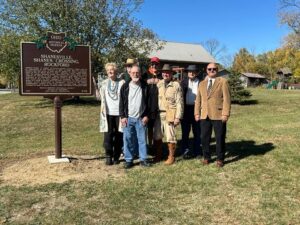
John Chapman (1774 – 1845) leased these three acres to the north and west from William Botts Hedges on April 29, 1828. He paid Hedges by cultivating 1,000 apple trees on the site over the next ten years. Apples provided an important food source. Cut and dried for sauces in the winter, they could be pressed into cider or “apple jack” at a time when water often carried disease. The Hedges Nursery profited the Shanesville area by shipping apples to the major trading posts at Piqua and Ft. Wayne. During his lifetime, Chapman proved an able businessman who established profitable orchards in Ohio, Pennsylvania, and Indiana. In 2009, American Forests, the Johnny Appleseed Foundation, the Museum at Urbana University, and the Village of Rockford planted two “Rambo” apple trees at the Hedges Nursery site.