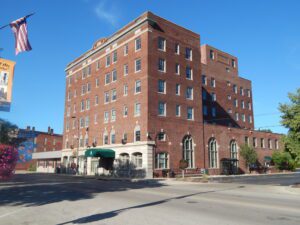
The Hotel Ashtabula was built in 1920 during an economic boom that lasted most of that decade. Architecturally, it represents a combination of Second Renaissance Revival and Georgian Revival styles. The H.L. Stevens and Company of Chicago and New York designed and built the hotel and others like it in Cleveland, Dayton, and Warren, Ohio and throughout the Midwest. The building included a ball room accommodating 300, a dining room that could seat 125, and club meeting and social rooms. A prominent structure of this downtown street, the Hotel Ashtabula was a hub for social activity. (Continued other side)
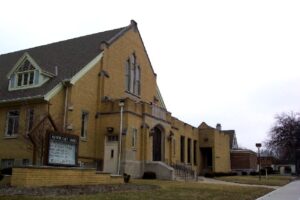
The first African American congregation and first African American Methodist Episcopal (AME) Church in Dayton trace their roots back to the early 1830s. They were organized by Father Thomas Willis and a small group of faithful men and women. After several moves, the congregation settled on Eaker Street and the church was dedicated in the early 1870s. The church was rededicated in 1882 and renamed Wayman Chapel AME Church. The eminent poet Paul Laurence Dunbar and his mother Matilda attended and worshiped at the Eaker Street church. His untimely death in 1906 brought family and friends to his funeral services held at the church. By 1923 church leadership felt the need for more secure space for the growing congregation and moved to a new building at Fifth and Banks streets. Three elegant chandeliers for the sanctuary were donated by the city’s newspaper, the Dayton Daily News. (Continued on other side)
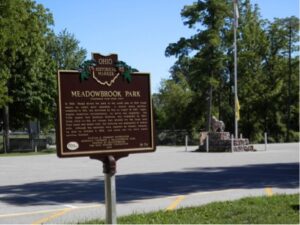
Meadowbrook Park began as a Tiffin, Fostoria & Eastern Electric Railway plan to draw weekend riders. Laura Stephenson Sneath, wife of a major company stakeholder, led the park development. Originally north of Wolf Creek, Meadowbrook included a baseball diamond and a 1902 dance pavilion. In 1923, William Richards purchased the buildings and leased the land from Henry Matthews of Matthews Boat Company. The pavilion was destroyed by fire under suspicious circumstances on October 12, 1925, but no one was charged. James Garfield Haugh, president of the Gem Manufacturing Company, purchased the land in 1925. (Continued on other side)
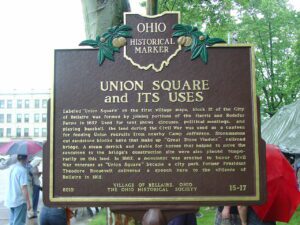
Labeled “Union Square” on the first village maps, block 12 of the City of Bellaire was formed by joining portions of the Harris and Rodefer Farms in 1857. Used for tent shows, circuses, political meetings, and playing baseball, the land during the Civil War was used as a canteen for feeding Union recruits from nearby Camp Jefferson. Stonemasons cut sandstone blocks here that make up “Great Stone Viaduct” railroad bridge. A steam derrick and stable for horses that helped to move the sandstone to the bridge’s construction site were also placed temporarily on this land. In 1882, a monument was erected to honor Civil War veterans as “Union Square” became a city park. Former President Theodore Roosevelt delivered a speech here to the citizens of Bellaire in 1912.
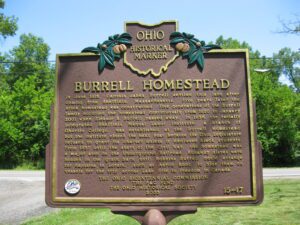
In June 1815, Captain Jabez Burrell settled this land after coming from Sheffield, Massachusetts. Five years later the brick homestead was constructed. Five generations of the Burrell family occupied the homestead continuously from 1820 to January 2001 when Eleanor B. Burrell passed away. In 1836, the racially integrated Sheffield Manual Labor Institute, a branch of Oberlin College, was established at the Burrell Homestead, but the Institute closed the next year because the Ohio Legislature refused to grant its charter unless it excluded black students. From 1837 until the start of the Civil War, the homestead was a major stop on the Underground Railroad. Runaway slaves were hidden in the grain barn until Robbins Burrell could arrange for captains in Lorain, such as Aaron Root, to hide them on vessels for the trip across Lake Erie to freedom in Canada.
Following the Civil War, many of Ohio’s disabled and wounded veterans found inadequate provisions for their long-term needs. In response, the Grand Army of the Republic’s Department of Ohio lobbied for a state-operated veterans’ home. In 1886 Governor Joseph B. Foraker signed a bill establishing the Ohio Soldiers’ and Sailors’ Home for honorably discharged veterans. A board of trustees led by Sandusky publisher I.F. Mack selected the site, and the Sandusky community donated the tract of land, utilities, and a connection to the Baltimore and Ohio Railroad. The facility opened in November 1888. (continued on other side)
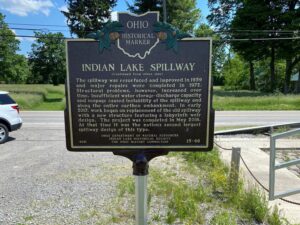
Indian Lake Dam was built 1851-1860 to create a feeder lake, known as the Lewistown Reservoir, for the Miami and Erie Canal. The dam included a 700-foot long concrete ogee weir spillway that discharged water from the lake into the Great Miami River. In 1898, the Ohio General Assembly designated the lake as a public recreation area and renamed it Indian Lake. The lake and dam structure have been owned and operated by the Ohio Department of Natural Resources since the creation of ODNR in 1949. (Continued on other side)
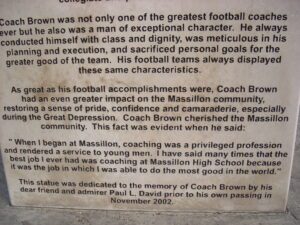
Paul E. Brown, born September 7, 1908 in Norwalk, Ohio, and raised in Massillon, is a member of the Professional Football Hall of Fame and was one of the greatest coaches in the history of football at all levels. From 1932 until 1940, he led Massillon High School to a record of 80-8-2. He coached Ohio State to the 1942 national collegiate championship, and joined the professional football ranks in 1946 as coach of the new franchise in Cleveland. He coached his namesake Cleveland Browns to seven league championships in 17 seasons.