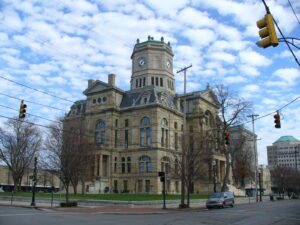
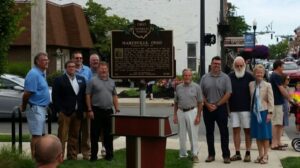
Butler County was created on March 24, 1803, about three weeks after Ohio became a state. Hamilton won the competition for the county seat, thanks to Israel Ludlow, Hamilton’s founder. Ludlow’s donation of the public square secured the county seat. The first Butler County trial court met in July 1803 in a tavern before moving to a two-story military building located at what had been Fort Hamilton (1791-1796). The county built the first courthouse on this public square in 1810. The two-story stone building contained a jail on the first floor and a courtroom on the upper level. A new brick two-story courthouse was built on this square in 1817 at a cost of $10,000. A four-sided clock was added to the top of the building in 1837. (continued on other side)
The Black community of Gallipolis pooled their resources and expertise to open Gallipolis Union Colored School in 1868. Located on the northwest corner of Third Avenue and Olive Street, the public school offered primary education until, around 1877, a high school curriculum was added. In 1882, the first four students to graduate high school were W.H. Haskins, Minnie Battles, Idella Black, and Mary Nease. By 1890, the school had been renamed for President Abraham Lincoln. Valuing their public education, many Lincoln School graduates became teachers; of 33 high school graduates in the first 8 classes, 11 would become schoolteachers. Dr. Edward Alexander Bouchet (Principal 1908-1913) added an intellectual rigor to Lincoln’s curriculum. The nation’s first Black Ph.D., Bouchet earned a doctorate in physics from Yale University in 1876. (Continued on other side)
In 1804 a group of neighbors in Granville, Massachusetts and Granby, Connecticut formed The Licking Company for the purpose of moving to “Newlands” in Ohio. Inspired and informed by the settlement of Worthington in 1803, the Company purchased 29,040 acres in the U.S. Military District. Advance parties surveyed and mapped a site, established a mill, and planted grain. The Company planned a public square, a school, library, quarry, burying ground, and property for the support of churches. In November and December 1805, some 150 emigrants in ox-drawn wagons arrived in their new home and built temporary shelters on the designated public square. On December 9 through 12 1805, Company members selected their Granville lots in an auction that was described as peaceable and honest.
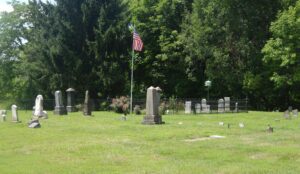
Originally part of the Casterline farm, this cemetery was once the site of the 1824 Bazetta Presbyterian Church, the first church in Bazetta Township. Ziba Casterline deeded .75 acres for the cemetery to the church in 1829 for five dollars. When the small log structured church was relocated to Lot 55 in the township, the cemetery remained. Buried in the cemetery are several early settlers, including Moses Hampton, Joseph Headley, Joseph Pruden, and John Hulse, the first white child born in the township. [continued on other side]
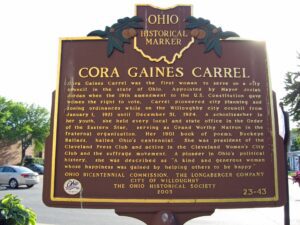
Cora Gaines Carrel was the first woman to serve on a city council in the state of Ohio. Appointed by Mayor Josiah Jordan when the 19th amendment to the U.S. Constitution gave women the right to vote, Carrel pioneered city planning and zoning ordinances while on the Willoughby city council from January 1, 1921 until December 31, 1924. A schoolteacher in her youth, she held every local and state office in the Order of the Eastern Star, serving as Grand Worthy Matron in the fraternal organization. Her 1901 book of poems, Buckeye Ballads, hailed Ohio’s centennial. She was president of the Cleveland Press Club and active in the Cleveland Women’s City Club and the suffrage movement. A pioneer in Ohio’s political history, she was described as “A kind and generous woman whose happiness was gained by helping others to be happy.”
Marysville, Ohio. On August 10, 1819, Samuel W. Culbertson (1780-1840), a Zanesville lawyer, established Marysville at the convergence of Mill Creek and the road connecting Delaware to Urbana. Culbertson purchased 450 acres of land on July 10, 1817 and authorized Charles Roberts to survey the village, which originally contained 96 lots. Culbertson named the village in honor of his daughter, Mary Ellen (1810-1853), who later married US Congressman, Joshua Mathiot (1800-1849). The village was originally in Delaware County, located in part of the Virginia Military District. It was land given as bounties to soldiers from Virginia after the Revolutionary War. Union County, which included Marysville, was created in 1820, and Marysville became the county seat in 1822. (Continued on other side)
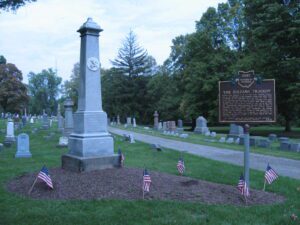
Soldiers from Company F of the 115th Ohio Volunteer Infantry died in the explosion of the steamboat Sultana seven miles north of Memphis on the Mississippi River on April 27, 1865. The Sultana reportedly carried more than 2,400 passengers–six times its capacity of 376. The vast majority were Union soldiers recently freed from Southern prisons at the end of the Civil War. Approximately 1,800 passengers and crew died in what is considered the worst maritime disaster in American history. Company F was organized in Stark, Columbiana, and Portage Counties and was mustered into service at Camp Massillon in the fall of 1862. This marker is a memorial to the soldiers of Company F who died as a result of the Sultana tragedy and other war-related causes.
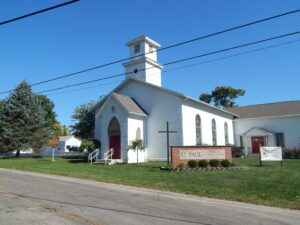
On July 30, 1816, the year before the establishment of Butler Township, a group of farmers of German background founded the Stillwater Church. The log structure with adjoining cemetery was located on three acres between Dog Leg Road and Frederick Pike. In 1842, the congregation replaced the log building with a brick one. In 1873, they moved the building to the northeast corner of Dog Leg and Little York Roads and renamed it St. Paul Lutheran Church. With a fruitful history of sharing God’s love, St. Paul celebrated it’s 200th anniversary on Sunday, July 31, 2016.