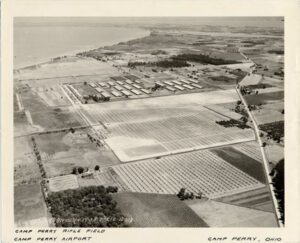
In an effort to improve the marksmanship of Ohio soldiers, Adjutant General Ammon B. Critchfield established Camp Perry, an Ohio National Guard Military Training site on the shore of Lake Erie in 1906. Camp Perry was named after Commodore Oliver Hazard Perry, who defeated British forces in the Battle of Lake Erie during the War of 1812. This particular location was ideal for shooting ranges because varying-length ranges were able to share a common firing line, and shooting practice could take place on all ranges, without the added risk of stray bullets. (continued on other side)
Massie’s Station, built in 1791, was the fourth permanent settlement center in Ohio and the last stockade settlement built in Ohio. It provided protection from the Indians for Manchester’s settlers until 1794. Manchester was the first settlement in the Virginia Military District and the site of the first court held in Adams County, September, 1797.
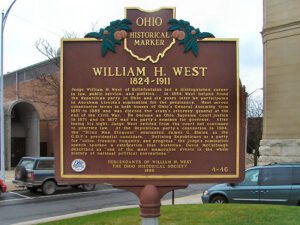
Judge William H. West of Bellefontaine led a distinguished career in law, public service, and politics. In 1854 West helped found the Republican party in Ohio and six years later he participated in Abraham Lincoln’s nomination for the presidency. West served consecutive terms in both houses of Ohio’s General Assembly from 1857 to 1865 and was elected the state’s attorney general at the end of the Civil War. He became an Ohio Supreme Court justice in 1871 and in 1877 was his party’s nominee for governor. After losing his sight, Judge West retired from the court but continued to practice law. At the Republican party’s convention in 1884, the “Blind Man Eloquent” nominated James G. Blaine as the G.O.P.’s presidential candidate. Defining Republicans as a party for “union, freedom, humanity, and progress,” the judge’s nomination speech sparked a celebration that historian David McCullough described as “one of the most memorable events in the whole history of national political conventions.”
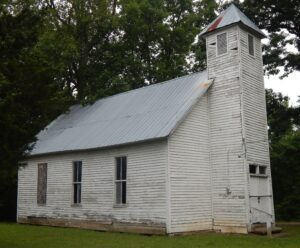
The present structure for the Macedonia Missionary Baptist Church was built in 1849 on Macedonia Ridge north of Burlington, an abolitionist sanctuary for escaped and freed slaves since 1799. It was built by the existing Baptist congregation and a group of 37 freed slaves who had arrived in Burlington from Virginia. The Baptist congregation in Macedonia had organized in 1811-1813 and practiced their faith in their homes and later in a small building with a bell tower made of sticks. The 1849 church was the religious and social focal point for the black community and became the “Mother Church” for approximately eight Baptist churches that exist in Ohio and West Virginia. The Macedonia Missionary Baptist Church was listed on the National Register of Historic Places in 1978.
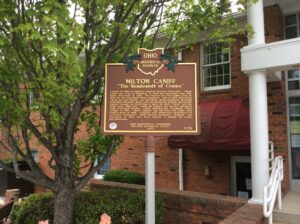
Creator of some of America’s favorite cartoon characters, Milton Caniff was born in Hillsboro in 1907 and graduated from Ohio State University in 1930. He created his first comic strip in 1932 for the Associated Press Syndicate, and in 1934 introduced “Terry and the Pirates,” an innovative serial adventure featuring believable characters drawn with unprecedented realism. Enormously popular through the World War II years for both “Terry” and the comic strip “Male Call,” which he created for the U.S. military’s Camp Newspaper Service, Caniff subsequently introduced “Steve Canyon” in 1947. “Steve Canyon” ran for forty-one years until Caniff’s death in 1988. Credited with influencing generations of successful cartoonists, Caniff brought adventure, suspense, and sensuality to what had been largely a medium for humor and melodrama.
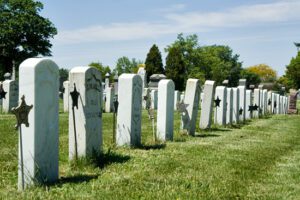
In 1884 the Ohio General Assembly authorized “the burial of the body of any honorably discharged union soldier, sailor or marine of this state who shall hereafter die without leaving means sufficient to defray funeral expenses.” Permanent government-issued headstones have been provided to veterans since the late 19th century. Between 1884 and the 1930s, Washington Cemetery buried 47 white soldiers (including 15 unknown) and 35 African-American soldiers. These veterans served in the Civil War, the Spanish-American War, and WWI. They are remembered for the sacrifices they made. In the fall of 2001, the cemetery underwent significant renovations, in which students of the Washington Senior High School Research History program aided in identifying the buried soldiers and restoring and replacing the gravestones. Here in Soldiers’ Row, the words of local United States Colored Troops veteran, Albert Bird, echo centuries later: “We have suffered to save the country; we ought to be remembered.”
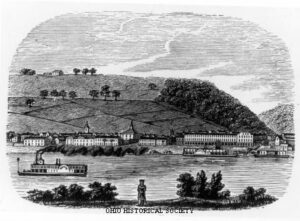
Ripley was incorporated as the village of Staunton in 1812. Its name was changed in 1816 to honor General Eleazer Wheelock Ripley, a hero of the War of 1812. In the years before railroads, Ripley was a principal Ohio River shipping center. Also important were its extensive boat-building, tobacco, pork, and timber industries. Ripley too was the home of saw and planing mills, iron foundries, and a piano factory. Such varied commerce enabled Ripley to remain vibrant throughout the nineteenth century. Although noted as a port, Ripley is best remembered as an abolitionist stronghold. Many of its citizens, including Rev. John Rankin and John P. Parker, served as conductors on the famed “Underground Railroad.” The notoriety of Ripley’s anti-slavery network perhaps eclipsed that of nearby Cincinnati, earning the town a reputation as the “Black Hole of Abolitionism.” (Continued on side two)
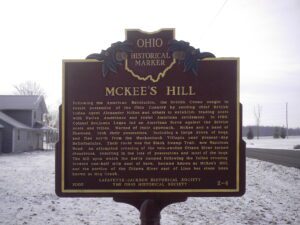
Following the American Revolution, the British Crown sought to retain possession of the Ohio Country by sending chief British Indian Agent Alexander McKee and others to establish trading posts with Native Americans and resist American settlement. In 1786, Colonel Benjamin Logan led an American force against the British posts and tribes. Warned of their approach, McKee and a band of Shawnee, took their possessions, including a large drove of hogs, and fled north from the Mackachack Villages near present-day Bellefontaine. Their route was the Black Swamp Trail, now Napoleon Road. An attempted crossing of the rain-swollen Ottawa River turned disastrous, resulting in the loss of possessions and most of the hogs. The hill upon which the party camped following the failed crossing, located one half mile east of here, became known as McKee’s Hill, and the portion of the Ottawa River east of Lima has since been known as Hog Creek.