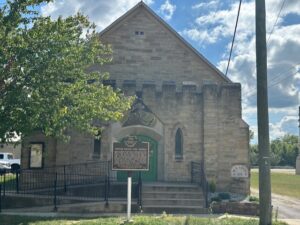
Wayman Chapel was dedicated in 1874 as part of Ohio’s Third District of the African Methodist Episcopal Church. The first Black church in Knox County, it began in 1870 under the guidance of Rev. James A. Ralls. The congregation met in local homes and church basements until completing their red brick church at 102 West Ohio Avenue in 1876. Additions made 1947-1948 included an upgraded facade. For more than a century, Wayman Chapel provided an educational, cultural, and spiritual hub for its members as well as the wider Black community of Mt. Vernon.
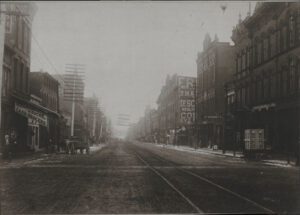
The center of African-American culture in Akron during the mid-20th century, Howard Street was home to many of the city’s black-owned business and entertainment establishments, and provided an atmosphere in which minority-owned businesses could thrive. Attracted to the vitality of the neighborhood, entrepreneur George Mathews (1887-1982) established a barbershop here in 1920 and in 1925 opened the adjoining Mathews Hotel. The hotel quickly became the anchor of the Howard Street district. Mathews’ success allowed him to endow a scholarship fund at the University of Akron in 1964.
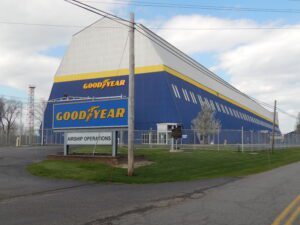
In March 1917, a month before U.S. entry into World War I, The Goodyear Tire & Rubber Company began construction of the hangar on land the firm purchased here in 1916. During World Wars I and II, the hangar was used for building and testing lighter-than-air craft for military uses, including intelligence-gathering and antisubmarine warfare. The first class of Navy airship pilots also trained at Wingfoot Lake. (Continued on other side)
Manchester was founded in 1791 by Nathaniel Massie as a base to survey the land warrants of American Revolutionary War soldiers in the Virginia Military District. This bank of the Ohio River provided a secure site for the last civilian stockade built in Ohio. The natural protection of this fortification included marshland to the west and north and the river on the south. The nearby three islands provided a safe place for retreat in dangerous circumstances and also supplied an area to raise food in its rich bottomlands. The invention of the steam powered paddle wheel boat allowed the river to become the city’s main source of shipping and commerce in the nineteenth century. Manchester was an important port of call for provisions; the export of agricultural products; and the manufacture of goods such as pottery, furniture, and leather goods.
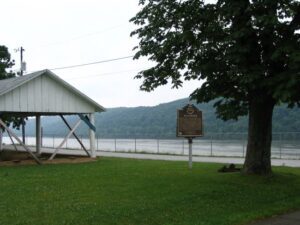
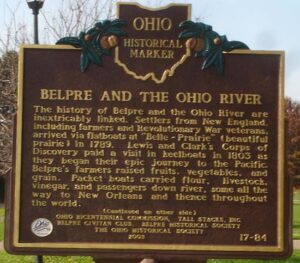
The history of Belpre and the Ohio River are inextricably linked. Settlers from New England, including farmers and Revolutionary War veterans, arrived via flatboats at “Belle-Prairie” (beautiful prairie) in 1789. Lewis and Clark’s Corps of Discovery paid a visit in keelboats in 1803 as they began their epic journey to the Pacific. Belpre’s farmers raised fruits, vegetables, and grain. Packet boats carried flour, livestock, vinegar, and passengers down river, some all the way to New Orleans and thence throughout the world. (Continued on other side)
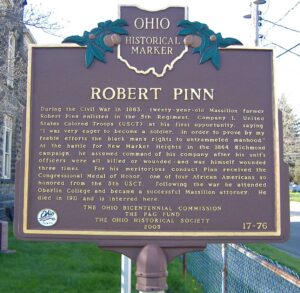
During the Civil War in 1863, twenty-year-old Massillon farmer Robert Pinn enlisted in the 5th Regiment, Company I, United States Colored Troops (USCT) at his first opportunity, saying, “I was very eager to become a soldier, in order to prove by my feeble efforts the black man’s rights to untrammeled manhood.” At the battle for New Market Heights in the 1864 Richmond campaign, he assumed command of his company after his unit’s officers were all killed or wounded – and was himself wounded three times. For his meritorious conduct Pinn received the Congressional Medal of Honor, one of four African Americans so honored from the 5th USCT. Following the war he attended Oberlin College and became a successful Massillon attorney. He died in 1911 and is interred here.
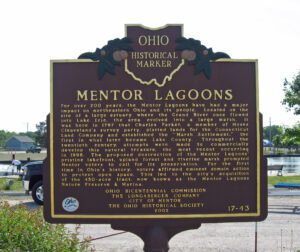
For over 200 years, the Mentor Lagoons have had a major impact on northeastern Ohio and its people. Located on the site of a large estuary where the Grand River once flowed into Lake Erie, the area evolved into a large marsh. It was here in 1797 that Charles Parker, a member of Moses Cleaveland’s survey party, platted lands for the Connecticut Land Company and established the “Marsh Settlement,” the first in what later became Lake County. Throughout the twentieth century, attempts were made to commercially develop this natural treasure, the most recent occurring in 1996. The proposed destruction of the Mentor Lagoons’ pristine lakefront, upland forest and riverine marsh prompted Mentor voters to call for its preservation. For the first time in Ohio’s history, voters affirmed eminent domain action to protect open space. This led to the city’s acquisition of the 450-acre tract, now known as the Mentor Lagoons Nature Preserve & Marina.
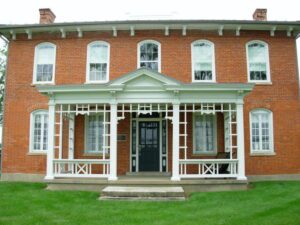
Known as the “Halfway House,” the Gooding House and Tavern was built by George B. Gooding halfway between the towns of Worthington and Delaware in 1827. Its location was influenced by construction of the Columbus and Sandusky Turnpike that was chartered by the State of Ohio the year before. Also known as the “Mud Pike,” the turnpike was slow and difficult for travelers and could take nearly a day to travel 10 miles. The Gooding House was the perfect place for stagecoach drivers to change teams of horses and for travelers to rest and have refreshments. George Gooding also prospered as a farmer with over 1,000 acres of land. This stately brick farmstead remained in the Gooding family for 175 years with each succeeding generation adding its imprint on the property. The Gooding House and Tavern was listed on the National Register of Historic Places in 2005 and restored in 2007.