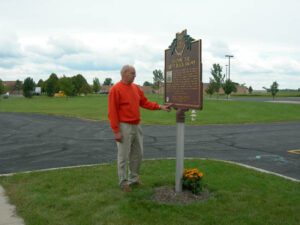
The landscape of northwest Ohio was formed by melting ice and the glacial lakes left behind in its wake. Because of the low gradient (3 feet fall per mile) to the northeast, the flat lacustrine plain evolved into a large swamp. A massive swamp forest with huge hardwoods, broken only sporadically with intermittent wet prairies and savannahs, dominated the landscape. Both prehistoric and historic Indians farmed the flood plains of the Maumee River and its tributaries: Auglaize, Tiffin, and Blanchard rivers. (continued on other side)
SW corner of W. Monroe Street and S. Washington Street
New Bremen
, OH
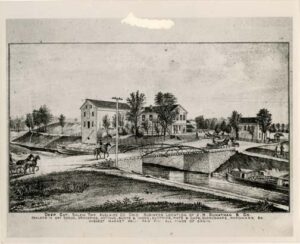
Begun in 1833, the Miami Extension Canal linked the Miami Canal in Dayton to the Wabash & Erie Canal at Junction. Engineering difficulties, epidemics, and the Panic of 1837 delayed completion of the Extension until June 1845, when the packet boat Banner first navigated the almost 250 miles distance from Cincinnati to Toledo in three days. New Bremen was the northern terminus for a period while work continued northward on the Extension. Designated the Miami & Erie Canal in 1849, it served as the primary avenue of commerce and military transport, and as a “post road” before the railroad era. The Miami & Erie remained in use until 1913, long after the canal era had passed. Along the course of the canal, New Bremen was the approximate midway point between Cincinnati and Toledo.
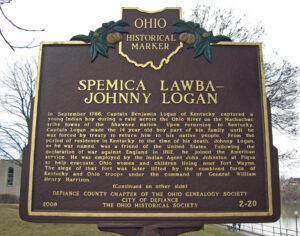
In September 1786, Captain Benjamin Logan of Kentucky captured a young Indian boy during a raid across the Ohio River on the Machachac tribe towns of the Shawnee nation. Upon returning to Kentucky, Captain Logan made the 14 year old boy part of his family until he was forced by treaty to return him to his native people. From the period of residence in Kentucky to the time of his death, Johnny Logan, as he was named, was a friend of the United States. Following the declaration of war against England in 1812, he joined the American service. He was employed by the Indian Agent John Johnston at Piqua to help evacuate Ohio women and children living near Fort Wayne. The siege of that fort was later lifted by the combined force of Kentucky and Ohio troops under the command of General William Henry Harrison. [continued on other side]
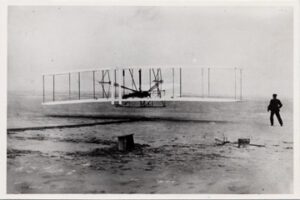
In 1899, Wilbur and Orville Wright of Dayton built a kite to test a revolutionary flight control system, and in 1900, built their first airplane (glider). With promising results, the Wrights built man-carrying gliders and airplanes to refine their ideas. Wind tunnel experiments led to accurate calculations of lift and drag. In 1903 in Kitty Hawk, North Carolina, they made the first sustained, controlled, powered flight in history, lasting 12 seconds. By 1905, the Wright brothers had developed the first practical airplane and the skills to pilot it. The U.S. Army Signal Corps purchased a Wright flyer, the first practical military aircraft, in 1909. Through public demonstrations beginning in 1908, the Wright brothers showed the world the future of aviation.
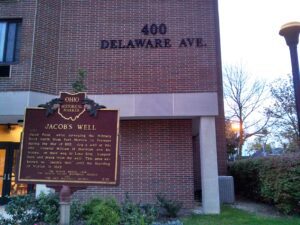
Jacob Foos, while surveying the Military Road north from Fort Morrow to Fremont during the War of 1812, dug a well at this site. General William H. Harrison and his troops, on their way to Lake Erie, camped here and drank from the well. This area was known as “Jacob’s Well” until the founding of Marion in 1822.
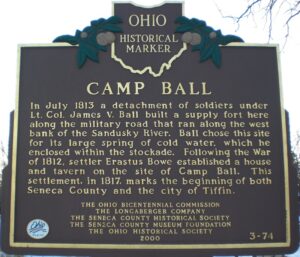
In July 1813 a detachment of soldiers under Lt. Col. James V. Ball built a supply fort here along the military road that ran along the west bank of the Sandusky River. Ball chose this site for its large spring of cold water, which he enclosed within the stockade. Following the War of 1812, settler Erastus Bowe established a house and tavern on the site of Camp Ball. This settlement, in 1817, marks the beginning of both Seneca County and the city of Tiffin.
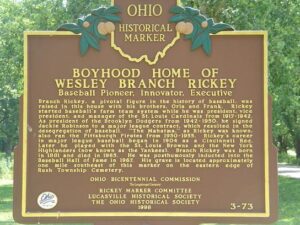
Branch Rickey, a pivotal figure in the history of baseball, was raised in this house with his brothers, Orla and Frank. Rickey started baseball’s farm team system while he was president, vice president, and manager of the St. Louis Cardinals from 1917-1942. As president of the Brooklyn Dodgers from 1942-1950, he signed Jackie Robinson to a major league contract, which resulted in the desegregation of baseball. “The Mahatma,” as Rickey was known, also ran the Pittsburgh Pirates from 1950-1955. Rickey’s career in major league baseball began in 1904 as a Cincinnati Red. Later he played with the St. Louis Browns and the New York Highlanders (now known as the Yankees). Branch Rickey was born in 1881 and died in 1965. He was posthumously inducted into the Baseball Hall of Fame in 1967. His grave is located approximately one mile southeast of this marker on the eastern edge of Rush Township Cemetery.
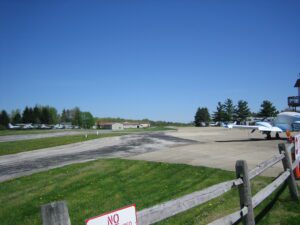
Daniel E. Weltzien, pilot and hometown son, dreamed of a flying community – one where every family would have a plane in their garage for work or play. In June 1965, the Williams Farm on Acme Hill became a runway with taxiways to every home. Young men and women came for flying lessons, and now traverse the world in space, the military, and commercially. Surviving fire, tornadoes, an earthquake, Ohio winters, and severe crosswinds, students still come here to take their first flight and become pilots. In Ohio, birthplace of aviation pioneers, this is “SKYPARK” THE FLYING COMMUNITY, a first in Ohio because a man dared to dream.