

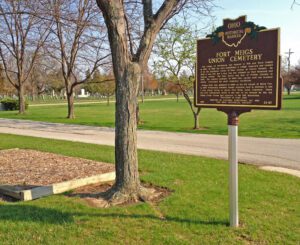
, OH
The village of Perrysburg was founded in 1816 and Wood County in 1820. In 1822 the town established a village cemetery and located it on the southwest corner of West Indiana at Cherry Streets. By 1848 it was full and a new one was created on West Boundary and Indiana Avenue. The first burial was that of William Cassady in 1849. The cholera epidemic of 1854 that caused over one hundred deaths, overloaded the small cemetery workforce. Potters Field was designed in 1868 on the NW corner of Block Two. In 1877 Perrysburg Township bought adjacent land in sections K and L and joined forces to create Fort Meigs Union Cemetery. There are nine underground vaults in the side of the terrace by the old Ewing Creek stream bed adjacent to the 1912 mausoleum.
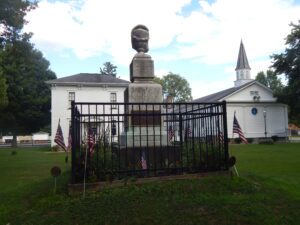
, OH
With the outbreak of the Civil War in 1861, many young men of Bristol Township enlisted in the army when President Abraham Lincoln issued his call to defend the Union cause. The death toll of some of these men at the Battle of Shiloh in Tennessee in April 1862 touched the local community as did the loss of Bristol Township lives at the Battle of Perryville in Kentucky, the Battle of Cedar Mountain in Virginia, and other theaters of war later in the year. The local citizenry responded to a plan for a lasting public memorial at the Town Park through a fund raising campaign. In 1863 the town square was transformed with a marble monument placed on an elevated mound at its center. The monument was designed by local artist Frank J. Hammond and manufactured by Myers, Uhl & Company of Cleveland at a cost of $500. [continued on other side]
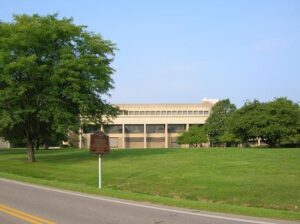
, OH
Wilberforce University, founded at Tawawa Springs in 1856 by the Methodist Episcopal Church, is the first private historically black college or university in America. The inspirations for Wilberforce were an unwavering faith in God, an acknowledgement of the contribution of the British abolitionist and Member of Parliament William Wilberforce, the leadership of AME Bishop Daniel Payne, and the belief in the potential of all women and men to learn and prosper. Wilberforce embraces the love of learning and the use of education as a tool of personal and community empowerment. Wilberforce seeks to cultivate and meet the historic hunger for freedom and liberty of all people. Today, Wilberforce is affiliated with the African Methodist Episcopal Church and educates diverse students from across the nation and around the world. Wilberforce continues to serve as a beacon for learning and research.
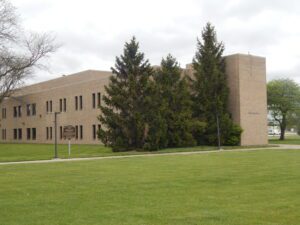
, OH
The site of Owens Community College, the Rossford Army Ordnance Depot played a supporting role in the United States’ victory in World War II and in national defense during the Cold War. From 1942 until 1945, the Rossford Ordnance Depot served as a distribution center for military vehicles during World War II. The complex also housed an ammunition storage depot. Virtually a city within itself, it featured an extensive railroad and road grid. Following World War II, the Depot remained a major site for military vehicles but expanded its mission to include tool storage and distribution. On July 1, 1963, General Orders No. 28 deactivated the facility from the United States Army Material Command.
, OH
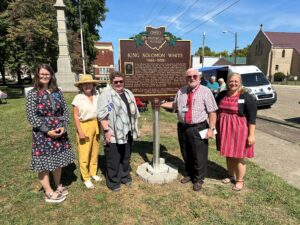
King Solomon “Sol” White was born in Bellaire on June 12, 1868. A Baseball legend, he was an all-around player, manager, and organizer in the Pre-Negro Leagues (1887-1912) and the Negro Leagues (1920-1926). White first played with integrated baseball clubs the Bellaire Globes (1884-1886) and Wheeling Green Stockings (1887). After 1887-1888 color barriers were imposed on baseball, White played on segregated minor league teams. They included: the Pittsburgh Keystones, Cuban Giants, York Colored Monarchs, Cuban X-Giants, Page Fence Giants, and Chicago Columbia Giants. As a coach, he helped organize and lead the powerhouse Philadelphia Giants to their 1904-1907 championships. White died on August 26, 1955, and was buried in an unmarked grave in Staten Island’s Frederick Douglas Memorial Cemetery. In 2006, “Sol” White was posthumously inducted into the Baseball Hall of Fame.
, OH
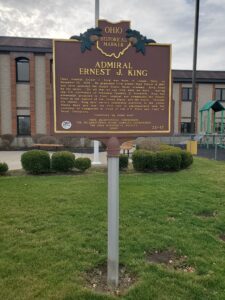
Fleet Admiral Ernest J. King was born in Lorain, Ohio, on November 23, 1878. He graduated from Lorain High School in 1897 and later attended the United States Naval Academy. King lived by his motto, “Do all that we can with what we have.” Having the full confidence of President Franklin D. Roosevelt, King was eventually promoted to Fleet Admiral and commanded the largest fleet in the history of the United States and the world. Through his career, King held various leadership positions in the United States Navy and was the first man to simultaneously hold the positions of Commander in Chief of the U.S. Fleet and Chief of Naval Operations. (continued on other side)
, OH
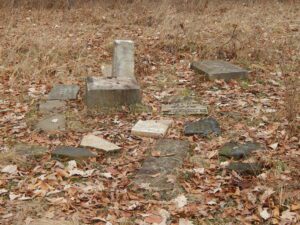
There are 48 known members of the Postle family buried in the cemetery. Their stories are interwoven with the history of Prairie Township, Franklin County, and Ohio. In 1810, Shadrach and Anna Stacia Postle were among the first settlers of Prairie Township. Their son Job was a veteran of the War of 1812 and later owned the Checker Inn, a popular stopping place on the National Road. In the 1860s, Smith Postle and his son, William Sylvester Postle, were some of the first manufacturers of clay drainage tile in Ohio. Their products improved drainage in farm fields and fostered the growth of the tile industry in the state. Gabriel Postle was the first Postle buried in the cemetery in 1829. Twelve graves are of children under the age of six, which testifies to the hardships endured by the area’s early residents. Other graves include those of John Whitehurst, a freed slave who lived with the family of the Job Postle and John Tracy, a veteran of the Civil War. In 1870, Nancy Postle was the last person buried in the cemetery.
, OH
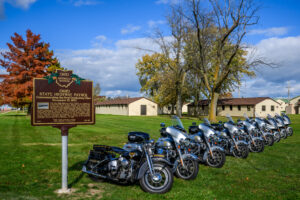
The Ohio State Highway Patrol (OSHP) was created by Ohio House Bill 270 in 1933. Over 5,000 applications to join the newly formed Division were trimmed and approximately 125 individuals — between the ages of 24 and 40 years — were admitted into the inaugural cadet class. The Ohio National Guard graciously volunteered the use of their facilities on Lake Erie’s shores. Colonel Lynn Black, the first OSHP superintendent, opened “Camp Perry School” on October 3, 1933. Although 54 new motorcycles were purchased for patrol duties, many of the cadets lacked motorcycle experience and had to be trained quickly. Severe weather shortened the training as cadets endured frigid temperatures and unheated facilities. The first class of 60 uniformed patrolmen were sworn in on November 15, 1933.