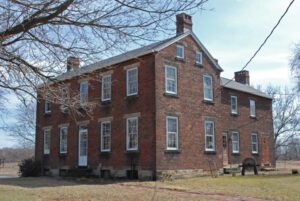
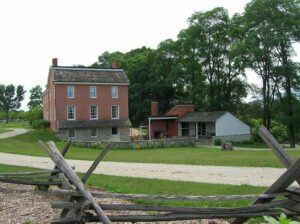
Maple-Dell was the home of John Butler, a Quaker who expressed his religious faith by working for humanitarian causes. An early Goshen Township teacher, Butler opened his home to orphans, the homeless, and runaway slaves, and devoted 20 years of his life to support the Freedman’s Camps for former slaves. One of the many individuals he sheltered was Edwin Coppock who was hung along with abolitionist, John Brown, after the raid on Harper’s Ferry in 1859. Butler met with President Lincoln and Secretary of War, Edwin Stanton in 1862 to request exemption from military service for Quakers during the Civil War. In 1868, President Grant petitioned the churches to assist in organizing a peace policy for the Indians. Butler prepared and presented to Congress a proposal for treating the Indians humanely including providing them with scientific and industrial education.
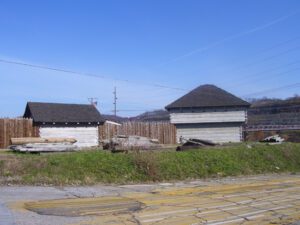
In 1787, the construction of Fort Steuben was completed by Captain John Francis Hamtramck and soldiers of the 1st American Regiment, who were sent to the frontier by the United States government to remove illegal squatters and protect government surveyors from American Indian raids. The surveyors were platting the First Seven Ranges of the Northwest Territory. The surveyed land was sold for settlement or offered to soldiers as payment for military service during the Revolutionary War. Consequently, the states of Ohio, Illinois, Indiana, Michigan, and Wisconsin were formed from the settlement of the Northwest Territory. Fort Steuben was named after Baron Frederich Wilhelm Augustus Steuben, who had served in the Revolutionary War and from which the town derived its name. Captain Hamtramck abandoned the fort in 1787 by order of Colonel Josiah Harmar, and by 1790 the remains of the fort had disappeared. Fort Steuben has been reconstructed on its original location.
Near intersection of Old Springfield Pike and US 68
Xenia
, OH
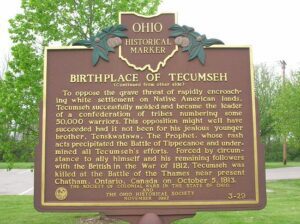
The great Native American Shawnee leader, Tecumseh, was born on the bank of a large spring at this site in 1768, at the very instant that a great meteor seared across the skies. The birth occurred while his parents, Shawnee war chief, Pucksinwah, and his wife, Methotasa, were en route from their village of Kispoko Town, on the Scioto River, to a major tribal council at the Shawnee tribal capital village of Chalahgawth (Chillicothe – now Oldtown), which was located “two arrow flights” northwest of this site. Though prohibited by tribal tradition from becoming chief of the Shawnees, Tecumseh rose to become one of the greatest warriors, orators, and military strategists of any tribe in America.
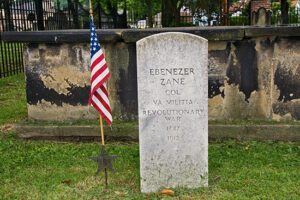
The Walnut Grove Cemetery is the burial place of members of the Zane and Martin families. Their graves lie within the brick enclosure. The cemetery is also the resting-place of many early Martins Ferry residents, including veterans of the Revolutionary War, the War of 1812, the Mexican War, and the Civil War. The Zane and Martin families were significant in the pioneer history of the region. Betty Zane’s legendary heroism at Fort Henry (now Wheeling, West Virginia) helped settlers resist an attack by the British and their Native American allies in September 1782. (Continued on other side)
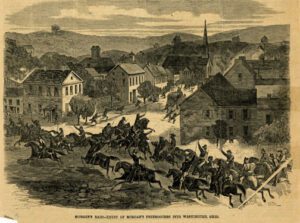
During the summer of 1863, General John Hunt Morgan, a Confederate cavalry leader from Kentucky, invaded southern Ohio with 2,460 mounted men. Throughout the campaign Morgan’s men plundered and looted before being captured by Union forces. On July 17, Morgan led his troops into Wilkesville stealing horses, sacking stores, and robbing private citizens. That night Morgan and some of his troops took lodging and meals with his first cousin Ruth Virginia Althar Cline and her husband Dr. William Cline. Morgan’s troops camped near the house of John and Elzia Levis where Elzia cooked for the men for fear they would harm her family. Additional soldiers of the raiding party stayed on the village square. Legend has it that while Morgan slept at the Cline Mansion, his black servant stole his looted money, and abolitionists Dr. Cline and Abraham Morris, helped him escape to freedom on the Underground Railroad.
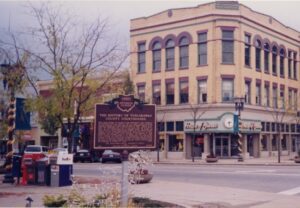
When David Knisely, the founder of New Philadelphia, first arrived in the Tuscarawas Valley on August 27, 1803, he found a sparsely populated, pristine wilderness. Five years later the state legislature approved a bill organizing Tuscarawas County effective March 15, 1808. Shortly thereafter, New Philadelphia was chosen as the county seat, and on April 16, 1808, the first commissioners met at Leininger’s tavern. By August, the tavern proved to be an inappropriate location for the county’s official business, and the commissioners approved the construction of a two-story, combination jail and county office building on land donated by John Knisely on the northeast corner of the square. By 1818 a new, larger brick courthouse was authorized by the commissioners. This building was occupied in 1825 and served as the courthouse until 1882 when the present structure was approved. Occupied in 1888, the building continues to be the center of the county’s business. The beautiful, state-of-the-art annex was dedicated on October 27, 1990.
The completion of the Wabash and Erie Canal on July 4, 1843 brought many new settlers into this region. The Wabash and Erie Canal connected with the Miami and Erie Canal at Junction. Antwerp, ideally located on the Maumee River, was seen as a perfect place in which to establish a town. That same year surveyors W. Wilshire Riley and Samuel Rice platted what would become Antwerp. Naming rights belonged to Riley and storeowner Horatio N. Curtis, who wanting a name not duplicated anywhere else in the country, named it after Antwerp, Belgium. Early pioneers subdued the massive forests that once formed the “Black Swamp” and built a thriving city. Antwerp was incorporated in 1863. (continued on other side)
Beginning in 1794, Colonel Johnston was a prominent Mason for 66 years. While serving as secretary of Washington lodge No. 59, F. & A. M. (Philadelphia), he was delegated to participate in President George Washington’s Masonic funeral. Colonel Johnston became a member of Warren Lodge No. 24, F. & A.M., in Piqua in 1843. He was buried with military and Masonic honors in the family cemetery on February 23, 1861. [Masonic Emblem]