

, OH
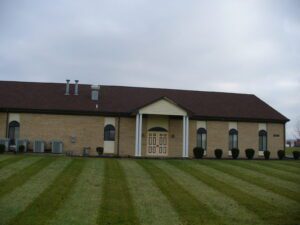
The Jain Center of Cincinnati and Dayton was established on April 22, 1979 as a non-profit tax-exempt organization under the laws of the United States and the State of Ohio. The foundation stone of the Jain temple, the first of its kind in Ohio, was laid down on August 21-22, 1994. The temple was dedicated on September 2 – 4, 1995 when more than one thousand people from all over Ohio and many other states participated in holy rituals to install three idols of Jinas (Gods). The Jain Center is a place for the teaching of non-violence, reverence for life, and compassion for all beings. The center was the home of the twelfth biennial convention for the Federation of Jain Associations in North America, which was held on July 3 – 6, 2003. (Continued on the other side)
, OH
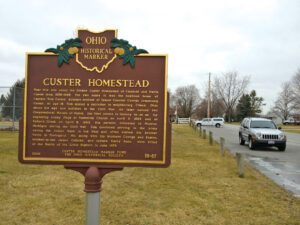
Near this site stood the former Custer Homestead of Emanuel and Maria Custer from 1856-1865. For two years it was the boyhood home of Captain Tom Custer, younger brother of famed General George Armstrong Custer. At age 16, Tom misled a recruiter in neighboring Gilead, Ohio about his age and enlisted in the Civil War. He later earned two Congressional Medals of Honor, the first person in history to do so, for capturing enemy flags at Namozine Church on April 3, 1865 and at Sailor’s Creek on April 6, 1865. His parents relocated to Monroe, Michigan during the Civil War. Tom continued serving in the Army during the Indian Wars in the West and often visited his brother Nevin in Tontogany. He, along with his brothers George and Boston, brother-in-law James Calhoun, and nephew Harry Reed, were killed at the Battle of the Little Bighorn in June 1876.
, OH
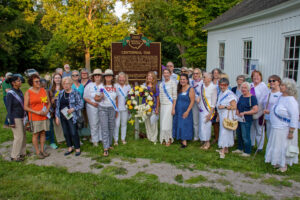
The Newbury Woman Suffrage Political Club, headquartered at Union Chapel, planted the Centennial Oak on July 4, 1876. The White Oak (Quercus alba) was chosen for its endurance, longevity, and beauty. The picnic and planting celebration included speeches, songs, fireworks, and a poem dedicated to the Oak written by local suffragist Anna Green. As the club gained national recognition, it attracted such notable suffragists as Susan B. Anthony and Harriet Taylor Upton as visitors and speakers. A Newbury gathering on August 23, 1919, held to celebrate Ohio’s recent ratification of the 19th Amendment, included suffragists Upton and Frances Jennings Casement. The last living founding member of Newbury’s Woman Suffrage Club, Dr. Julia Porter Green, led a parade from the chapel to Centennial Oak. There she placed a wreath of evergreen and goldenglow upon the tree.
, OH
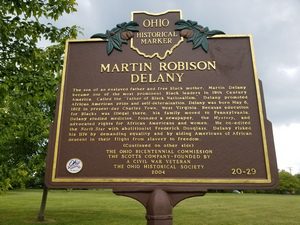
The son of an enslaved father and free Black mother, Martin Delany became one of the most prominent Black leaders in 19th Century America. Called the “Father of Black Nationalism,” Delany promoted African American pride and self-determination. Delany was born May 6, 1812 in present-day Charles Town, West Virginia. Because education for Blacks was illegal there, his family moved to Pennsylvania. Delany studied medicine, founded a newspaper, the “Mystery,” and advocated rights for African Americans and women. He co-edited the “North Star” with abolitionist Frederick Douglass. Delany risked his life by demanding equality and by aiding Americans of African descent in their fight from slavery to freedom. (Continued on other side)
, OH
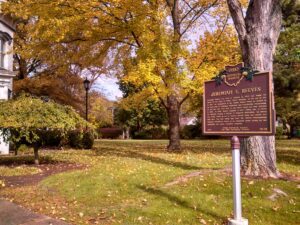
Jeremiah Reeves was born in England in 1845 and began his career in the mills of Wales, United Kingdom, at the age of ten. In 1867, he immigrated to the United States where he worked in the steel mills of Cleveland, Pittsburgh, and Connellsville, Pennsylvania. He met his wife Jane Rees in the latter place and they married in 1869. In 1883, Reeves acquired a steel rolling mill in Dover for $14,000. Despite a history of financial difficulties, the Reeves Iron Works would go on to expand several times and employ over 800 men. The iron works and later the Reeves Manufacturing Company established Dover as an industrial center during the late nineteenth and early twentieth centuries.
, OH
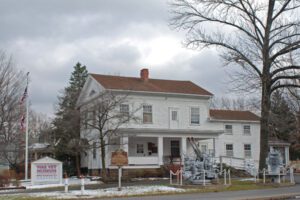
The Canfield War Vet Museum was chartered in 1988 by American Legion Post 177 and Ladies Auxiliary to collect and preserve items and history from American wars. The building that houses the museum was built in 1809 by Comfort S. Mygatt, a Revolutionary War veteran, and later, passed through several generations of the Church family. Colonel James Madison Nash, a Civil War officer, lived here for a time, giving the house its nickname, “The Colonel’s House.” The structure stands as the oldest building in Canfield on its original site. The carding barn on the rear of the property was built in 1810 to process sheep wool. The Wall of Honor at this site honors war veterans, in particular, the Revolutionary War veterans interred in Canfield cemeteries and the 18 Canfield men who lost their lives in World War II.
, OH
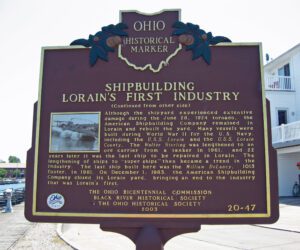
Lorain’s shipbuilding industry began when Augustus Jones and William Murdock began constructing wooden sailing vessels on the west side near the mouth of the Black River. The sloop General Huntington was the first boat launched from Lorain in 1819. In 1897, the shipbuilding industry moved to the east side of the river with the establishment of the Lorain yard of the Cleveland Shipbuilding Company, the precursor of the American Shipbuilding Company. In 1898, they were the largest dry dock on the Great Lakes. On April 13, 1898, the first steel ship, the Superior City, was launched. At the time, it was the largest vessel on fresh water. During the early years well-known passenger ships, railroad car ferries, tankers, self-unloaders, tugs, and barges were built here.
, OH
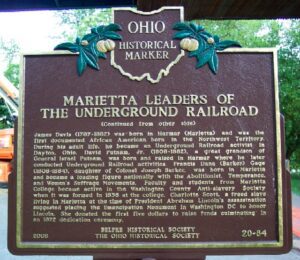
People living in Marietta and along the Muskingum River shared a history of slavery opposition. Manasseh Cutler, from Massachusetts and an Ohio Land Company agent, helped draft the Ordinance of 1787 that prohibited slavery in the Northwest Territory. General Rufus Putnam, Captain Jonathan Stone, and other Ohio Land Company Revolutionary War veterans, founded Marietta at the mouth of the Muskingum River in 1788 bringing with them their anti-slavery sentiments. A proposal to legalize slavery in the proposed state of Ohio was vetoed largely due to the efforts of Marietta’s Ephraim Cutler and General Putnam at the 1802 Ohio Constitutional Convention. These conditions were precursors toward the formation of the Underground Railroad as fugitive slaves crossed the Ohio River seeking freedom. From 1812 through 1861, large numbers of fugitive slaves fleeing toward Canada, were aided by descendants of early settlers who operated Underground Railroad Stations along the Muskingum River. (Continued on other side)