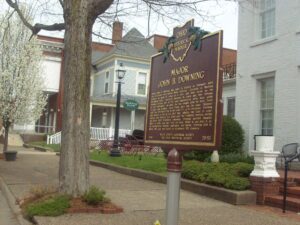
Major John B. Downing was born in Rutland in February 1834, son of Rodney and Marian Black Downing. Educated at Marietta College, he spent 27 years as a pilot and boat owner on the Mississippi River, operating between St. Louis and New Orleans. Downing became one of the most experienced river boat pilots on the Mississippi. As such, he was sought after by Mark Twain to teach him piloting. Later Twain gave him the name “Alligator Jack” and referenced him in his book Life on the Mississippi. Downing also played a role in the Civil War, piloting the fleet in cooperation with General U.S. Grant past the Vicksburg fortress during the famed 1863 Vicksburg Campaign. Downing married Romaine Miller in 1868, and they had two sons, Miller R. and John B. Jr. An accomplished violinist, marksman, and hunter, Downing died in March 1914 and was buried in Middleport Hill Cemetery.
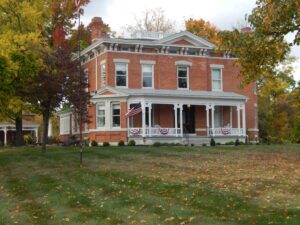
Built of bricks of clay from the Little Miami River, the King Mansion has stood majestically overlooking the town of Kings Mills since 1885. The home of industrialist Ahimaaz King and the first house in Kings Mills, this 12-room, three-story Italianate-style house is crowned with a widow’s walk and features stained-glass windows, distinctive fireplaces, and a tack room. The carriage house included a milking operation for cows on the lower level, stables on the main level, and carriage storage on the upper level. A cast iron fountain in the yard gave the name “Fountain Square” to the area. Occupied by three generations of Kings until 1988, the mansion was added to the National Register of Historic Places in 2008 and is a reminder of Ahimaaz King’s importance to the history of Kings Mills.
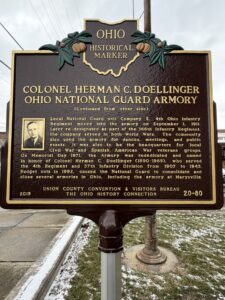
The Marysville Ohio National Guard Armory was the first such armory constructed in the state after the recognition of the Guard in 1909. The new armory and others like it were built in response to federalization of National Guard units after the passage of the Militia Act of 1903. Armory buildings served as the headquarters for local companies and provided drill rooms and arsenals for the storage of military equipment and supplies. Architect Charles Insco Williams designed Marysville’s armory and it was built by James Laughlin, both of Dayton, Ohio. Marysville contractor George W. Fox provided the brickwork for the structure. Construction began in 1910 and was completed in 1911 at a cost of $19,886. (Continued on other side)
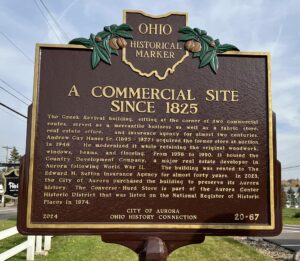
James Willard Converse (1806-1892) opened his store in 1825 at 10 South Chillicothe Road. Serving residents, merchants, and travelers, the store proved central to Aurora’s early commercial development. Converse’s Daybook survives as a glimpse into the habits of early citizens, who, along with household items, regularly purchased whiskey. Surprisingly, such sales surged on George Washington’s February 22 birthday. Converse deeded the business to employee Seth A. Gillett in 1834. Hopson Hurd Sr. (1793-1869) purchased it from Gillett in 1845. Hurd’s store was popular with local farmers who used their home made cheese as legal tender and enjoyed the barrel of whiskey kept in Hurd’s basement for customers who paid their bills. Hurd added a cheese warehouse to his store and, as a major exporter of cheese to Cleveland, Warren, and Pittsburgh, amassed a sizeable fortune.
The Fugitive Slave Act of 1850 prompted an expansion of the “Underground Railroad,” and as the state spanning the shortest distance between the Ohio River and Canada, Ohio saw heavy traffic in escaping slaves in the decades before the Civil War. Hancock County was home to many sympathetic residents who defied fugitive slave laws to help conduct slaves to freedom. “Stationmasters” offered safe havens, “conductors” accompanied fugitives through the county, and “stockholders” provided financial support and misled pursuers. Known stations were located mainly along the Perrysburg Road, now U.S. Highway 68. (continued on other side)
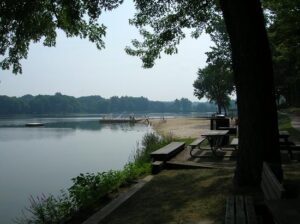
Silver Lake was previously known as Wetmore’s Pond, named for Judge William Wetmore, an agent for the Connecticut Land Company. In 1808, Wetmore built a cabin overlooking the spring-fed lake, which was then a part of Portage County. Local lore records his friendship and conscientious dealings with the Native Americans, likely Seneca, who inhabited a populous village between the lake and the Cuyahoga River. The tribe left the area to join the British during the War of 1812, but later sided with the United States.
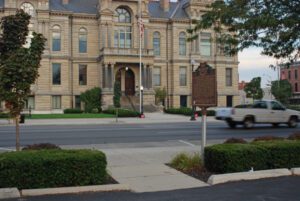
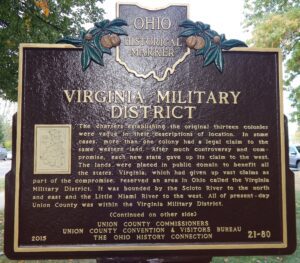
The charter establishing the original thirteen colonies were vague in their descriptions of location. In some cases, more than one colony had a legal claim to the same western land, After much controversy and compromise, each new state gave up its claim to the west. The lands were placed in public domain to benefit all the states. Virginia, which had given up vast claims as part of the compromise, reserved an area in Ohio called the Virginia Military District. It was bounded by the Scioto River to the north and east and by the Little Miami River to the west. All of present-day Union County was within the Virginia Military District. (Continued on other side)
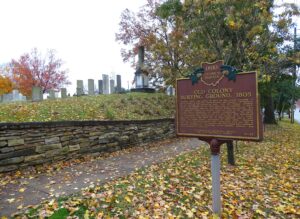
Granville, Ohio, was settled in 1805 by the Licking Company, a group formed in Granville, Massachusetts, and Granby, Connecticut, for the purpose of emigrating west. The Old Colony Burying Ground was defined on the first town plat of Granville in 1805. Many of Granville’s pioneers are interred within this ground, and the cemetery retains its original form and most of its westward facing rows of sandstone and marble gravestones. The early settlers buried here helped to lay out this town and determined the appearance and development of the village as it is today. The first burial, the infant son of Ethan Bancroft, was in April 1806. The oldest extant gravestone is dated 1808. Eighteen veterans of the Revolutionary War, thirty-nine from the War of 1812, and sixteen Civil War veterans rest here along with ministers, farmers, industrialists, physicians, young mothers, children, and other citizens of Granville.