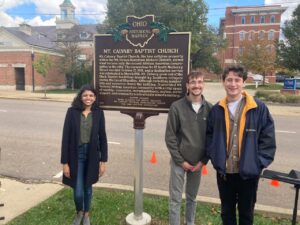
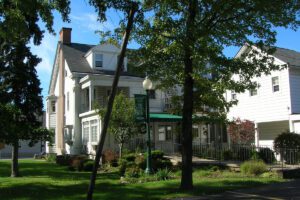
Mt. Calvary Baptist Church, the lone religious property within the Mt. Vernon Downtown Historic District, served what became only the second African American congregation in the city. The cornerstone for 13 South Mulberry Street was laid October 17, 1915, and a dedication service was celebrated in March 1916. Mt. Calvary grew out of the Black Baptist traditions brought by Southern refugees during the Great Migration. Although dwindling membership and resources closed the building, it provided Mt. Vernon’s African American community with a vital space of worship, communion, mutual assistance, asylum, social support, and community celebration for almost a century.
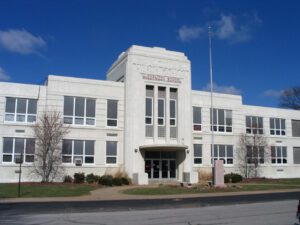
Ohio’s oldest continuing summer theatre, the Huron Playhouse has been housed at McCormick Middle School for its entire history. Dr. Frederick G. Walsh (1915-1999) of the Bowling Green State University (BGSU) Speech Department founded the theatre in 1949. Huron met Walsh’s expectations for an attractive site for the playhouse, and Huron Schools Superintendent R.L. McCormick (1904-1978) offered the use of this school. The curtain opened on the first Huron Playhouse production, Norman Krasna’s hit Broadway comedy John Loves Mary, on June 29, 1949. With persisting support from BGSU, actors and alumni, and the local community, the acclaimed Playhouse has provided theatrical experience for thousands of students and entertainment for generations of Huron residents.
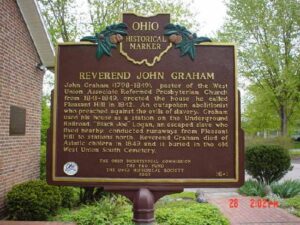
John Graham (1798-1849), pastor of the West Union Associate Reformed Presbyterian Church from 1841-1849, erected the house he called Pleasant Hill in 1842. An outspoken abolitionist who preached against the evils of slavery, Graham used his house as a station on the Underground Railroad. “Black Joe” Logan, an escaped slave who lived nearby, conducted runaways from Pleasant Hill to stations north. Reverend Graham died of Asiatic cholera in 1849 and is buried in the old West Union South Cemetery.
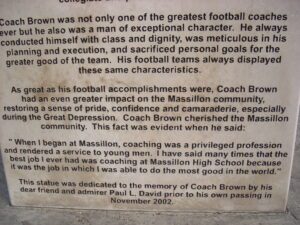
Paul E. Brown, born September 7, 1908 in Norwalk, Ohio, and raised in Massillon, is a member of the Professional Football Hall of Fame and was one of the greatest coaches in the history of football at all levels. From 1932 until 1940, he led Massillon High School to a record of 80-8-2. He coached Ohio State to the 1942 national collegiate championship, and joined the professional football ranks in 1946 as coach of the new franchise in Cleveland. He coached his namesake Cleveland Browns to seven league championships in 17 seasons.
Monteith Hall was built in 1835 as the residence of Reverend John Monteith (1788-1868) and family. Before coming to Elyria as the first superintendent of the new high school, Rev. Monteith was an educator and minister in Detroit, Michigan. He was instrumental in founding the University of Michigan, originally located in Detroit, and became its first president. William Gates, Rev. Monteith’s grandson, enlarged Monteith Hall in 1897. Monteith Hall was a station on the Underground Railroad on the route that extended from Oberlin. A tunnel, which ran from the basement of the home to the Black River, was used to help slaves escape to the shore of Lake Erie. Rev. Monteith managed the network on the southern shore of Lake Erie, and aided fugitive slaves in boarding ships to cross the lake to Canada.
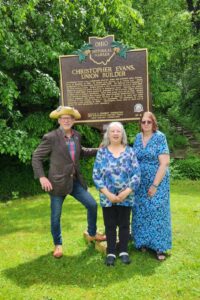
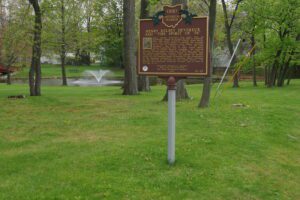
Christopher Evans was a celebrated district, state, and national union builder. Born in England in 1841, he began coal mining as a young boy. Evans immigrated to Pennsylvania around 1869-1870. By 1874 he was president of his local mining union. Evans moved to New Straitsville between 1875-1877, where he organized union meetings in Robinson’s Cave. During the miners’ strike of 1884-1885, Evans served as president of the Hocking Valley District of Ohio and its Relief Committee. After area mines were set on fire, miners were forced to abandon New Straitsville when its mines closed forever. Evans helped organize the United Mine Workers of America in 1890 and later authored a two-volume history of the movement. He remained in union leadership until retiring in 1908. Christopher Evans died in 1924 and is buried in New Straitsville Joint Cemetery.
Henry Kelsey Devereux was born into an aristocratic family on October 10, 1859 in Cleveland, Ohio. Ohio artist, Archibald Willard, chose Harry, as he was fondly known, to portray the drummer boy in one of America’s most famous patriotic paintings, “The Spirit of ’76”. At the time Willard approached him to pose, young Harry was a cadet at Brooks Military Academy. He married socialite Mildred French in 1885 and in 1910 they settled in her father’s pretentious country estate in Wickliffe, Ohio (presently Telshe Yeshiva College). His passion for harness racing and for breeding horses culminated in the organization of the American Association of Trotting Horse Breeders and his position as president of the Grand Circuit. The affluent and charitable Wickliffe resident died in 1932 at the age of 72.
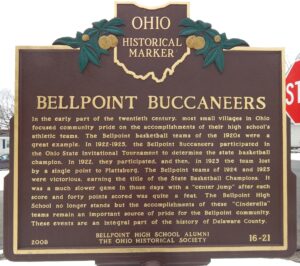
In the early part of the twentieth century, most small villages in Ohio focused community pride on the accomplishments of their high school’s athletic teams. The Bellpoint basketball teams of the 1920s were a great example. In 1922-1925, the Bellpoint Buccaneers participated in the Ohio State Invitational Tournament to determine the state basketball champion. In 1922, they participated, and then, in 1923 the team lost by a single point to Plattsburg. The Bellpoint teams of 1924 and 1925 were victorious, earning the title of the State Basketball Champions. It was a much slower game in those days with a “center jump” after each score and forty points scored was quite a feat. The Bellpoint High School no longer stands but the accomplishments of these “Cinderella” teams remain an important source of pride for the Bellpoint community. These events are an integral part of the history of Delaware County.