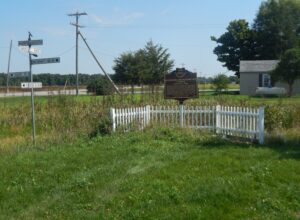
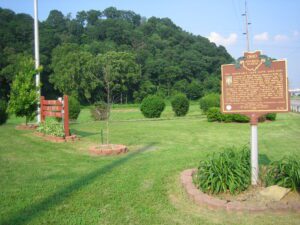
On this site, the Miami and Erie Canal, that came north from Cincinnati and the Ohio River, intersected with the Wabash and Erie Canal that came from Fort Wayne and Evansville, Indiana. From this point, which became the town of Junction, the canals proceeded as one to Defiance, Toledo, and Lake Erie. From the 1830s to the 1870s, the canals played a key role in the settling of Paulding County, an area that was once a part of the Great Black Swamp. They held the promise of easier and quicker passenger transportation and commodity shipping and Junction became a landmark for fugitive slaves escaping to Canada. Once a thriving and growing community, the village of Junction became a forgotten historical note with the passing of the canal era and the coming of the railroads. Today, the Buckeye Trail and North County Trail follow the canal path through Paulding County.
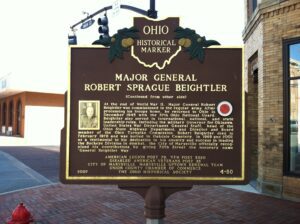
Robert Sprague Beightler was born in 1892 in Marysville. A graduate of Marysville High School, he began his career as a soldier in 1911, when he enlisted as a private in Marysville’s guard unit, Company E, Fourth Ohio Infantry Regiment. He served in Mexico from 1916-1917, World War I from 1917-1919, and World War II from 1940-1945. From his stint with the Ohio Infantry, he rose in rank to command the famous 37th Ohio National Guard Buckeye Division as Major General during WWII. Beightler was one of the most successful National Guard Generals and the only National Guard General to lead his troops through both training and combat in WWII. He was with his troops through 700 days of fighting in the South Pacific Theater. Fighting occurred on Bougainville Island and in the islands of New Georgia and the Philippines. (Continued on other side)
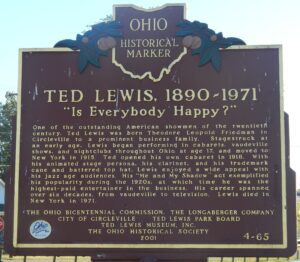
One of the outstanding American showmen of the twentieth century, Ted Lewis was born Theodore Leopold Friedman in Circleville to a prominent business family. Stagestruck at an early age, Lewis began performing in cabarets, vaudeville shows, and nightclubs throughout Ohio at age 17, and moved to New York in 1915. Ted opened his own cabaret in 1918. With his animated stage persona, his clarinet, and his trademark cane and battered top hat, Lewis enjoyed a wide appeal with his jazz age audiences. His “Me and My Shadow” act exemplified his popularity during the 1920s, at which time he was the highest-paid entertainer in the business. His career spanned over six decades, from vaudeville to television. Lewis died in New York in 1971.
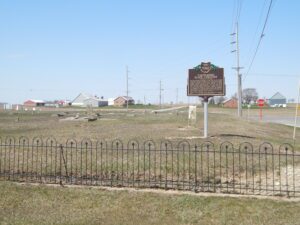
The Carthagena Black Cemetery (Union Cemetery) is a remnant of approximately 70 documented rural black and mulatto settlements established in Ohio before the Civil War. In the charged atmosphere following race riots in Cincinnati in 1829, Quaker abolitionist Augustus Wattles led 15 black families north in 1835. In 1837 Wattles purchased 189 acres where the cemetery is located. Headstones date from 1840, the year mulatto Charles Moore, platted the Village of Carthagena. Wattles and mulatto clergymen Sam Jones and Harrison Lee were Underground Railroad conductors. Wattles moved to Kansas in 1855. By 1860, more than 100 black and mulatto families, totaling 600 people, owned over 10,000 acres. (Continued on other side)
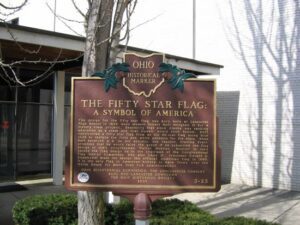
The design for the fifty star flag was born here at Lancaster High School in 1958 when student Robert Heft designed it for a history class project. Reasoning that since Alaska was seeking admission as a state and that Hawaii would soon follow, Heft constructed a fifty star flag from an old 48-star flag using blue cloth to replace the field and white adhesive for the stars. When Heft received a B- on his project, his teacher, Stanley Pratt, promised that he would raise the grade if he submitted the flag design to their congressman, Walter Moeller. Moeller in turn passed the flag design on to the chairman of the Congressional Flag Design Committee, who also liked it. President Dwight D. Eisenhower made the design the official American flag in 1960. It is the only flag in American history to have flown over the White House for more than five administrations.
Colonel John J. Voll from Goshen, Ohio, was the highest scoring ace of the 15th U.S. Army Air Force in the Mediterranean theater of World War II. As a Captain flying a P-51 Mustang fighter plane, he was credited with twenty-one aerial victories. His superior skill in one particular battle enabled him to maneuver three enemy aircraft into crashes without firing a shot. On a separate mission, while flying solo, Captain Voll had four confirmed kills, two probables, and damaged two additional enemy planes. (continued on other side)
A native of New Boston, Vernal G. Riffe Jr. served the 92nd House District in the Ohio General Assembly from 1959 to 1994. As Speaker of the Ohio House of Representatives from 1974 through 1994, he served longer than any other speaker in the state’s history. Widely regarded as Ohio’s most influential legislator of the late 20th century, Riffe, a Democrat, built effective political alliances across party lines. A powerful advocate for southern Ohio, he was instrumental in the growth and expansion of Shawnee State University.
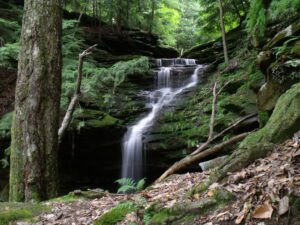
Hemlock Falls is located nearby. Two small streams cascade down the face of the massive sandstone cliff in the shade of tall hemlock trees. One of the falls drops about 60 feet and the other about 100 feet. The rock is Black Hand Sandstone deposited in the deltas along the great salt-water sea during the Mississippian Period about 350 million years ago. The cliffs were created later and were produced by erosion along the side of the valley of the ancient pre-glacial Groveport River. One large slump block, which has separated from the rock wall by weathering, may be the largest in Ohio. Plants more typical of the Appalachian Plateau and rare to Richland County can be found in this area. The ecosystem is typical of that found at the past edge of a glacier.