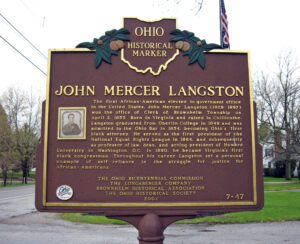
The first African-American elected to government office in the United States, John Mercer Langston (1829-1897) won the office of Clerk of Brownhelm Township on April 2, 1855. Born in Virginia and raised in Chillicothe, Langston graduated from Oberlin College in 1849 and was admitted to the Ohio Bar in 1854, becoming Ohio’s first black attorney. He served as the first president of the National Equal Rights League in 1864, and subsequently as professor of law, dean, and acting president of Howard University in Washington, D.C. In 1890, he became Virginia’s first black congressman. Throughout his career Langston set a personal example of self-reliance in the struggle for justice for African-Americans.
John “Appleseed” Chapman (b. September 26, 1774—d. March 18, 1845) was the first lessee of this 160 acre tract (NW 1/4, S 20, T 20, R 16), when he secured it for 99 years from the Virginia Military District School Lands on April 10, 1815. This $320 lease complied with the Ordinance of 1785 which stipulated that proceeds from the sale or lease of a 36th of all new land in the Northwest Territory be used to support public education. Perrysville author, Rosella Rice, knew Appleseed. In a history of Ashland County, she wrote, “One of his nurseries is near us and I often go to the secluded spot on the quiet banks of the creek [Blackfork]…with sod never broken since the old man did it.” Attributed as Green Township’s first permanent settler, Abram Baughman’s original 160 acres (c. 1807) adjoined this property to the west.
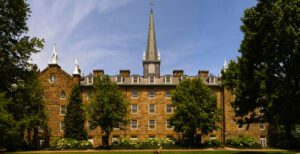
The state’s oldest private institution of higher education, Kenyon College was founded in 1824 in Worthington by Philander Chase, first Episcopal bishop of Ohio, and relocated to Gambier four years later. Both college and village are named for British benefactors, statesman Lord Kenyon and naval hero Lord Gambier. Throughout its history, Kenyon has prepared men and women for leading roles in society, including nineteenth-century graduates Edwin M. Stanton, Abraham Lincoln’s secretary of war, and Rutherford B. Hayes, Ohio governor and U.S. president. In the twentieth century, Kenyon educated such literary luminaries as poet Robert Lowell and novelist E.L. Doctorow. Kenyon has also been an innovator in education-the Advanced Placement Program began as the Kenyon Plan in the 1950s.
The history of New Knoxville provides one of the best examples of chain migration to America. After the Shawnee were removed from what would become Auglaize County, James Knox Lytle, cousin to James Knox Polk, purchased land in Washington Township. Lytle platted a village of 102 lots in 1836, calling it Knoxville to honor his mother’s family. Meanwhile, newly married Wilhelm and Elisabeth Fledderjohann Kuckhermann (later Kuck) immigrated from Ladbergen in northwest Germany. Having missed their boat to St. Louis, the couple lived briefly in Stallostown (Minster) and Bremen (New Bremen). They wrote home, encouraging others to emigrate; in the summer of 1835 the Fledderjohanns (Elisabeth’s family), Meckstroths, and Lutterbecks arrived. The families bought land near the site of Knoxville. (continued on other side)
The Putnam County Pioneer Association was organized September 6, 1873, at a meeting in Kalida, Ohio. Its stated purpose was to “perpetuate the early history of our county.” Members gathered oral histories from early residents and published two volumes of Pioneer Reminiscences in 1878 and 1887. The all-day annual meeting, held every year in September, grew into a larger festival. In 1970, the Kalida Lions Club, with funds generated from the event, purchased the former Kalida Methodist Church at 201 E. Main Street and “sold” it for $10 to the Pioneer Association for use as a museum. The Pioneer Association adopted a revised constitution and changed its name to The Putnam County Historical Society in 1971. It continues to hold its annual meeting during the “Pioneer Days” weekend.
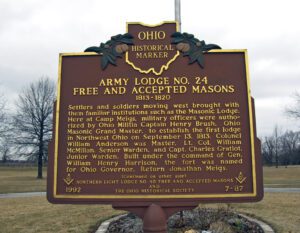
Settlers and soldiers moving west brought with them familiar institutions such as the Masonic Lodge. Here at Camp Meigs, military officers were authorized by Ohio Militia Captain Henry Brush, Ohio Masonic Grand Master, to establish the first lodge in Northwest Ohio on September 13, 1813. Colonel William Anderson was Master, Lt. Col. William McMillan, Senior Warden, and Capt. Charles Gratiot, Junior Warden. Built under the command of Gen. William Henry Harrison, the fort was named for Ohio Governor, Return Jonathan Meigs.
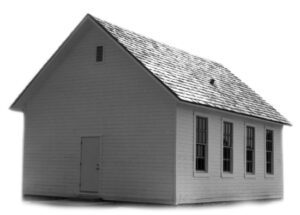
Descendants of slaves, who may have reached Ohio through the Underground Railroad, and other African Americans, formed the community of Flatwoods in the southwest part of Bokescreek Township. This one-room schoolhouse was built circa 1868 for African American children of Flatwoods and remained open until 1923. Remnants of past lessons remain inscribed on the chalkboard. The schoolhouse was threatened with demolition in 1999 and later moved to Veteran’s Park. The Logan County Historical Society owns and maintains the site as a living history museum.
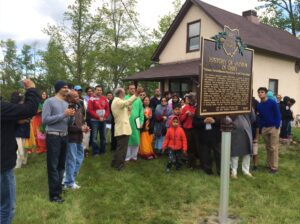
The Jain Center of Central Ohio was established on May 12, 1991. The foundation stone of the Jain temple, the first of its kind in Central Ohio, was laid down on October 15-16, 2011. The temple was dedicated on July 19-23, 2012. More than 1,000 people from all across Ohio, many other states and India particpated in holy rituals to install deities of Jina (translated as “spirital victors” and God). Following the rituals, the temple was opened for regular worship. The Jain Center is a place for the teaching on non-violence, reverence for life and compassion for all beings. The Jain principle of karma states, “As you sow, so shall you reap.”