

, OH
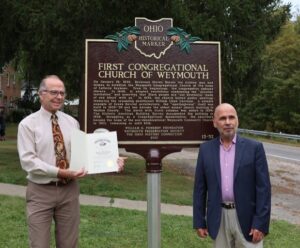
On January 19, 1835, Reverend Steven Barnes led sixteen men and women to establish the Weymouth Congregational Church at the home of Lathrop Seymour. From its beginnings, the congregation opposed slavery. In 1848, it adopted resolutions condemning the “peculiar institution” and asserting that Black people are “our brother[s] ‘made one blood’ with us.” In 1853, the church hosted public meetings featuring the crusading abolitionist William Lloyd Garrison. A notable example of Greek Revival architecture, the “meetinghouse” itself was built in 1835-’36 and has become the oldest extant church building in Medina County. The porch with Doric columns was added in 1854. The Historical American Building Survey documented the building in 1936. Struggling as a Congregational denomination, the sactuary became the home of the non-denominational Weymouth Community Church in 1920, remaining so until 2018.
, OH
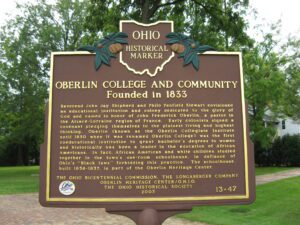
Reverend John Jay Shipherd and Philo Penfield Stewart envisioned an educational institution and colony dedicated to the glory of God and named in honor of John Frederick Oberlin, a pastor in the Alsace-Lorraine region of France. Early colonists signed a covenant pledging themselves to the plainest living and highest thinking. Oberlin (known as the Oberlin Collegiate Institute until 1850 when it was renamed Oberlin College) was the first coeducational institution to grant bachelor’s degrees to women and historically has been a leader in the education of African Americans. In fact, African American and white children studied together in the town’s one-room schoolhouse, in defiance of Ohio’s “Black laws” forbidding this practice. The schoolhouse, built 1836-1837, is part of the Oberlin Heritage Center.
, OH
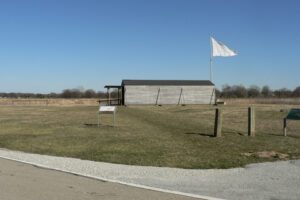
Huffman Prairie Flying Field, a unit of the Dayton Heritage National Historical Park, is the site where Wilbur and Orville Wright flew and perfected the world’s first practical airplane, the 1905 Wright Flyer III, after their first flights in Kitty Hawk, North Carolina in 1903. The Wright brothers mastered the principles of controlled, powered flight at Huffman Prairie during 1904 and 1905. From 1910 to 1915, they operated the Wright School of Aviation here, training many of the world’s first pilots, including many military pilots.
, OH
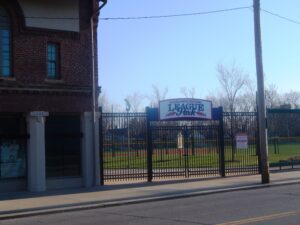
League Park opened on May 1, 1891, with the legendary Cy Young pitching for the Cleveland Spiders in their win over the Cincinnati Redlegs. The park remained the home of Cleveland’s professional baseball and football teams until 1946. In 1920 the Cleveland Indians’ Elmer Smith hit the first grand slam home run, and Bill Wamby executed the only unassisted triple play, in World Series history. Babe Ruth hit his 500th home run over the park’s short right field wall in 1929. With the park as home field, the Cleveland Buckeyes won the Negro World Series in 1945.
, OH
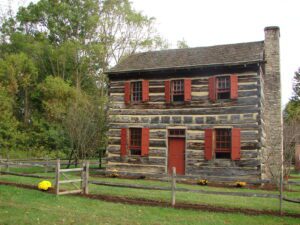
Zachariah Price DeWitt was born of a Dutch family in New Jersey in 1768. With brothers Jacob and Peter, he migrated to Kentucky where, in 1790, he married Elizabeth Teets, who was born in Pennsylvania in 1774. By 1805 all three brothers had settled in Ohio near Four Mile (Talawanda) Creek. Here Zachariah and Elizabeth raised corn, hogs, and eventually, nine children. Zachariah became a prominent community leader, operating a sawmill, building houses in Oxford, serving as Masonic Lodge secretary, and commanding a rifle company during the War of 1812. Tradition has it that Elizabeth wore a black sunbonnet to cover a scar from having been scalped as a child in Kentucky. Elizabeth died in 1843, followed by Zachariah in 1851. Both are buried in Darrtown Cemetery.
, OH
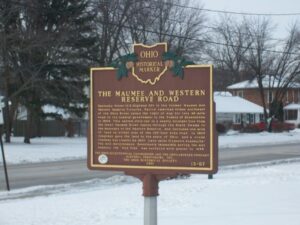
Sandusky Street (U.S. Highway 20) is the former Maumee and Western Reserve Turnpike. Native American tribes northwest of the Ohio River ceded the right of way for this 46-mile road to the federal government in the Treaty of Brownstown in 1808. This narrow strip ran in a nearly straight line from the lower Maumee River rapids through the Black Swamp to the boundary of the Western Reserve, and included one mile of land on either side of the 120-foot wide road. In 1823 Congress gave the land to the state of Ohio, and a crude roadway was cleared by 1827. Land sales financed roadbuilding and maintenance. Notoriously impassible during the wet seasons, the “Mud Pike” was surfaced with gravel in 1838.
, OH
In 1834, ministers gathered at Providence Church in Berlin Crossroads and organized the Providence Anti-Slavery Baptist Association; believed to be both the first African American Baptist Association in Ohio and among the earliest in the country. The Association’s name boldly reflected its stance: opposition to slavery and a commitment to freedom. Several affiliated churches and their members were known Underground Railroad safe houses and conductors. Providence Association grew to include member churches across Ohio—including Athens, Bidwell, Beaver, Blackfork, Burlington, Gallipolis, Glouster, Ironton, Middleport, Nelsonville, Rutland—as well as congregations in West Virginia, Kentucky, and Michigan.
, OH
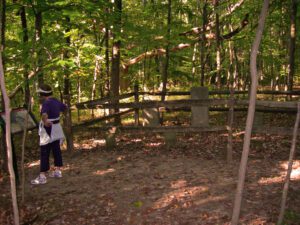
Congress established the United States Military District in 1796 by an act to provide bounty land for Revolutionary War officers and soldiers. District lands consisted of 2.6 million acres in twelve Ohio counties, including Delaware County. The Union Land Company, organized by James Kilbourne of Connecticut in 1806, was formed to purchase Military District land. Kilbourne purchased 4,000 acres in southeast Liberty Township, Delaware County for $7,000, and, in turn, sold the land to 26 Union Land Company members for $2.00 per acre. Five members were from the Case family, and they purchased 950 acres–Ambrose, George, Jonathan, Seth, and Silas. George and Seth were Revolutionary War veterans who did not claim their bounty lands. George purchased lot 11, a part of which is in northwest Highbanks Park today, and Seth purchased 300 acres north of this site. By 1849 the Case family owned over 1,000 acres.