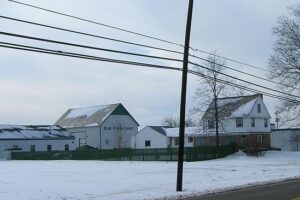
In 1927, Henry Abell, a master plumber, purchased a 100-acre dairy farm. When the Great Depression struck the nation two years later, Abell could find little work as a plumber and decided to develop his dairy farm. In 1934, he and his family began the Dairy, growing the farm to 500 acres and producing enough milk, ice cream, and other dairy products to supply five counties. The dairy closed in 1979, but today houses America’s Ice Cream and Dairy Museum, dedicated to the cultural history of the ice cream and dairy industry in Ohio and the United States.
The historic Law Farm (circa 1846) is situated in a broad valley formed by the confluence of Little Stillwater Creek and Plum Run in Monroe Township. Henry Law (1812-1869) immigrated from Ireland to Ohio in 1830. He married Elizabeth McMillan (1818-1892) in 1839, and they moved to their Monroe Township farm by 1846. The couple had eleven children and raised cattle, sheep, and other crops. By 1860, their farm was one of the most productive in Harrison County. In recognition of its agricultural and Scots-Irish immigration history, the Henry Law Farm Historic District was listed on the National Register of Historic Places in 2002. Its contributing buildings (1846-1920) included: two houses; a summer kitchen; tool, milk, coal, smoke houses; multiple barns; carriage houses; and other outbuildings.
The Plains lay south and west of the Sandusky River, bounded by the Olentangy River on the east and Tymochtee Creek on the west. The local black prairie soils mark the extent of the grasslands, which were uncommon in the dense eastern forests. Bur Oak trees, from the period of the Wyandot Indians, have survived because their thick bark protected them from the common prairie grass fires. This remnant of wilderness–Bur Oak Grove and Tall Grass Prairie–is protected from cultivation, which would destroy most of the native plant species.
4401 Elk Creek Road (intersection of Howe & Elk Roads)
Middletown
, OH
The village of Miltonville, located along the banks of Elk Creek, was platted in 1816 by George Bennett, Theophilus Eaglesfield, and Richard V. V. Crane. The creek served two grist mills, one built around 1804 and operated by a free black, Bambo Harris, and the second was built by George Bennett in 1815. An Indian burial ground was located on the east bank of Elk Creek near the site of Huff’s Ferry. Eagle Tavern, the area’s first three-story brick inn, was a stopover for stagecoach lines traveling the Miltonville-Trenton Turnpike. The village was known for pottery factories, vineyards and wineries, and Frisch’s brickyard, established in 1880. The United Brethren Church, organized in 1811, and Miltonville Cemetery were the sites of church conferences and celebrations. The Miltonville School operated from the 1800s to 1936, and the local post office was in service during the years 1889-1904.
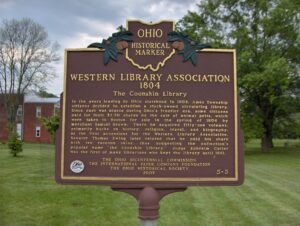
In the years leading to Ohio statehood in 1803, Ames Township citizens decided to establish a stock-owned circulating library. Since cash was scarce during Ohio’s frontier era, some citizens paid for their $2.50 shares by the sale of animal pelts, which were taken to Boston for sale in the spring of 1804 by merchant Samuel Brown. There he acquired fifty-one volumes, primarily books on history, religion, travel, and biography, as the first accessions for the Western Library Association. Senator Thomas Ewing later related that he paid his share with ten raccoon skins, thus suggesting the collection’s popular name “the Coonskin Library.” Judge Ephraim Cutler was the first of many librarians who kept the library until 1861.
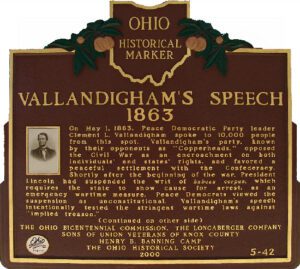
On May 1, 1863, Peace Democratic Party leader Clement L. Vallandigham spoke to 10,000 people from this spot. Vallandigham’s party, known by their opponents as “Copperheads,” opposed the Civil War as an encroachment on both individuals’ and states’ rights, and favored a peaceful settlement with the Confederacy. Shortly after the beginning of the war, President Lincoln had suspended the writ of habeas corpus, which requires the state to show cause for arrest, as an emergency wartime measure. Peace Democrats viewed the suspension as unconstitutional. Vallandigham’s speech intentionally tested the stringent wartime laws against “implied treason.” (continued on other side)
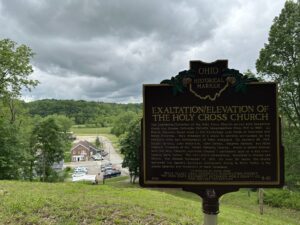
The Exaltation/Elevation of the Holy Cross Church served both Byzantine Greek and Russian Orthodox Catholic congregations from 1915 to 1967. As Slovak migrants found work in the Cambridge coal fields of Guernsey and Noble Counties, they dreamed of a place to worship surrounded by the religious rites and iconography of their homeland. On January 26, 1914, Daniel Varhola, John Fetkovich, John Demko, Stephen Varhola, and Mike Zeleznik (trustees of the “Greek Catholic Church, which is united forever with the Holy Catholic Apostolic Church”) purchased land on a hill overlooking Belle Valley. The two-sided cornerstone, inscribed in Russian and Slovak, was blessed November 15, 1915. For over 50 years, the church anchored the Eastern European immigrants living in Belle Valley to the ethnic identity and traditions of their homeland. (Continued on other side)
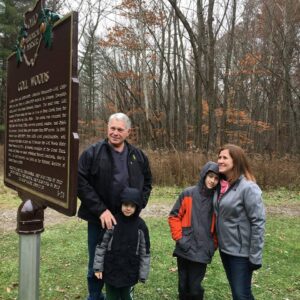
Two Deputy U.S. General Land Office Surveyors traversed Goll Woods: Benjamin Hough in 1815 and Captain James Riley in 1821. Hough (1772-1819) established the Michigan Meridian in 1815 and was county and state office holder in Ohio. Riley’s life was more tumultuous. Riley (1777-1840) captained the merchant ship Commerce, which wrecked off the Saharan coast in 1815. Riley and crew were enslaved for four months until ransomed by British diplomat William Willshire. In 1817, Riley published a famous account of his time in North Africa, and, in 1819, was appointed a surveyor by Surveyor General Edward Tiffin. Moving to Northwest Ohio, Riley named the village he founded in 1822, Willshire, for his deliverer. Riley returned to New York in 1826 and to the sea, where he died. Riley’s book went through more than twenty editions by 1860 and Abraham Lincoln credited the account as one that influenced him deeply.