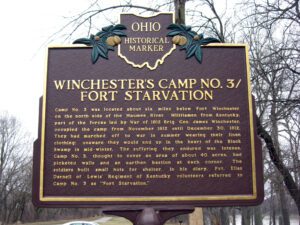
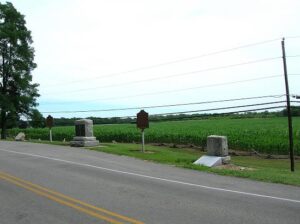
Camp No. 3 was located about six miles below Fort Winchester on the north side of the Maumee River. Militiamen from Kentucky, part of the forces led by War of 1812 Brig. Gen. James Winchester, occupied the camp from November 1812 until December 30, 1812. They had marched off to war in summer wearing their linen clothing; unaware they would end up in the heart of the Black Swamp in mid-winter. The suffering they endured was intense. Camp No. 3, thought to cover an area of about 40 acres, had picketed walls and an earthen bastion at each corner. The soldiers built small huts for shelter. In his diary, Pvt. Elias Darnell of Lewis’ Regiment of Kentucky volunteers referred to Camp No. 3 as “Fort Starvation.”
In the mid-1700s, France found its influence waning among midwestern tribes as it contested for Native American trade and military alliances with Great Britain. Shortly after Miami chief Memeskia (also known as Old Britain or La Demoiselle) moved his village to Pickawillany, British traders were given permission to establish a small post in the village, which was deep in the territory claimed by France. When French demands to evacuate the post failed, Charles Langlade led a party of 250 Ottawa and Ojibwe warriors and French Canadians in a surprise attack on the Miami village on June 21, 1752. The trading post was destroyed, British traders were taken to Detroit as prisoners, and Memeskia was executed. Pickawillany was completely abandoned soon after. As a prelude to the French and Indian War, the Battle of Pickawillany fueled land claim and trading right conflicts between France and Britain.
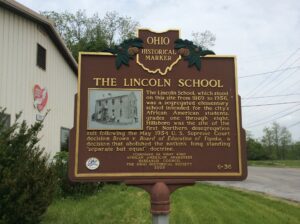
The Lincoln School, which stood on this site from 1869 to 1956, was a segregated elementary school intended for the city’s African American students, grades one through eight. Hillsboro was the site of the first Northern desegregation suit following the May 1954 U.S. Supreme Court decision Brown v. Board of Education of Topeka, a decision that abolished the nation’s long standing “separate but equal” doctrine. (Continued on other side)
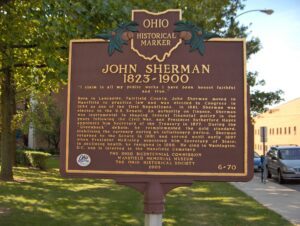
Born in Lancaster, Fairfield County, John Sherman moved to Mansfield to practice law and was elected to Congress in 1854 as one of the first Republicans. In 1861, Sherman was elected to the U.S. Senate. An authority on finance, Sherman was instrumental in shaping federal financial policy in the years following the Civil War, and President Rutherford Hayes appointed him Secretary of the Treasury in 1877. During the “Greenback” debate, he re-implemented the gold standard, stabilizing the currency during an inflationary period. Sherman returned to the Senate in 1881 and served until early 1897 when President McKinley appointed him Secretary of State; in declining health, he resigned in 1898. He died in Washington, D.C. and is interred in the Mansfield Cemetery.
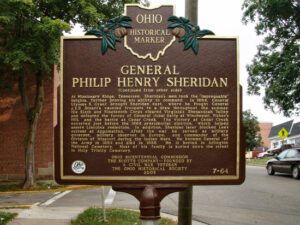
Philip Sheridan was most likely born in County Cavan, Ireland in 1831, but records do not indicate his actual birthplace. His family moved to Somerset when Philip was a child and lived down the avenue from this site. His family later owned the house across the street. His military interest was inspired by “Muster” day and frequent visits from a young West Pointer named William T. Sherman. Sheridan graduated from the United States Military Academy in 1853 and served on the Western Frontier Indian campaigns prior to the Civil War. In 1862, Sheridan became Colonel of the Second Michigan Calvary. At Stones River, Tennessee, he commanded a Division of the Twentieth Corps and stubbornly held General William S. Rosecrans’ right flank, distinguishing himself in battle. (continued on other side)
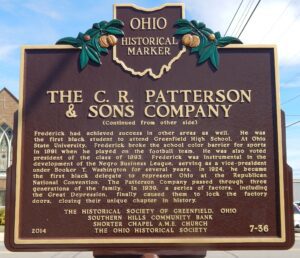
The factory of the C. R. Patterson & Sons Company once stood near here at 138 N. Washington Street. Established in the mid-nineteenth century by the black businessman Charles Richard (C. R.) Patterson and his white partner, J. P. Lowe, the business, originally known as J. P. Lowe & Company, became a successful carriage firm. Patterson became the sole owner in 1893 and changed the name to C. R. Patterson & Sons. After succeeding his father as owner, C. R.’s son, Frederick, became the first known African-American automobile manufacturer. Under his leadership, the company transitioned from building carriages to automobiles, then to trucks and buses to keep up with the changing demands of the transportation industry. (Continued on other side)
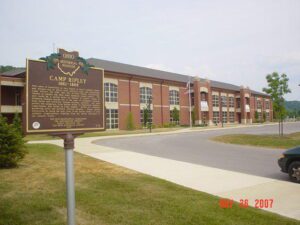
With news of hostilities at Fort Sumter in South Carolina, Ripley men formed one of Ohio’s first military units and established Camp Ripley on what was the 12-acre Ripley Fairgrounds. Chosen as Captain was West Point graduate Jacob Ammen. His unit would be a saving force for Ulysses S. Grant’s troops at Pittsburg Landing raising him to the rank of Brigadier General. Soon barns and buildings became military quarters, and tents dotted the landscape from William Street to Maplewood Cemetery. Camp Ripley, also known as Camp Ammen, served as a regional mustering point and military drilling location. Ripley gained distinction as being the only town in the United States to have soldier’s organizations fighting from the Rocky Mountains to the Atlantic Ocean.
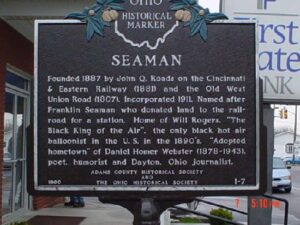
Founded 1887 by John Q. Roads on the Cincinnati & Eastern Railway (1881) and the Old West Union Road (1807). Incorporated 1911. Named after Franklin Seaman who donated land to the railroad for a station. Home of Will Rogers, “The Black King of the Air,” the only black hot air balloonist in the U.S. in the 1890’s. “Adopted hometown” of Daniel Homer Webster (1878-1943), poet, humorist and Dayton, Ohio, journalist.