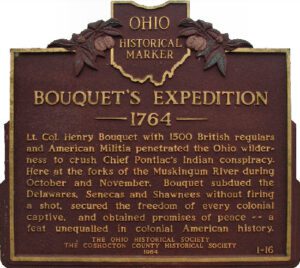
Lt. Col. Henry Bouquet with 1500 British regulars and American militia penetrated the Ohio wilderness to crush Chief Pontiac’s Indian conspiracy. Here at the forks of the Muskingum River during October and November, Bouquet subdued the Delawares, Senecas, and Shawnee without firing a shot, secured the freedom of every colonial captive, and obtained promises of peace–a feat unequaled in colonial American history.
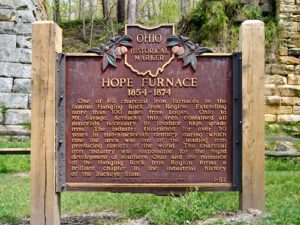
One of the 69 charcoal iron furnaces in the famous Hanging Rock Iron Region. Extending more than 100 miles from Logan, Ohio to Mt. Savage, Kentucky this area contained all materials necessary to produce high grade iron. The industry flourished for over 50 years in mid-nineteenth century during which time the area was one of the leading iron producing centers of the world. The charcoal iron industry was responsible for the rapid development of southern Ohio and the romance of the Hanging Rock Iron Region forms a brilliant chapter in the industrial history of the Buckeye State.
Constitution Park-Just N of Intersection of OH 725 and US 42
Spring Valley
, OH
In 1779 John Bowman’s forces followed the east bank to Glady Run, then north to the Indian village of Old Chillicothe. In 1780 and 1782 militia commanded by George Rogers Clark, and guided by Simon Kenton and Daniel Boone, crossed the river and camped two miles north of Caesar’s Creek, then marched on the villages near Springfield, Piqua, and Bellefontaine.
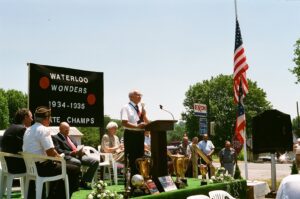
Waterloo was home to the legendary Waterloo Wonders. Coach Magellan Hariston and his Wonder Five captured consecutive Ohio state high school Class B basketball championships in 1934 & 1935, winning 94 out of 97 games, and defeating many Class A and college teams. The 91st Ohio House of Representatives honored the Waterloo Wonders with a resolution following their second Class B State Championship win. The Wonders, known for their colorful passing show, entertained fans with their scoring ability, defense, trick passes, and hardwood antics. Hailing from a small village with a school male enrollment of only 26, the Waterloo Wonders were considered one of the greatest basketball teams ever assembled on the Ohio high school athletic scene. After high school, four of the Wonder Five played professionally as the Waterloo Wonders, ranking among the best basketball squads in the country.
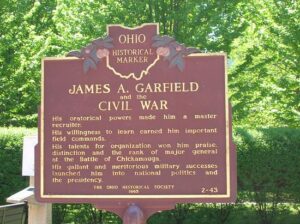
His oratorical powers made him a master recruiter. His willingness to learn earned him important field commands. His talents for organization won him praise, distinction and the rank of major general at the Battle of Chickamauga. His gallant and meritorious military successes launched him into national politics and the presidency.
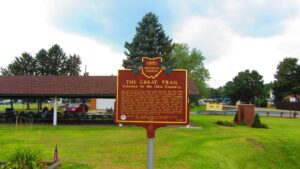
The ancient trail that passed near this spot was the major overland route entering the Ohio Country from the east through the 1700s. Also known as the Tuscarawas Path, the Great Trail was used by Native Americans, European explorers, fur traders, missionaries, military expeditions, land agents-and settlers after Ohio became a state. In January 1761, during the French and Indian War, Major Robert Rogers and thirty-eight rangers passed en route to Fort Pitt after taking Fort Detroit from the French. In 1764, during “Pontiac’s Conspiracy,” Colonel Henry Bouquet crossed here with an army of 1,500 men on his way to Goshachgunk (Coshocton), where he treated with the Delaware and freed captives. During the American Revolution, the Continental Army under General Lachlan McIntosh camped here for two days in November 1778.
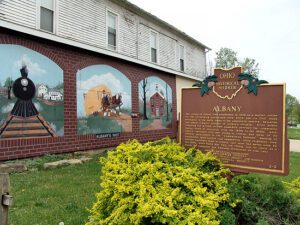
The village of Albany was established in 1838 as a market center for the surrounding agricultural area, which saw its first white settlement in the early years of the nineteenth century. Education was always a major concern of Albany’s citizens. Since public schooling was minimal, private academies provided the community various levels of education from the 1840s to the 1880s. Anti-slavery sentiment also was strong in Albany, and many of its citizens participated in the “Underground Railroad.” Because of educational opportunities and sympathetic white neighbors, free African-Americans came to Albany, but most had moved away by the 1930s. After World War Two, the village lost its status as a center for commerce and business.
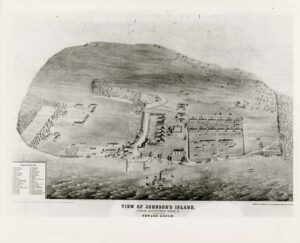
Military Prison Camp In 1861 the United States Army established a prisoner of war camp on Johnson’s Island, approximately 1 mile south of this point. The camp, which housed captured Confederate officers, was maintained until 1865 when it was dismantled. The camp cemetery contains the graves of 206 men who died as a result of disease, wounds, or by execution while incarcerated.