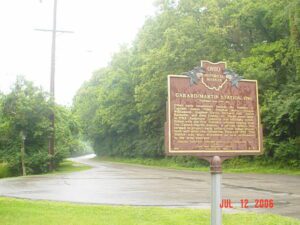
Site of the first fortified settlement in Anderson Township and one of the first in the Virginia Military District. John Garard and Joseph Martin were the founders of this Station, who, with Elias Garard, Joseph Frazee, and others, came by two flatboats with families and livestock from Garards Fort, Pennsylvania, via the Ohio and Little Miami rivers. They landed here on December 23, 1790, and proceeded to erect the fortification.(Continued on other side)
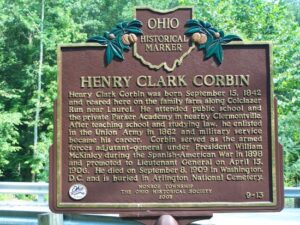
Henry Clark Corbin was born September 15, 1842 and reared here on the family farm along Colclazer Run near Laurel. He attended public school and the private Parker Academy in nearby Clermontville. After teaching school and studying law, he enlisted in the Union Army in 1862 and military service became his career. Corbin served as the armed forces adjutant-general under President William McKinley during the Spanish-American War in 1898 and promoted to Lieutenant General on April 15, 1906. He died on September 8, 1909 in Washington, D.C. and is buried in Arlington National Cemetery.
Legend has it that Mogadore’s first settler, Ariel Bradley, was a spy for George Washington in October, 1776. As a nine year old boy, Ariel crossed British lines on a supposed errand to the nearest grist mill and returned with troop positions and tent counts. In 1801, Ariel left Connecticut to make his new home in what would be Ohio. In 1807, he built a log cabin on a 146 acre plot of farm land that cost $335. Until 1825 the new community had been named Bradleyville, but Ariel did not want the area named after him. Martin Kent was building a residence and a sailor, John Robinson, climbed to the top of the framework, pulled a flask of whiskey from his pocket. Breaking the flask on the last beam of construction, Robinson shouted “Three cheers for Mogador,” which is a large city in Morocco, thusly christening the area Mogadore.
The American Civil War was in its second year, and Confederate forces were advancing in the east and in the west. Confederates led by General Edward Kirby Smith had defeated a Union Force at Richmond, Kentucky on August 30, 1862. Word was received that they were advancing on Cincinnati. Ohio Governor David Tod issued a proclamation to all Ohioans: “Our Southern border is threatened with invasion. I therefore recommend that all the loyal men of your Counties at once form themselves into military companies. Gather up all the arms in the county and furnish yourselves with ammunition for the same. The service will be but for a few days. The soil of Ohio must not be invaded by the enemies of our glorious government.” (continued on other side)
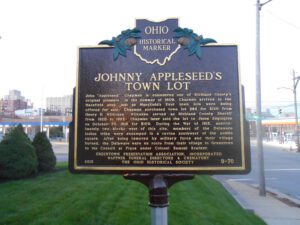
John “Appleseed” Chapman is considered one of Richland County’s original pioneers. In the summer of 1809, Chapman arrived in the Mansfield area just as Mansfield’s first town lots were being offered for sale. Chapman purchased town lot 265 for $120 from Henry H. Wilcoxen. Wilcoxen served as Richland County Sheriff from 1820 to 1825. Chapman later sold the lot to Jesse Edgington on October 30, 1818 for $100. During the War of 1812, approximately two blocks west of this site, members of the Delaware Indian tribe were encamped in a ravine southwest of the public square. After being removed by military force and their village burned, the Delaware were en route from their village in Greentown to the Council at Piqua under Colonel Samuel Kratzer.
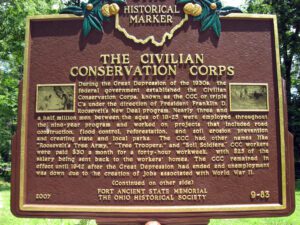
During the Great Depression of the 1930s, the federal government established the Civilian Conservation Corps, known as the CCC or triple C’s under the direction of President Franklin D. Roosevelt’s New Deal program. Nearly three and a half million men between the ages of 18-25 were employed throughout the nine-year program and worked on projects that included road construction, flood control, reforestation, and soil erosion prevention and creating state and local parks. The CCC had other names like “Roosevelt’s Tree Army,” “Tree Troopers,” and “Soil Soldiers.” CCC workers were paid $30 a month for a forty-hour workweek, with $25 of the salary being sent back to the workers’ homes. The CCC remained in effect until 1942 after the Great Depression had ended and unemployment was down due to the creation of jobs associated with World War II.
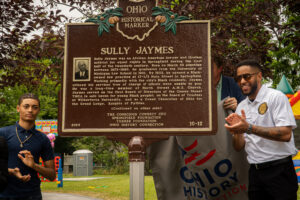
Sully Jaymes was an African American lawyer and tireless activist for equal rights in Springfield during the first half of the twentieth century. Born on March 30 sometime between 1875-1880, he graduated from the University of Michigan Law School in 1901. By 1903, he opened a Black-owned law practice at 17-1/2 Main Street in Springfield. Working primarily with the city’s Black residents, Jaymes offered his services free of charge if clients were unable to pay. He was a long-time member of North Street A.M.E. Church. Jaymes served on the first Board of Directors of the Center Street YMCA (a safe-haven for young Black people), on the Board of Trustees at Wilberforce University, and as a Grand Chancellor of Ohio for the Grand Lodge, Knights of Pythias. (Continued on other side)
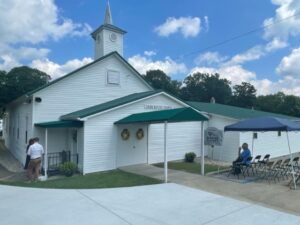
Union Baptist Church, established in 1819, is one of Ohio’s early Black churches. Its pastor and members were active on the Underground Railroad from that early date. Between the 1840s-1860s Black churches along the route to and from nearby Poke Patch assisted over 200 escaped slaves. Members met in their homes until able to obtain a log cabin (circa 1879) on a Blackfork farm. In 1919, a larger church was built on land given by The Cambria Clay Products Company. The adjacent cemetery has over fifty veterans from the Civil, Spanish American, both World, Korean, and Vietnam wars. Donald Russell Long, laid to rest in 1966, received a posthumous Congressional Medal of Honor. Union Baptist Church, the historic foundation of the Poke Patch-Blackfork community, celebrates an annual Church Anniversary to honor its legacy.