

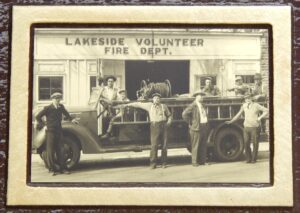
, OH
The Lakeside Volunteer Fire Protective Association responded to both fire and medical emergencies on the Marblehead Peninsula for more than 100 years. It was founded in 1905, after a devastating fire destroyed Lakeside’s business district. In 1946, the Association began providing emergency medical aid. During their service, the Lakeside Volunteer Fire Protective Association progressed from hand-drawn chemical carts to the area’s first heavy-duty fire and rescue truck. In 2013, the Association donated its assets to the newly-formed Danbury Township Volunteer Fire Department and passed into history.
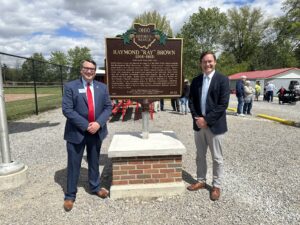
, OH
Raymond “Ray” Brown was a star in the Negro Leagues 1930-1948. Born in Alger on February 23, 1908, Brown graduated from Alger High School in 1926. He made his professional baseball debut playing for the Dayton Marcos in 1930. Brief stints with the Indianapolis ABCs and Detroit Wolves followed. In 1932, Brown joined Pittsburgh’s Homestead Grays mid-season and became a mainstay of their pitching staff for the next fourteen years. Utilizing a devastating curveball, he led the Grays to eight Negro National League pennants in a nine-year span (1937-1945). In 1938, he won the pitching triple crown and lead the league in wins, earned run average, and strikeouts. When the Negro League World Series was re-instituted in 1942, Brown’s team competed four straight years, winning twice. (Continued on other side)
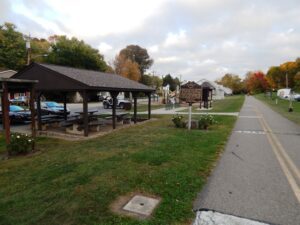
, OH
Deerfield was laid out around 1795 and in 1802 Major Benjamin Stites, his son Benjamin, Jr., and John Gano officially recorded the village’s plat. A part of the great tide of Americans moving into the Northwest Territory (and Ohio after 1803), Deerfield’s early inhabitants included Revolutionary war veteran Ephraim Kibbey as well as Andrew Lytle, Nathan Kelly, William Snook, and War of 1812 veteran David Sutton. Deerfield was so called because it was a settlement in Deerfield Township, Hamilton County in the 1790s. (Continued on other side)
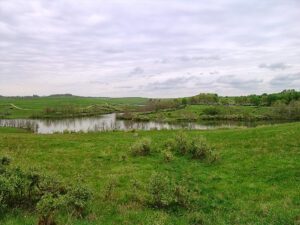
, OH
Near this location stood the settlement of African American families known as “The Lett Settlement.” The Lett Settlement was a self-sustaining community of mixed race families, including the Caliman, Guy, and Lett families. The families had formed ties through marriage and common background during the mid-1700s in Virginia and Maryland. These early African American pioneer families came to Ohio as “free people of color,” and began acquiring land in Meigs Township, Muskingum County, and surrounding townships in adjacent counties during the 1820s. They were soon joined by the Brown, Clifford, Earley, Simpson, Tate, and Pointer families. The families of the Lett Settlement were land owners and tax payers in Ohio before the Civil War and challenged the State of Ohio for the right to vote and for access to education during the 1840s, 1850s, and 1860s. (Continued on other side)
, OH
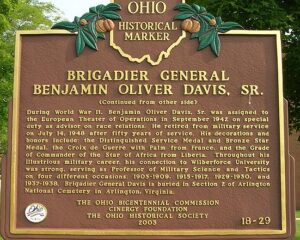
Benjamin Oliver Davis, Sr. (July 1, 1877 – November 26, 1970), the nation’s first African American general in the Regular Army, was born in Washington, D.C. Davis first served as a temporary first lieutenant of the 8th U.S. Volunteer Infantry during the Spanish-American War. Following that conflict, he enlisted as a private in the 9th U.S. Cavalry, serving in the Philippine Insurrection where he began to rise in rank. Davis was promoted to first lieutenant in 1905, captain in 1915, lieutenant colonel in 1920, colonel in 1930, and brigadier general in 1941. His military career took him around the world. In 1909, he was detailed as Military Attache to Monrovia, Liberia. During World War I, Davis was stationed in the Philippines. In 1938, he took command of the New York’s African American 396th National Guard Infantry, later known as the 369th Coast Artillery (Antiaircraft) Regiment. (Continued on other side)
, OH
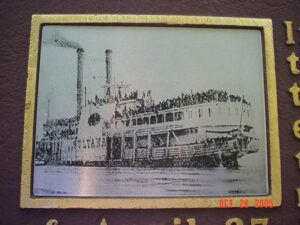
In 1862, less than a mile upriver from this marker, the John Lithoberry Shipyard in Cincinnati constructed the Sultana, a 260-foot, wooden steam transport. At the end of the Civil War, the U.S. Government contracted the Sultana to transport recently freed Federal prisoners north from Confederate stockades. During the night of April 27, 1865, while carrying over 2,300 Union soldiers – over six times its capacity of 376 passengers – a steam boiler aboard the Sultana exploded. The ship erupted in a massive fireball and sank in the cold, flood-swollen Mississippi River ten miles north of Memphis, Tennessee. Over 1,700 individuals died – some 200 more than those lost aboard the Titanic in 1912 – in what remains the worst maritime disaster in American history. Of the total casualties, Ohio lost the most of any state, with 791 dead. Indiana lost 491 persons, with Kentucky suffering 194 dead. It is estimated that, of the Ohio casualties, over fifty were Cincinnatians.
, OH
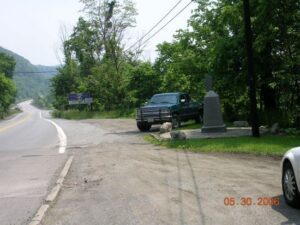
In April 1784, the Continental Congress adopted the Report of Government for the Western Territory, a broad plan drafted primarily by Thomas Jefferson for organizing the United States’ new western lands that were ceded by the states and purchased from Native Americans. One of the most far-reaching legislative acts in American history, the resulting Land Ordinance of 1785, passed on May 20th, established the public land system by which all federal land was surveyed and distributed. The Ordinance established a rectilinear survey system that divided land into townships of six miles square aligned by north-south and east-west baselines, and set aside certain lands for Revolutionary War veterans and for public schools.
, OH
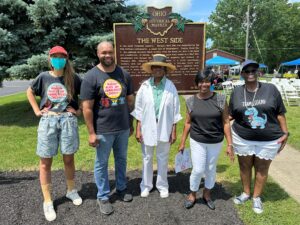
In the early twentieth century, Marion’s West Side was dominated by the Erie Railroad switchyards, a major hub of employment. During World War I, the railroad recruited Black workers from the South for jobs in its yards and roundhouses. In Marion, these workers made their homes in a West Side encampment that became the target of white suspicion and violence. In February 1919, following the unsolved murder of a white roundhouse worker’s wife and a separate alleged assault, a 300-man lynch mob smashed windows and occupied the West Side. All Black residents were ordered to leave the city by 6:00 pm the next day. Despite pleas to Governor Cox, at least 200 Black residents were forced to flee Marion. Marion’s anti-Black violence foreshadowed the nationwide “Red Summer” of 1919.