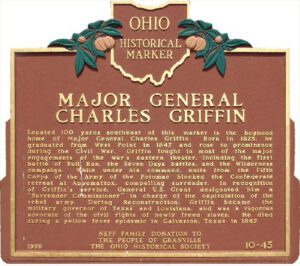
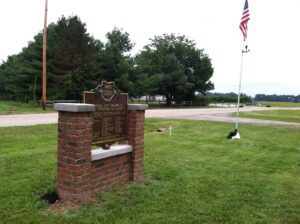
Located 100 yards southeast of this marker is the boyhood home of Major General Charles Griffin. Born in 1825, he graduated from West Point in 1847 and rose to prominence during the Civil War. Griffin fought in most of the major engagements of the war’s eastern theater, including the first battle of Bull Run, the Seven Days battles, and the Wilderness campaign. While under his command, units from the Fifth Corps of the Army of the Potomac blocked the Confederate retreat at Appomattox, compelling surrender. In recognition of Griffin’s service, General U.S. Grant designated him a “Surrender Commissioner” in charge of the capitulation of the rebel army. During Reconstruction, Griffin became the military governor of Texas and Louisiana, and was a vigorous advocate of the civil rights of newly freed slaves. He died during a yellow fever epidemic in Galveston, Texas in 1867.
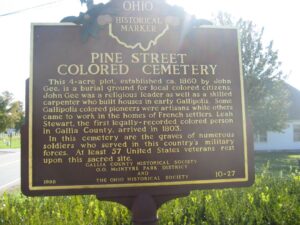
This 4-acre plot, established ca. 1860 by John Gee, is a burial ground for local colored citizens. John Gee was a religious leader as well as a skilled carpenter who built houses in early Gallipolis. Some Gallipolis colored pioneers were artisans while others came to work in the homes of French settlers. Leah Stewart, the first legally-recorded colored person in Gallia County, arrived in 1803. In this cemetery are the graves of numerous soldiers who served in this country’s military forces. At least 57 United States veterans rest upon this sacred site.
J. W. Denver Williams Memorial Park, 1100 Rombach Avenue
Wilmington
, OH
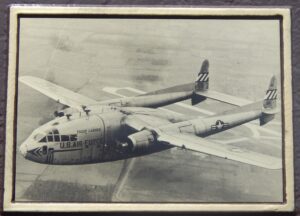
On April 18, 1964, reservists from the 302nd Troop Carrier Wing at the Clinton County Air Force Base (CCAFB) and 2nd Special Forces Group (Green Berets) of Fort Hayes, Columbus were to undergo an Operational Readiness Inspection. In a flight of nine C-119 “Flying Boxcars,” the men were to execute a routine night formation paratroop drop. Airborne, the flight encountered worsening weather conditions and the lead plane called off the mission. Returning to CCAFB, two C-119s collided in mid-air and crashed about five miles northeast of the base, near the intersection of Stone and Melvin roads. Tragically, 17 of the 19 men aboard were killed.(Continued on other side)
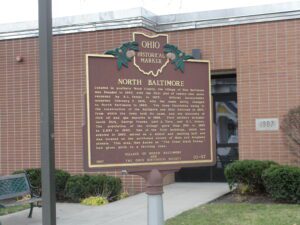
Located in southern Wood County, the village of New Baltimore was founded in 1860, with the first plat of twenty-nine acres recorded by B.L. Peters in 1873. Official incorporation occurred February 7, 1876, with the name being changed to North Baltimore in 1880. The town flourished owing to the construction of the Baltimore and Ohio Railroad in 1873, from which the town took its name, and the discovery of rich oil and gas deposits in 1886. First settlers included: Jacob Dirk, George Franks, Levi A. Tarr, and B.L. Peters. The population of the village grew from 700 in 1880 to 2,857 in 1890. One of the first buildings, which was erected in 1860, served as a school and meeting hall and was located on the northwest corner of Main and Broadway streets. This area, then known as “The Great Black Swamp,” had given birth to a thriving town.
Great Miami River Recreational Trail, Taylorsville Metro Park, 2005 U.S. Route 40
Vandalia
, OH
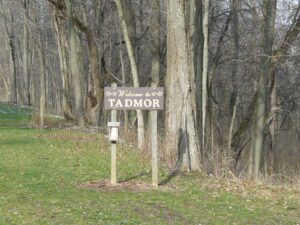
The Village of Tadmor is significant as being the location of one of the most important centers of transportation in early Ohio history. As early as 1809, keelboats were poled up river from Dayton to load and unload freight in the village. By 1837, the Miami and Erie Canal had reached Tadmor, connecting it to the Ohio River in the south and Lake Erie in the north. In the 1830s, the National Road was constructed through Tadmor, connecting it to points east and west. In 1851, the Dayton & Michigan Railroad established freight and passenger service to the growing town. Residents hoped that Tadmor’s strategic location would help it prosper, however, successive flooding on the Great Miami River stifled growth. Tadmor was finally abandoned when a dam constructed by the Miami Conservancy District in 1922 to retain water during flooding made the site uninhabitable.
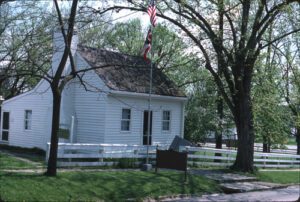
Hiram Ulysses Grant was born in this one-story, timber-frame home on April 27, 1822 to Jesse and Hannah Simpson Grant. The Grants settled in Point Pleasant the previous year, and Jesse took charge of the tannery located near the cottage. Now restored, the building remained in relatively good condition through the 1880s. In 1823, the family moved to Georgetown, Ohio, where Hiram lived until his appointment to West Point at age 17. Although reluctant to attend the Academy, Grant, now known as Ulysses Simpson Grant due to an error on the application, graduated in 1843 and was stationed at Jefferson Barracks near St. Louis, where he courted his future wife Julia Dent, with whom he had four children, Frederick, Ellen, Ulysses Jr., and Jesse. (continued on other side)
Through the terms of his will, British absentee landowner Samuel Gist (c. 1723-1815) freed his 350 Virginia slaves and provided funds for their relocation, the purchase of land, and the establishment of schools and homes. The executors of Gist’s will acquired over 2,000 acres of land in Ohio, including two large tracts in Scott and Eagle townships in Brown County in 1819. In 1831 and 1835, an agent of the Gist estate purchased 207 acres in Highland County and divided the acreage into thirty-one lots. This Gist settlement in Eagle Township was the first to be purchased and settled. It was recorded at Brown County on August 4, 1819 as 1197 acres of land divided among “150 Negroes who were emancipated by the will of Samuel Gist”. In 2009, descendants of the freed Gist slaves still inhabited part of the original settlement.
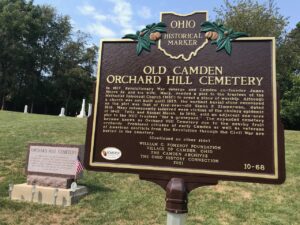
In 1817, Revolutionary War veteran and Camden co-founder James Moore Sr. and his wife, Mary, deeded a plot to the trustees of the Methodist Episcopal Church (MEC) to erect a place of worship. Although a church was not built until 1825, the earliest burial stone recovered on the plot was that of five-year-old Simon P. Zimmerman, dated 1818. Many subsequently interred were victims of the cholera epidemic of 1849. Felix and Rachel Marsh, in 1852, sold an adjacent one-acre plot to the MEC trustees “for a graveyard.” The expanded cemetery became known as Orchard Hill Cemetery due to the nearby fruit orchards. Prominent citizens of early Camden as well as veterans of American conflicts from the Revolution through the Civil War are buried in the cemetery. (Continued on the other side)