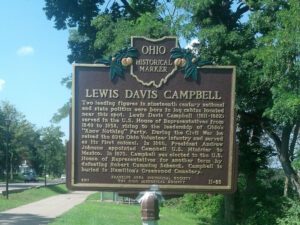
Two leading figures in nineteenth century national and state politics were born in log cabins located near this spot. Lewis Davis Campbell (1811-1882) served in the U.S. House of Representatives from 1849 to 1858, rising to the leadership of Ohio’s “Know Nothing” Party. During the Civil War he raised the 69th Ohio Volunteer Infantry and served as its first colonel. In 1866, President Andrew Johnson appointed Campbell U.S. Minister to Mexico. In 1870, Campbell was elected to the U.S. House of Representatives for another term by defeating Robert Cumming Schenck. Campbell is buried in Hamilton’s Greenwood Cemetery.
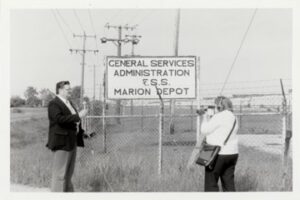
Early in 1942, during World War II, the U. S. Army Corps of Engineers acquired 640 acres along two miles of U. S. Route 30 South (now State Route 309) from ten landowners. By June 11 of that year, the farm families were removed and construction of The Marion Engineer Depot (MED) began, costing $4 million. The first military encampment in Marion County, the 333rd Engineering Regiment, arrived in May and established its camp in a wheat field. They lived in tents while constructing streets and railroad tracks around the Depot. MED was dedicated on December 7, 1942. During the war, food, munitions, equipment, and other military supplies flowed in and out of MED and heavy machinery was renovated. Peak employment came in July 1944 with 1,487 civilian and 47 military personnel on site. (Continued on other side)
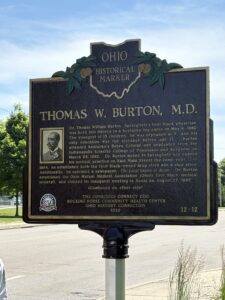
Dr. Thomas William Burton, Springfield’s first Black physician, was born into slavery in a Kentucky log cabin on May 4, 1860. The youngest of 15 children, he was orphaned at 9, and his only education was the alphabet before age 21. Burton attended Kentucky’s Berea College and graduated from the Indianapolis Eclectic College of Physicians and Surgeons on March 24, 1892. Dr. Burton moved to Springfield and opened his medical practice on East Main Street the same year. In 1894, he established both the first Black-owned drug store and a shoe store. Additionally, he operated a newspaper, The Loyal Legion of Honor. Dr. Burton established the Ohio Mutual Medical Association (Ohio’s first Black medical society), and chaired its inaugural meeting in Xenia on August 27, 1897. (Continued on other side)
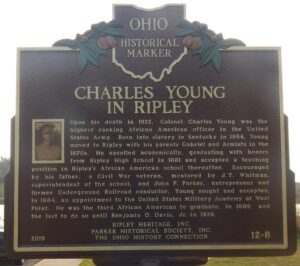
Charles Young in Ripley. Upon his death in 1922, Colonel Charles Young was the highest ranking African American officer in the United States Army. Born into slavery in Kentucky in 1864, Young moved to Ripley with his parents Gabriel and Arminta in the 1870s. He excelled academically, graduating with honors from Ripley High School in 1881 and accepted a teaching position in Ripley’s African American school thereafter. Encouraged by his father, a Civil War veteran, mentored by J. T. Whitman, superintendent of the school, and John P. Parker, entrepreneur and former Underground Railroad conductor, Young sought and accepted, in 1884, an appointment to the United States Military Academy at West Point. He was the third African American to graduate, in 1889, and the last to do so until Benjamin O. Davis, Jr. in 1936.
In 1918, Charles Young made a desperate attempt to convince the U.S. Army that he was fit for duty. The Army’s highest-ranking Black officer, he had been medically retired and not given a command during World War I. To demonstrate his fitness, he rode 497 miles from his home in Wilberforce, Ohio, to Washington, D.C. Leaving on June 6 he made the journey in 17 days, 16 on horseback and 1 resting. Averaging 31 miles each day, he rode 45 minutes and walked 15 minutes every hour. Upon his arrival, Young met with Secretary of War Newton Baker. Pressured by the Black press and the White House, Baker hedged. He recalled Young to active duty a year later and assigned him to Camp Grant, Illinois, just five days before the end of the war.
A dense swamp forest roughly the size of the state of Connecticut once stretched across this region of Ohio and Indiana. A remnant of ancient Lake Maumee, this dense, soggy flatland supported abundant waterfowl and wildlife, but blocked travel and settlement and remained largely uninhabited until it was cleared and drained for agriculture between 1860 and 1885. This marsh and other scatter remnants are all that remain of the Great Black Swamp. Managed for a variety of wetland wildlife, Magee is one of the premier bird watching sites in North America, with more than 300 species.
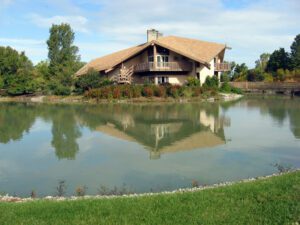
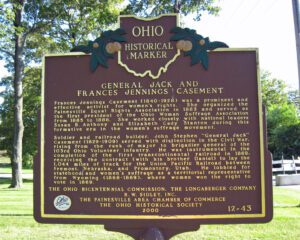
Western Reserve agriculturalist Charles Clement Jennings built the Casement House, also known as the “Jennings Place,” for his daughter Frances Jennings Casement in 1870. Designed by Charles W. Heard, son-in-law and student of Western Reserve master builder Jonathan Goldsmith, it is an excellent example of the Italianate style, featuring ornate black walnut woodwork, elaborate ceiling frescoes, and an innovative ventilation system. It remained in the Casement family until 1953. It was added to the National Register of Historic Places in 1979.
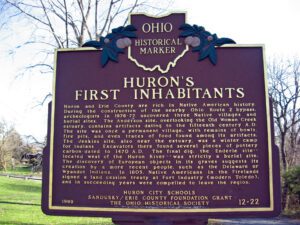
Huron and Erie County are rich in Native American history. During the construction of the nearby Ohio Route 2 bypass, archeologists in 1976-77 uncovered three Native villages and burial sites. The Anderson site, overlooking the Old Woman Creek estuary, contains artifacts dating to the fifteenth century A.D. The site was once a permanent village, with remains of bowls, fire pits, and even traces of food found among its artifacts. The Jenkins site, also near the estuary, was a winter camp for Indians. Excavators there found several pieces of pottery carbon-dated to 1470 A.D. The final dig, the Enderle site — located west of the Huron River — was strictly a burial site. The discovery of European objects in its graves suggests its creation by a more recent people, such as the Delaware or Wyandot Indians. In 1805, Native Americans in the Firelands signed a land cession treaty at Fort Industry (modern Toledo), and in succeeding years were compelled to leave the region.