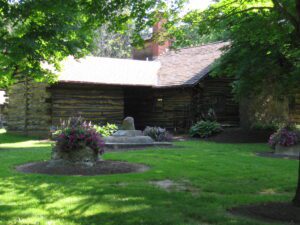
In recognition of its noteworthy representation of the history, culture, and architecture of the Western Reserve, Burton Village’s Historic District was placed on the National Register of Historic Places in 1974. The Historic District, an area of approximately 20 acres surrounding the Village Green and along streets at the north end of the Green, includes 15 buildings of historical significance built between 1815 and 1891. Preserved within the District are commercial and public buildings and private dwellings that reflect the cultural and architectural development of a village of the Western Reserve of Ohio during the 19th century. Buildings in the predominant architectural styles of the 19th century are all represented in the Historic District, including Western Reserve, Greek Revival, Second Empire, Italianate, and Queen Anne. [Continued on other side]
From the 1770s until 1832, the Logan County area was the homeland to much of the Shawnee Nation. Ten villages known as the Upper Mad River towns included the homes of influential leaders Moluntha, Black Hoof, and Blue Jacket. The West Liberty area contained three villages: Moluntha’s Town, Wapakoneta, and Mackachack. To the northeast stood Wapatomica, the Shawnee’s political center and site of several intertribal councils. To the north sat Blue Jacket’s Town, Kispoktha Town, and Reed Town. To the west were Pigeon Town and Stony Creek, site of one of Tecumseh’s first pan-Indian confederacy councils. From 1817 to 1832, many Shawnees were relocated to Indian Territory, which in 1907 became the state of Oklahoma. These Shawnees are now the Eastern Shawnee of Oklahoma.
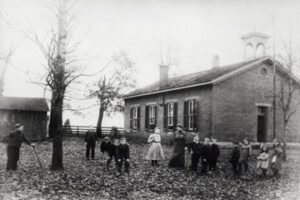
In 1854, Samuel and Rebecca McClellan Collins deeded 1.28 acres to Beavercreek Township, Greene County, for the purpose of building a schoolhouse. The first two schoolhouses were constructed of stone with fireplaces for heat. Collins neighborhood children in first through eighth grade were educated in the present red brick building until 1944, when decreased enrollment forced Xenia Township to close the school. Virgil and Helen Bryson Brantley, great-granddaughter of Samuel and Rebecca Collins, purchased the school property in 1982 and began the restoration of the vandalized and deteriorated schoolhouse. The pony/coal shed and privies were rebuilt on their foundations. (Continued on other side)
J.W. Denver Williams Jr. Park, 1100 Rombach Avenue
Wilmington
, OH
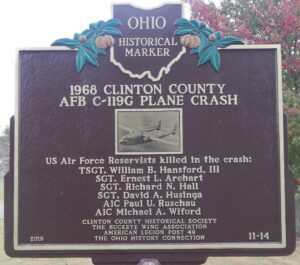
On August 9, 1968, a plane carrying 31 military passengers and crew members left the Clinton County Air Force Base for completion of an annual two-week active duty training held at Otis Air Force Base, Massachusetts. The transport was assigned to the 907th Tactical Airlift Group, 302nd Tactical Airlift Wing. Just after takeoff, the C-119G “Flying Boxcar” lost power, and the pilot attempted to return to the base. The plane crash-landed and caught fire on the Ottie Griffith Farm two miles from the base. Six reservists perished, and many passengers and rescuers were injured.
Generations of the Barker family lived in the house that stood at 89 Wood Street from 1875 to 1973. George W. Barker (1836-1913) was born enslaved in Virginia, emancipated age 13, and settled in Mansfield by 1870. He worked as a well-known chef in downtown hotels. In December 1873, Barker married Dayton-native Harriet J. Hurley (1840-1925). The next April, he purchased a corner plot in Snyder’s Subdivision for $450. Completed by 1875, his original brick house sheltered Barker, his wife, and his mother-in-law, Eliza Hurley (1815-1885). The Barker’s children — Sumner (1875-1890) and Sarah Daisy (1877-1973) — were born there. The Barker family were one of Mansfield’s historic Black families and members of the First Congregational Church. Their house once included a decorative wooden porch, numerous outbuildings, and served as an important community gathering place.
Established in 1879 by Chicago industrialist William P. Rend as a coal mining town, Rendville became a place where African Americans broke the color barrier. In 1888, Dr. Isaiah Tuppins, the first African American to receive a medical degree in Ohio, was elected Rendville’s mayor, also making him the first African American to be elected a mayor in Ohio. Richard L. Davis arrived in Rendville in 1882 and became active in the Knights of Labor. He was one of the labor organizers from the Little Cities of Black Diamonds region who helped found the United Mine Workers of America in 1890. An outstanding writer and orator, Davis was elected to UMWA’s national executive board and organized thousands of African Americans and immigrants to join the union. (continued on other side)
Veteran’s Park, S triangle of OH 66 & Washington Avenue
Piqua
, OH
Local views on the Vietnam War mirrored national attitudes of pride and confusion. Piqua citizens participated in the “Letters for Life” campaign in 1970 for prisoners of war. Piqua Daily Call assistant news editor James W. DeWeese traveled to Paris in a frustrated attempt to deliver the letters to the Hanoi Peace delegation. The state activated the local Ohio National Guard unit in 1970 to help suppress anti-Vietnam student rioting in Columbus. The military conflict came home in 1966 when William Pitsenbarger became the first of eleven men from Piqua to die in Vietnam. In 1967, Piqua High School graduate Air Force Major William J. Baugh was shot down over North Vietnam and taken prisoner. He remained a P.O.W. until 1973.
St. Mary of the Assumption parish — Ohio’s second and Fairfield County’s first — was founded circa 1817-1820 by Father Edward Dominic Fenwick. Dominican priests from Somerset began ministering regularly to Lancaster faithful and a small church was dedicated during Easter 1819. Construction on the parish’s third church building, The Basilica of St. Mary of the Assumption, began in February 1854 under the pastorate of Rev. Henry Lange. On August 15, 1859, the Very Rev. John Purcell, Bishop of Cincinnati, laid the cornerstone and it was blessed by former pastor Rev. Josue M. Young, Bishop of Erie, Pennsylvania. Construction proved slow as the Civil War depleted both parish funds and available workers. Father Lange rallied his parishioners, enlisted local contracters Guy and George Blair, and continued the work until his death in February 1864. (Continued on other side)