On this site Daniel Gebhart established a tavern in 1811. Taverns were where people gathered to eat, rest, and share news. During spring freshets, boatmen from the Great Miami River stayed at the tavern. Joining them were pioneers coming by the river and overland to settle at Hole’s Station, now Miamisburg. The tavern closed in 1840, became a boarding house, and then sold to become a private residence in 1853. To commemorate the nation’s Bicentennial in 1976, Miamisburg’s bicentennial committee purchased the tavern and gave it to the city. It was restored and opened as a museum in 1982. (Continued on other side)
This area of western Hancock County is a part of the Maumee River Watershed known as “Indian Green.” Wyandot Indians chose this area for hunting and ceremonial grounds along the Blanchard River in the 1700s because it was next to the river, yet high enough to avoid frequent flooding. One-half mile east of this location is a Liberty Township cemetery. It is located upon a sand ridge once used as a burial ground by Indians, hence the name “Indian Green.”
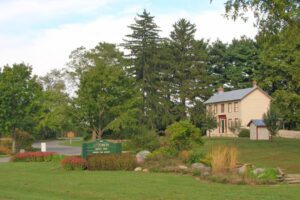
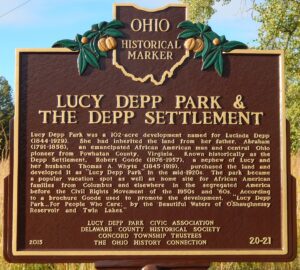
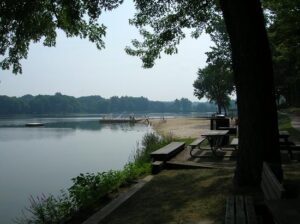
Lucy Depp Park was a 102-acre development named for Lucinda Depp (1844-1929). She had inherited the land from her father, Abraham (1791-1858), an emancipated African American man and central Ohio pioneer from Powhattan County, Virginia. Known historically as the Depp Settlement, Robert Goode (1876-1957), a nephew of Lucy and her husband Thomas A. Whyte (1845-1919), purchased the land and developed it as “Lucy Depp Park” in the mid-1920s. The park became a popular vacation spot as well as home site for African American families from Columbus and elsewhere in the segregated America before the Civil Rights movement of the 1950s and 60s. According to a brochure Goode used to promote the development, “Lucy Depp Park…For People Who Care; by the Beautiful Waters of O’Shaughnessy Resevoir and Twin Lakes.”
Silver Lake was previously known as Wetmore’s Pond, named for Judge William Wetmore, an agent for the Connecticut Land Company. In 1808, Wetmore built a cabin overlooking the spring-fed lake, which was then a part of Portage County. Local lore records his friendship and conscientious dealings with the Native Americans, likely Seneca, who inhabited a populous village between the lake and the Cuyahoga River. The tribe left the area to join the British during the War of 1812, but later sided with the United States.
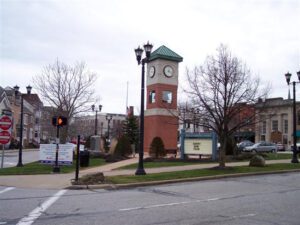
The Triangle, one of the most historic places in Berea, has been the center of the city’s civic life since the mid-19th century. Just beneath lie the solid layers of the famous Berea Sandstone that brought prosperity to Berea during its early years. Quarry owner and Berea Seminary founder John Baldwin obtained much of what is now Berea from Gideon Granger, Postmaster General under President Thomas Jefferson and original owner of Township 6, Range 14 (later Middleburg Township) of the Western Reserve. When the seminary trustees transferred the Triangle tract to the people of Berea in 1847, they designated it by deed as a public promenade. This farsighted stipulation preserved it from commercial development during the 20th century. (continued on other side)
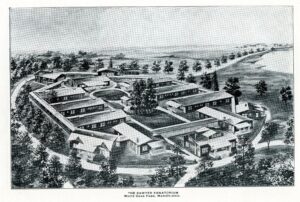
Doctors Charles Elmer Sawyer and his son, Carl Walker Sawyer, opened Sawyer Sanatorium on White Oaks Farm in 1911. Built to provide physical and emotional healing in a unique environment, the complex incorporated six patient bungalows, houses for the two doctors, offices, a large dining and social hall, and treatment buildings. An enclosed quarter-mile-long cloister connected these buildings around a large courtyard. Each bungalow, given botanical names such as “Ivy” and “Rose,” contained individual patient rooms, a communal living room, and bathing facilities. Hydropathic and electropathic treatments buildings were added later. A shady ten-acre knoll on the farm featured a grove of white oak trees that served as a picnic area for patients. Over the years, the facility also hosted local and national social and political events. (Continued on other side)
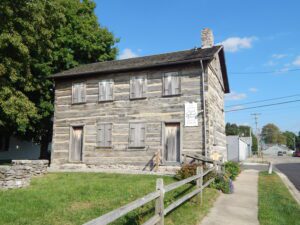
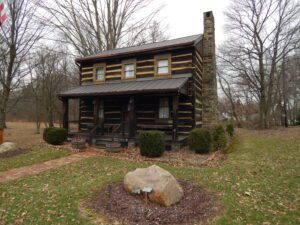
This circa 1840s log house, which now serves as a museum and home to the East Palestine Historical Society, was originally located at the corner of West Main and Walnut Streets. Some of its most notable and earliest residents were Dr. Robert Chamberlin (1798-1876), the town’s first resident physician, and his wife Rebecca (1810-1895). Chamberlin practiced medicine for 30 years, serving the town as a township trustee in 1834, the first postmaster in 1836, and township clerk in 1839. (Continued on other side)
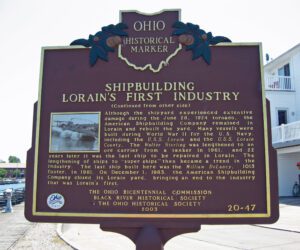
Lorain’s shipbuilding industry began when Augustus Jones and William Murdock began constructing wooden sailing vessels on the west side near the mouth of the Black River. The sloop General Huntington was the first boat launched from Lorain in 1819. In 1897, the shipbuilding industry moved to the east side of the river with the establishment of the Lorain yard of the Cleveland Shipbuilding Company, the precursor of the American Shipbuilding Company. In 1898, they were the largest dry dock on the Great Lakes. On April 13, 1898, the first steel ship, the Superior City, was launched. At the time, it was the largest vessel on fresh water. During the early years well-known passenger ships, railroad car ferries, tankers, self-unloaders, tugs, and barges were built here.