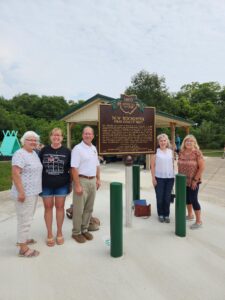
New Rochester was platted in 1835 in an area recognized as a vital transportation hub through the Great Black Swamp. The 18-acre plat was situated on a high bluff overlooking the Maumee River. A 2009 archaeological survey discovered stone tools and evidence of 4,000 years of habitation. When Paulding County was organized in March 1839, New Rochester was designated as its county seat. On November 21, 1839, three associate judges of the common pleas court appointed a clerk pro tem and sheriff. As no courthouse was built by April 1840, the court convened in a room above H.N. Curtis’s General Store. At that time, New Rochester was a flourishing village with thirty to forty families, three hotels, three stores, two blacksmiths, a post office, a school, and three taverns. (Continued on other side)
Seba Bronson Jr. left Columbia Township in early 1810 and followed the Rocky River to an area one and a half miles north of here. He built a cabin and planted a crop and thus started what became known as the village of Hardscrabble in Liverpool Township. The village was centered around the Columbia/Grafton Road area, and the township is the oldest continuously inhabited township in Medina County. The Potawatami Indians occupied this area and camped annually along the Rocky River. For five silver dollars, they showed Seba and a partner a hidden salt springs which they sought to exploit. Other men also scrabbled to own it and Justus Warner succeeded. Seba was turned out. Warner operated the Liverpool Salt Works beginning in 1811. The first industry in the county, salt was a necessity and eagerly sought by setters in the area.
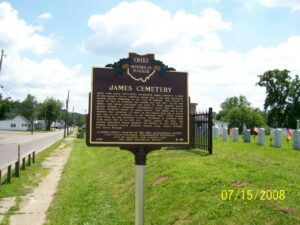
Major John James (1772-1854) established James Cemetery in 1828 on and around a Native American mound that is the only significant ancient mound remaining in the city of Jackson. The mound is about 70 feet in diameter and nearly six feet tall. In the late 1800s, this mound comprised one point of three ancient mound groups forming a triangular configuration along East Broadway Street, formerly known as James Street. One group was a few hundred feet northeast of here on the Watson farm and a second was just to the northwest on the Warnicke farm. These mounds were built by the Hopewell Culture, prominent in southern Ohio from about 100 BC to 400 AD. Major James, his wife, and several immediate family members are buried on the mound including Jackson County pioneers Andrew Long, Daniel Hoffman, and David Mitchell.
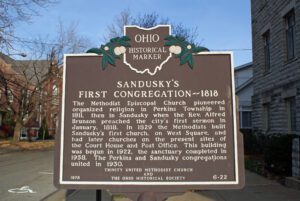
The Methodist Episcopal Church pioneered organized religion in Perkins Township in 1811, then in Sandusky when the Rev. Alfred Brunson preached the city’s first sermon in January, 1818. In 1829 the Methodists built Sandusky’s first church, on West Square, and had later churches on the present sites of the Court House and Post Office. This building was begun in 1922, the sanctuary completed in 1958. The Perkins and Sandusky congregations united in 1930.
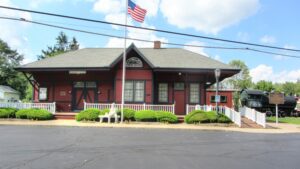
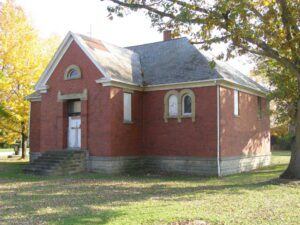
This Little Red Schoolhouse served children from Berea, Brookpark, and Middleburg township. The first mayor and council of Middleburgh Heights were elected here. During its colorful history, the schoolhouse has been a City Hall where town meetings were held, a speak-easy, a railroad way station, and a private residence.
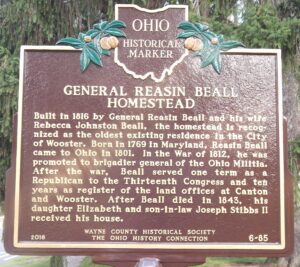
Built in 1816 by General Reasin Beall and his wife Rebecca Johnston Beall, the homestead is recognized as the oldest existing residence in the City of Wooster. Born in 1769 in Maryland, Reasin Beall came to Ohio in 1801. In the War of 1812, he was promoted to brigadier general of the Ohio militia. After the war, Beall served one term as a Republican to the Thirteenth Congress and ten years as a register of the land offices at Canton and Wooster. After Beall died in 1843, his daughter Elizabeth and son-in-law Joseph Stibbs II received his house.
This is the gravesite of Robert Nesbitt, an immigrant from Convoy, Ireland who named Convoy, Ohio after his home town. In 2010, the Convoy Community Foundation, Convoy Lions Club, Convoy Business Association, and Convoy Community Days, Inc. raised the funds to restore Nesbitt’s tombstone. A representative from Convoy, Ireland – Ray Bonar – attended the rededication ceremony on July 4, 2010. The Van Wert County Historical Society took over the care of the grave site, which is in the Sugar Ridge Cemetery. The cemetery has been under the care of the Tully Township Trustees since its foundation.
1806 – Built his log cabin home in Heaton Park, Vienna Avenue. 1806/07 – Constructed a grist mill, dam and mill race along Mosquito Creek. 1809 – Manufactured first bar iron in Ohio. 1812/13 – Constructed “Maria” blast furnace. 1820 – Built his residence at 1355 Robbins Avenue. 1834 – Platted 54 downtown lots. Names settlement “Nilestown.”