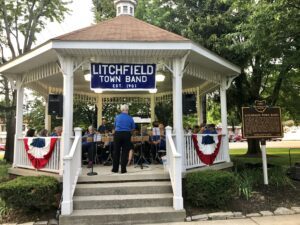
Around 1900, the newly formed Litchfield Cemetery and Park Association needed a band to lead processions to and from the town cemetery on Memorial Day. The Litchfield Town Band was born. Urial Crow served as its first director, so the group was sometimes known as “The Crow Band”. Although there were periods when the band was inactive, it has been a community institution for more than a century. The group plays a broad repertoire of standards and marches by John Philip Sousa at Memorial Day and other commemorations, ice cream socials, and various community events. Directors have included Urial Crow, Loren Hayes (c. 1915), Floyd Koons (mid-1920s), Raymond Bradley (1935-1939), Hal Leach (1939-1945), Kenneth Bradley (1946-2011) and Cynthia Bennett (since 2012).
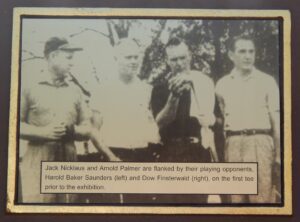
Golfing greats Arnold Palmer and Jack Nicklaus first met on the golf course at the Athens Country Club in Athens, Ohio. The event was a celebration for native son Dow Finsterwald, winner of the 1958 PGA Championship. Due to the significance of the event, Athens city officials proclaimed September 25, 1958, “Dow Finsterwald Day,” and the day featured an 18-hole exhibition golf match at the Athens Country Club. Reigning Masters Champion Arnold Palmer joined his long-time friend Finsterwald for the exhibition. Outstanding amateur Howard Baker Saunders of Gallipolis and eighteen year old Jack Nicklaus of Columbus completed the foursome. Nicklaus, a recent high school graduate, was a promising amateur with an Ohio State Open title and a national Jaycee championship to his credit. [Continued on other side]
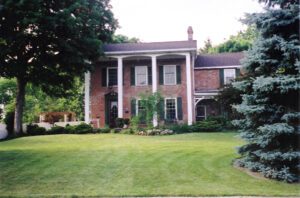
Jonathan Wright (1782-1855) and his wife Mary Bateman Wright (1787-1866) moved with their five children from Menallen, Adams County, Pennsylvania, in 1814 and built this Federal style house. Using skills acquired from his father, Joel Wright, a surveyor who platted the city of Columbus, Jonathan platted the village of “Springborough,” named for the many springs in the vicinity. The Wright family established and operated a woolen factory, two flour mills, a general store, and a 320-acre farm in the Springboro area. The Wrights were active members of the Society of Friends (Quakers) and strongly opposed slavery. The house was a station on the Underground Railroad, offering assistance to runaway slaves during their flight to freedom. Many members of the Wright family, including Jonathan, Mary, and four of their children, are buried in the Friends Cemetery on nearby Factory Road.
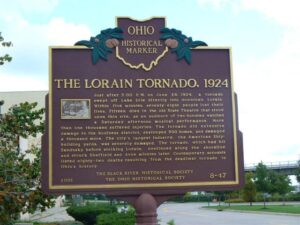
Just after 5:00 P.M on June 28, 1924, a tornado swept off Lake Erie directly into downtown Lorain. Within five minutes, seventy-eight people lost their lives. Fifteen died in the old State Theatre that stood upon this site, as an audience of two hundred watched a Saturday afternoon musical performance. More than one thousand suffered injuries. The tornado did extensive damage to the business district, destroyed 500 homes, and damaged a thousand more. The city’s largest industry, the American Shipbuilding yards, was severely damaged. The tornado, which had hit Sandusky before striking Lorain, continued along the shoreline and struck Sheffield and Avon minutes later. Contemporary accounts listed eighty-two deaths resulting from the deadliest tornado in Ohio’s history.
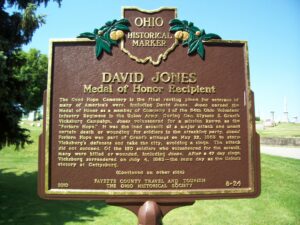
The Good Hope Cemetery is the final resting place for veterans of many of America’s wars, including David Jones. Jones earned the Medal of Honor as a member of Company I of the 54th Ohio Volunteer Infantry Regiment in the Union Army. During Gen. Ulysses S. Grant’s Vicksburg Campaign, Jones volunteered for a mission known as the “Forlorn Hope.” It was the lead assault of a major attack and meant certain death or wounding for soldiers in the attacking party. Jones’ Forlorn Hope was part of Grant’s attempt on May 22, 1863 to storm Vicksburg’s defenses and take the city, avoiding a siege. The attack did not succeed. Of the 150 soldiers who volunteered for the assault, many were killed or wounded, including Jones. After a 47 day siege, Vicksburg surrendered on July 4, 1863—the same day as the Union’s victory at Gettysburg.
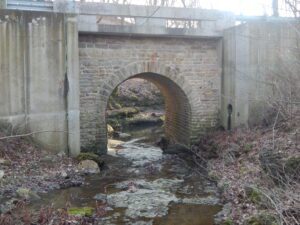
Listed on the National Register of Historic Places in 2009, the span is the oldest in Clark County a traveler can cross. It is also one of the oldest stone bridges in use in Ohio. Stone mason Samuel S. Taylor (1837-1930) built the culvert from locally quarried limestone in 1871, his first public works project. A Civil War veteran, Taylor worked on several projects, including the Mill Run underground sewer (1877), Champion’s East Street shops (1883), and the foundation for Springfield’s city hall (1890).
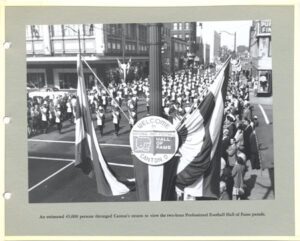
On September 17, 1920, representatives from ten professional football teams met in Canton and formed the American Professional Football Association, which in 1922 became the National Football League (NFL). Pro football evolved from club football in the 1890s, and by the early 1900s had begun to spread across the country, concentrating in the Midwest. Jim Thorpe, the first nationally prominent pro, started with the Canton Bulldogs-an early pro football power-in 1915. In 1959, Canton citizens launched a well-organized and ultimately successful effort to have their city, “the cradle of professional football,” designated as the site of a monument to the sport’s historic stars. The Professional Football Hall of Fame opened on September 7, 1963, inducting seventeen charter members. The Hall of Fame interprets and promotes the study of the role of professional football in American culture.
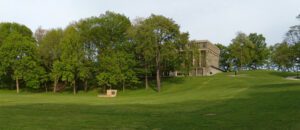
In 1968, Richard Nixon won the presidency partly based on a campaign promise to end the Vietnam War. Though the war seemed to be winding down, on April 30, 1970, Nixon announced the invasion of Cambodia, triggering protests across college campuses. On Friday, May 1, an anti-war rally was held on the Commons at Kent State University. Protestors called for another rally to be held on Monday, May 4. Disturbances in downtown Kent that night caused city officials to ask Governor James Rhodes to send the Ohio National Guard to maintain order. Troops put on alert Saturday afternoon were called to campus Saturday evening after an ROTC building was set on fire. Sunday morning in a press conference that was also broadcast to the troops on campus, Rhodes vowed to “eradicate the problem” of protests at Kent State. (Continued on other side)