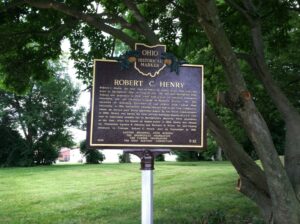
Robert C. Henry, the first African-American mayor of an Ohio city, was born in Springfield, Ohio, on July 16, 1921. He attended Springfield High School and graduated in 1939. After high school, he attended Wittenberg University and the Cleveland College of Mortuary Science. He also received an honorary Doctorate of Law degree from Central State University. In 1961, Springfield citizens elected him to the City Commission, where he served until being appointed mayor by his fellow commissioners in 1966. Henry was among the first African-American mayors of a U.S. city, and is especially notable due to Springfield’s majority white population at the time. After his tenure as mayor ended in 1968, Henry was chosen by presidents Lyndon B. Johnson and Richard M. Nixon for fact- finding missions in Vietnam. Robert C. Henry died on September 8, 1981.
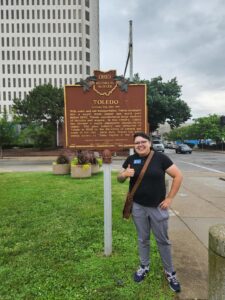
After consolidation of the villages of Fort Lawrence and Vistula, the City of Toledo was incorporated in 1837. Originally named “Toledo” in 1833, the site became part of Ohio when the “Toledo War,” a bloodless boundary conflict with Michigan, was resolved by Congress in 1836. Settlers were attracted by the commercial potential of the Maumee River, called “Miami of the Lake,” and later the Miami-Erie Canal. (Continued on other side)
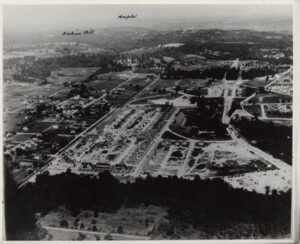
Ground was broken for Mariemont by Mary M. Emery, the village’s founder, on April 23, 1923. This planned community was designed by eminent town planner John Nolen and twenty-five of America’s leading architects. As part of the “garden city movement,” Mariemont was influenced by English models. Mariemont was incorporated July 12, 1941, and was listed on the National Register of Historic Places on July 24, 1979.
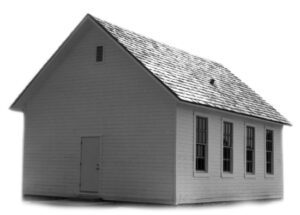
Descendants of slaves, who may have reached Ohio through the Underground Railroad, and other African Americans, formed the community of Flatwoods in the southwest part of Bokescreek Township. This one-room schoolhouse was built circa 1868 for African American children of Flatwoods and remained open until 1923. Remnants of past lessons remain inscribed on the chalkboard. The schoolhouse was threatened with demolition in 1999 and later moved to Veteran’s Park. The Logan County Historical Society owns and maintains the site as a living history museum.
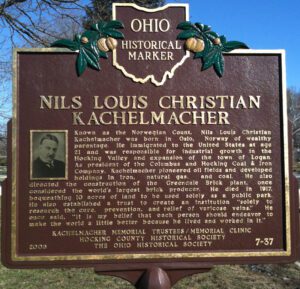
Known as the Norwegian Count, Nils Louis Christian Kachelmacher was born in Oslo, Norway of wealthy parentage. He immigrated to the United States at age 21 and was responsible for industrial growth in the Hocking Valley and expansion of the town of Logan. As president of the Columbus and Hocking Coal & Iron Company, Kachelmacher pioneered oil fields and developed holdings in iron, natural gas, and coal. He also directed the construction of the Greendale Brick plant, once considered the world’s largest brick producer. He died in 1917, bequeathing 10 acres of land to be used solely as a public park. He also established a trust to create an institution “solely to research the cure, prevention, and relief of varicose veins.” He once said, “It is my belief that each person should endeavor to make the world a little better because he lived and worked in it.”
James Elrick, a local carpenter, built the Lane-Hooven House in 1863 for Clark Lane (1823-1907), a Hamilton industrialist and philanthropist. Lane, who first came to the area at age twenty-one as a blacksmith, resided in the house for more than eleven years. In 1866, Lane built the library, also originally an octagon, across the street. In 1868, he conveyed the library to the city. The C. Earl Hooven family resided in the house from 1895 to 1942. In 1943, Bertrand Kahn purchased the residence and presented it to the community for civic and charitable uses. It was donated as a memorial to his father, Lazard Kahn, a Hamilton industrialist and civic leader. The Lane-Hooven House was added to the National Register of Historic Places in 1973. (Continued on other side)
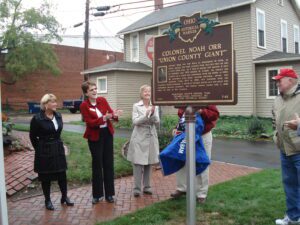
Cyprian Lee (1792-1854) settled in the Union County wilderness in 1820 and purchased the 118 West Sixth Street lot in 1828 for $6. County treasurer, coroner, shoemaker, and anti-slavery activist, Lee lived here in a log cabin until 1832 when this Greek Revival two-story brick house was completed. Other notable citizens to have resided in this oldest brick house in Marysville were showman Noah Orr (1836-1882), also known as the “Union County Giant,” and Josiah Jacob Morelock (1833-1899), a member of the Marysville City Council and the first Fire Department in Marysville. The Morelock family tannery business and stables were located behind this house.
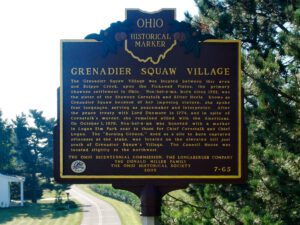
The Grenadier Squaw Village was located between this area and Scippo Creek, upon the Pickaway Plains, the primary Shawnee settlement in Ohio. Non-hel-e-ma, born circa 1722, was the sister of the Shawnee Cornstalk and Silver Heels. Known as Grenadier Squaw because of her imposing stature, she spoke four languages, serving as peacemaker and interpreter. After the peace treaty with Lord Dunmore in 1774, and in spite of Cornstalk’s murder, she remained allied with the Americans. On October 1, 1978, Non-hel-e-ma was honored with a marker in Logan Elm Park near to those for Chief Cornstalk and Chief Logan. The “Burning Ground,” used as a site to burn captured prisoners at the stake, was located on the elevated hill just south of Grenadier Squaw’s Village. The Council House was located slightly to the northwest.