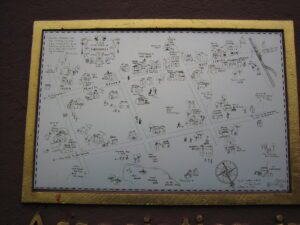
Acclaimed author and illustrator of juvenile literature Lois Lenski was born in Springfield in 1893, grew up in Anna, and graduated from Sidney High School. In 1915, Lenski graduated from The Ohio State University and moved to New York City to work and study art. After illustrating several children’s books in the early 1920s, she began writing and illustrating her own stories. Lenski specialized in historical fiction and regional themes–eventually publishing nearly one hundred carefully-researched books.
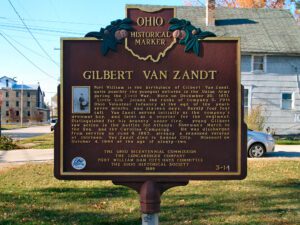
Port William is the birthplace of Gilbert Van Zandt, quite possibly the youngest enlistee in the Union Army during the Civil War. Born on December 20, 1851, “Little Gib” joined the ranks of Company D, 79th Ohio Volunteer Infantry at the age of ten years, seven months, and sixteen days. Barely four feet tall, Van Zandt served initially as the company’s drummer boy, and later as a courier for the regiment. Distinguished for his bravery under fire, young Gilbert saw action in the battles for Atlanta, Sherman’s March to the Sea, and the Carolina Campaign. He was discharged from service on June 9, 1865, already a seasoned veteran at thirteen. Van Zandt died in Kansas City, Missouri on October 4, 1944 at the age of ninety-two.
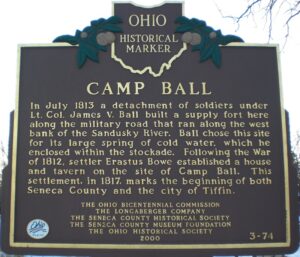
In July 1813 a detachment of soldiers under Lt. Col. James V. Ball built a supply fort here along the military road that ran along the west bank of the Sandusky River. Ball chose this site for its large spring of cold water, which he enclosed within the stockade. Following the War of 1812, settler Erastus Bowe established a house and tavern on the site of Camp Ball. This settlement, in 1817, marks the beginning of both Seneca County and the city of Tiffin.
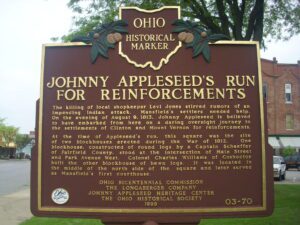
The killing of local shopkeeper Levi Jones stirred rumors of an impending Indian attack. Mansfield’s settlers needed help. On the evening of August 9, 1813, Johnny Appleseed is believed to have embarked from here on a daring overnight journey to the settlements of Clinton and Mount Vernon for reinforcements. At the time of Appleseed’s run, this square was the site of two blockhouses erected during the War of 1812. One blockhouse, constructed of round logs by a Captain Schaeffer of Fairfield County, stood at the intersection of Main Street and Park Avenue West. Colonel Charles Williams of Coshocton built the other blockhouse of hewn logs. It was located in the middle of the north side of the square and later served as Mansfield’s first courthouse.
The completion of the Wabash and Erie Canal on July 4, 1843 brought many new settlers into this region. The Wabash and Erie Canal connected with the Miami and Erie Canal at Junction. Antwerp, ideally located on the Maumee River, was seen as a perfect place in which to establish a town. That same year surveyors W. Wilshire Riley and Samuel Rice platted what would become Antwerp. Naming rights belonged to Riley and storeowner Horatio N. Curtis, who wanting a name not duplicated anywhere else in the country, named it after Antwerp, Belgium. Early pioneers subdued the massive forests that once formed the “Black Swamp” and built a thriving city. Antwerp was incorporated in 1863. (continued on other side)
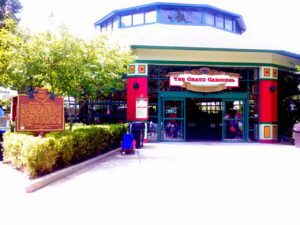
This “Grand Carousel,” manufactured in 1914 by the William I. Mangels Company with wood horses carved by the Marcus Illions Company, was first located at Olentangy Park, an interurban-era amusement park in Clintonville. In 1938, the Mangels-Illions carousel was relocated to the Scioto Ranch Park (also known as the Zoo Amusement Park and Wyandot Lake). On June 17, 2000, the restored carousel, with the original 52 horses and 2 chariots, began “spinning its magic” at this location. Of the nearly 5000 “Grand Carousels” that were operational in the early 1900s, fewer than 200 remain.
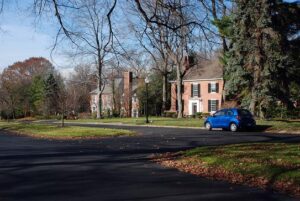
Youngstown’s earliest automobile suburb, Forest Glen Estates was developed in the 1920s during a period of change in urban transportation patterns and rapid expansion in the regional steel economy. A composite of design work by leading northeastern Ohio landscape and residential architects, the park-like suburb integrates period revival architecture into the natural landscape and blends gracefully with adjacent Mill Creek Park. Gently curving streets with low curbs and landscaped islands were a novel departure from traditional grid patterns. Attached garages and walkways that connect to driveways rather than the street reflect the influence of the personal automobile in the suburban landscape during this era. In 1998, the Forest Glen Estates Historic District was listed on the National Register of Historic Places.
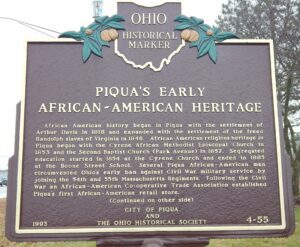
African-American history began in Piqua with the settlement of Arthur Davis in 1818 and expanded with the settlement of the freed Randolph slaves of Virginia in 1846. African-American religious heritage in Piqua began with the Cyrene African Methodist Episcopal Church in 1853 and the Second Baptist Church (Park Avenue) in 1857. Segregated education started in 1854 at the Cyrene Church and ended in 1885 at the Boone Street School. Several Piqua African-American men circumvented Ohio’s early ban against Civil War military service by joining the 54th and 55th Massachusetts Regiments. Following the Civil War an African-American Co-operative Trade Association established Piqua’s first African-American retail store. Continued on/from other side)