Legend has it that Mogadore’s first settler, Ariel Bradley, was a spy for George Washington in October, 1776. As a nine year old boy, Ariel crossed British lines on a supposed errand to the nearest grist mill and returned with troop positions and tent counts. In 1801, Ariel left Connecticut to make his new home in what would be Ohio. In 1807, he built a log cabin on a 146 acre plot of farm land that cost $335. Until 1825 the new community had been named Bradleyville, but Ariel did not want the area named after him. Martin Kent was building a residence and a sailor, John Robinson, climbed to the top of the framework, pulled a flask of whiskey from his pocket. Breaking the flask on the last beam of construction, Robinson shouted “Three cheers for Mogador,” which is a large city in Morocco, thusly christening the area Mogadore.
Intersection of State Route 554 and Depot Road, Springfield Township
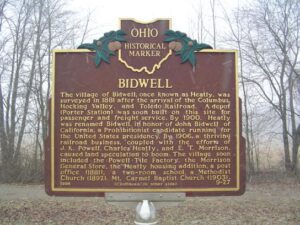
Bidwell
, OH
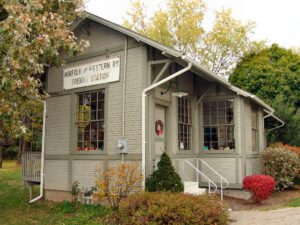
The village of Bidwell, once known as Heatly, was surveyed in 1881 after the arrival of the Columbus, Hocking Valley, and Toledo Railroad. A depot (Porter Station) was soon built on this site for passenger and freight service. By 1900, Heatly was renamed Bidwell, in honor of John Bidwell of California, a Prohibitionist candidate running for the United States presidency. By 1906, a thriving railroad business, coupled with the efforts of J.K. Powell, Charles Heatly, and E.T. Morrison, caused land speculation to boom. The village soon included the Powell Tile Factory, the Morrison General Store, the Heatly housing addition, a post office (1881), a two-room school, a Methodist Church (1892), Mt. Carmel Baptist Church (1903), (Continued)
corner of South Michigan Avenue and East Indiana Street
Edgerton
, OH
Edgerton was settled beside the St. Joseph River when the Lake Shore & Michigan Southern railroad was completed in 1854. The village was incorporated on December 4, 1865, and named for Alfred P. Edgerton, who donated the land for the park. He was an agent for Hicks & Company, a land speculation business. The firm of Von Behren & Shaffer built the town hall and opera house in 1884 for $7,998. The building and park became a hub of local activity. The park’s bandstand showcased the Edgerton Village Band and citizens gathered for picnics and festivities. (Continued on other side)
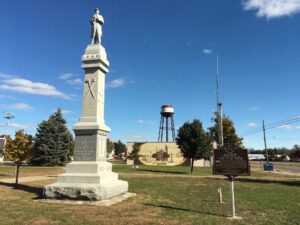
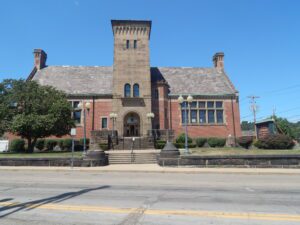
Andrew Carnegie was born in Dunfermline, Scotland. He immigrated to Allegheny City Pennsylvania with his family when he was 13. While operating the telegraphs for the Pennsylvania Railroad, Carnegie perceived the great need for steel in the railroad industry. With this insight, he founded the Carnegie Steel Corporation which operated for 35 years before he sold it to J.P. Morgan in 1901. Andrew Carnegie wrote the article, “Wealth” in 1889 in which he said that a responsible person of wealth should help his fellow man. Carnegie’s philanthropy provided 2,509 libraries throughout the world. Carnegie was already familiar with the city when he wrote a letter to offer funds to build the Steubenville library on June 30, 1899.(Continued on other side)
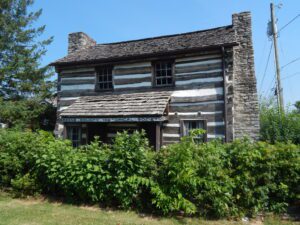
James Sr. and Rebecca (Junkin) Galloway moved with their family to Greene County from Kentucky in 1798, constructing their first home, a small log cabin. Galloway built the present structure around 1799 near the bend in the Little Miami River near what is now Goes Station on U.S. 68. In 1936, the Greene County Historical Society moved the home to the corner of Second and Monroe streets and then to the present site in 1965. The 1974 Xenia Tornado caused serious damage to the building, which has been restored and maintained by the historical society. James Sr. served as a hunter during the American Revolution, procuring game for the army, and while in Ohio, was the first treasurer of Greene County. His son James Jr. served as the first County Surveyor.
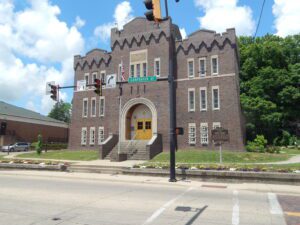
In the first years of the twentieth century, Athens’ citizens formed a new National Guard company. The guardsmen initially held drill at the Campbell Block on Court Street, but soon the Athens Commercial Club began advocating for an armory from the Ohio National Guard. In 1912, the Armory Board approved the request. Plans were drawn up for the armory and the Guard purchased land from the Athens Brick Company at the foot of Shale Hill. Construction began in the spring of 1915 and the Armory opened in December. In March of 1917, the city held a dedication ceremony and parade. Before World War I, the Athens Armory housed Company L and the Machine Gun Company, both part of the 7th Infantry Regiment, Ohio National Guard. (Continued on other side)
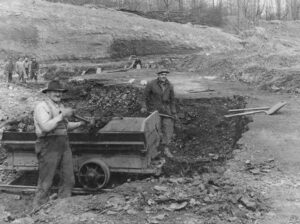
Agriculture dominated the economy of southeastern Ohio’s Morgan County until the 1940s when harvests dwindled, the population declined, and land values dropped. Surface mining the area’s rich underground coal deposits replaced agriculture as the major industry and revitalized the declining local economy. As the nation’s demand for electricity grew over the next half-century, so did the demand for coal as fuel for nearby power generation plants. During mining’s heyday in the 1960s to the late 1980s, American Electric Power’s former Central Ohio Coal Company subsidiary employed nearly 1,000 people. Nearby communities-such as Cumberland, Caldwell and Chandlersville-thrived. As time passed, however, the robust coal industry was hit hard by environmental regulations that reduced the market for the area’s high-sulfur coal. In turn, mine work forces shrank considerably and local businesses closed. (continued on other side)
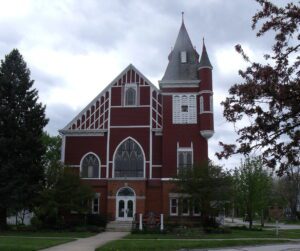
The Burton Congregational Church was organized in 1808 and met in several nearby locations before this present building was erected in 1836 at a cost of $4,000. It was originally located within the park directly opposite where it stands today, but was moved to its present location in 1850. The steeple, rising 104 feet from the ground, crowned the roof in 1875. The church building was frequently used as a public hall and for many years was also used as the main hall for the Agricultural Fair, the forerunner of the Great Geauga County Fair. A former architect referred to the church as “Steamboat Gothic” because of its unusual appearance, but to its membership and friends it is just a beautiful place to worship God.