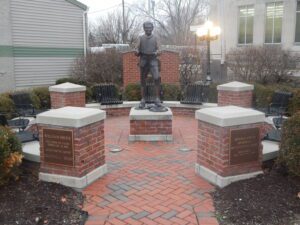
William Bruce founded and platted the city of Eaton in 1806. Born in Virginia in 1762, Bruce relocated to Ohio in 1793. In 1806, he purchased nearly two thousand acres of land from the government for the founding of Eaton. Bruce, a Revolutionary War veteran, named the town for General William Eaton, a veteran of the Tripolitan War, a war fought between the United States and the Barbary States from 1800-1805. Some of Eaton’s principal streets also took their names from other Tripolitan War veterans, including Somers, Decatur, and Israel. Bruce established the first sawmill and gristmill in Eaton and often distributed corn meal to the needy and deserving. He also made liberal donations of land for the benefit of the town, and sold many lots inexpensively or on partial payment to induce settlers to locate in the town. William Bruce died in 1830 and is interred in the Mound Hill Cemetery in Eaton.
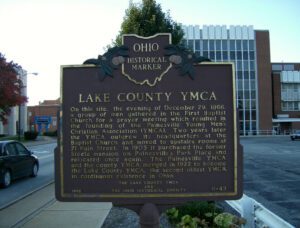
On this site, the evening of December 29, 1866, a group of men gathered in the First Baptist Church for a prayer meeting which resulted in the founding of the Painesville Young Men’s Christian Association (YMCA). Two years later the YMCA outgrew its headquarters at the Baptist Church and moved to upstairs rooms at 71 Main Street. In 1905 it purchased the former Steele mansion on Painesville’s Park Place and relocated once again. The Painesville YMCA and the county YMCA merged in 1922 to become the Lake County YMCA, the second oldest YMCA in continuous existence in Ohio.
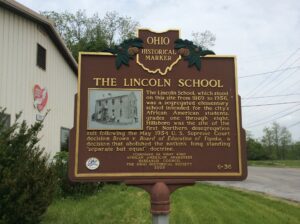
The Lincoln School, which stood on this site from 1869 to 1956, was a segregated elementary school intended for the city’s African American students, grades one through eight. Hillsboro was the site of the first Northern desegregation suit following the May 1954 U.S. Supreme Court decision Brown v. Board of Education of Topeka, a decision that abolished the nation’s long standing “separate but equal” doctrine. (Continued on other side)
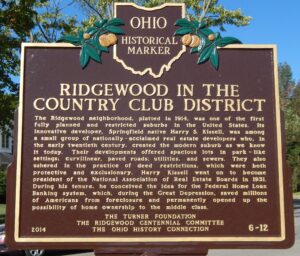
The Ridgewood neighborhood, platted in 1914, was one of the first fully planned and restricted suburbs in the United States. Its innovative developer, Springfield native Harry S. Kissell, was among a small group of nationally-acclaimed real estate developers who, in the early twentieth century, created the modern suburb as we know it today. Their developments offered spacious lots in park-like settings; curvilinear, paved roads; utilities, and sewers. They also ushered in the practice of deed restrictions, which were both protective and exclusionary. Harry Kissell went on to become president of the National Association of Real Estate Boards in 1931. During his tenure, he conceived the idea for the Federal Home Loan Banking system, which, during the Great Depression, saved millioins of Americans from foreclosure and permanently opened up the possibility of home ownership to the middle class.
Following a wage reduction from 70 to 60 cents per ton after many Hocking Valley coal mines consolidated in 1883, the Ohio Miners’ Amalgamated Association struck on June 23, 1884. The operators responded by offering an even smaller tonnage rate and a requirement for returning miners to sign no-strike contracts. The strike idled three thousand miners in 46 mines at Nelsonville, Murray City, New Straitsville, Carbon Hill, Buchtel, Longstreth, and Shawnee. (Continued on other side)
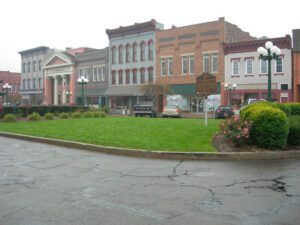
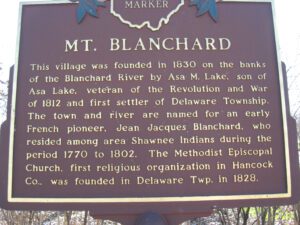
This village was founded in 1830 on the banks of the Blanchard River by Asa M. Lake, son of Asa Lake, veteran of the Revolution and War of 1812 and first settler of Delaware Township. The town and river are named for an early French pioneer, Jean Jacques Blanchard, who resided among area Shawnee Indians during the period 1770 to 1802. The Methodist Episcopal Church, first religious organization in Hancock Co., was founded in Delaware Twp. in 1828.
Congregations of the Religious Society of Friends (Quakers), called “meetings”, worshiped in plain meeting houses. On this site stood the last Richland Friends Meeting House, built in 1872. Ninety-four Friends established the meeting in 1826 and it endured for 147 years. The cemetery is where many generations of members of this meeting are buried. The faith, based on pacifism and simplicity, blossomed in the region during the first half of the 19th century. (Continued on other side)
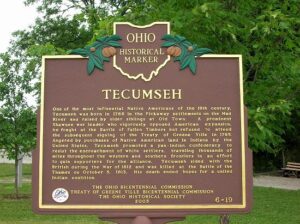
One of the most influential Native Americans of the 19th century, Tecumseh was born in 1768 in the Pickaway settlements on the Mad River and raised by older siblings at Old Town. A prominent Shawnee war leader who vigorously opposed American expansion, he fought at the Battle of Fallen Timbers but refused to attend the subsequent signing of the Treaty of Greene Ville in 1795. Angered by purchases of Native American land in Indiana by the United States, Tecumseh promoted a pan-Indian confederacy to resist the encroachment of white settlers, traveling thousands of miles throughout the western and southern frontiers in an effort to gain supporters for the alliance. Tecumseh sided with the British during the War of 1812 and was killed at the Battle of the Thames on October 5, 1813. His death ended hopes for a united Indian coalition.