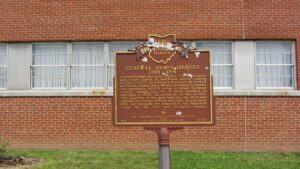
General Hedges was born in Ohio County, Virginia, and taught school in that state before coming to Ohio in 1803. As a Deputy Surveyor, he worked in Ashland, Holmes, Knox, Medina and Wayne Counties, and purchased 19,000 acres in future Richland County. Hedges was one of three founders of Mansfield in 1808. He served in the War of 1812. This unselfish Mason gave land for the Methodist Church, and Hedges School and Park. In February, 1818, he obtained the Deposition for Mansfield Lodge #35, Free and Accepted Masons. [Masonic Emblem]
Described as a Columbus “institution” when he died in 1969, Emerson C. Burkhart was born on a farm in Union Township, Putnam County in 1905. The son of Albert and Nora Burkhart, Emerson graduated from Kalida High School in 1924 and from Ohio Wesleyan University in 1927. After studying art in Provincetown, Massachusetts and in New York City, he settled in Columbus and, in 1937, married Mary Ann Martin, an artists’ model who devoted herself to his career. Burkhart was a prolific painter and completed an estimated 3,000 pictures during his 40-year career, including street scenes, rural landscapes, and more than 250 self-portraits, once noting his face was “cheaper than a model’s and always there.”
As a member of the Connecticut Land Company, Judge Samuel Hinckley of North Hampton, Massachusetts purchased township 4N Range 13W of the Western Reserve in 1795 for a sum equivalent to 23 cents an acre. The township remained unsettled until Abraham Freeze was commissioned by Judge Hinckley in 1819 to survey the township into 100 plots of 160 acres each. In return for having the township, founded in 1825, named “Hinckley,” the judge gave land for two burying grounds and one-half acre for a public square. In 1919, upon the 101st anniversary of the “Great Hinckley Hunt,” where men from surrounding counties gathered on Christmas Eve to rid the township of wild animals, Judge Amos Webber spoke for the deceased Judge Hinckley: “When I last saw this country, it was a howling wilderness – by industry and frugality you and your ancestors have made these ever lasting hills and pleasant valleys blossom as the rose.”
SW corner of W. Monroe Street and S. Washington Street
New Bremen
, OH
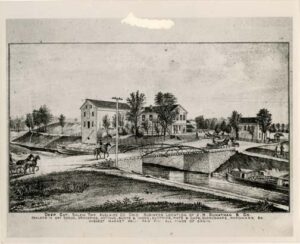
Begun in 1833, the Miami Extension Canal linked the Miami Canal in Dayton to the Wabash & Erie Canal at Junction. Engineering difficulties, epidemics, and the Panic of 1837 delayed completion of the Extension until June 1845, when the packet boat Banner first navigated the almost 250 miles distance from Cincinnati to Toledo in three days. New Bremen was the northern terminus for a period while work continued northward on the Extension. Designated the Miami & Erie Canal in 1849, it served as the primary avenue of commerce and military transport, and as a “post road” before the railroad era. The Miami & Erie remained in use until 1913, long after the canal era had passed. Along the course of the canal, New Bremen was the approximate midway point between Cincinnati and Toledo.
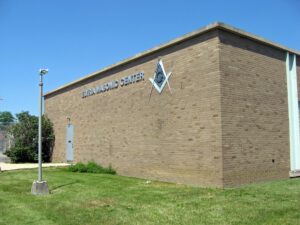
King Solomon Lodge, the first Masonic Lodge in Lorain County, was chartered on December 11, 1821, with Heman Ely as Worshipful Master. Ely (1775-1852), a prominent land developer, founded the City of Elyria in 1817, and built the first grist and saw mills and frame house in the village. Through his efforts, Elyria became the county seat in 1823.
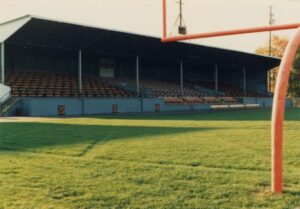
Opened in 1926, Tanks Memorial Stadium became the home of the Ironton Tanks semi-professional football team. The Tanks were formed in 1919 and through the years played other semi-professional teams as well as teams from the American Professional Football Association that became the National Football League in 1930. In twelve seasons the Tanks had a record of 85 wins, 19 losses, and 14 ties, including wins against the Chicago Bears and New York Giants. The Tanks disbanded in 1931, but five players moved on to the Portsmouth Spartans, which became the Detroit Lions, and other NFL teams picked up four other players. Tanks Memorial Stadium is one of the few remaining roofed high school football stadiums in the country.
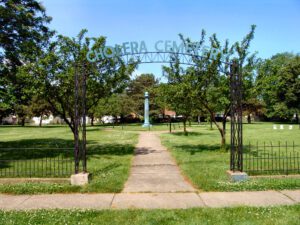
Of the city’s 5,667 people in 1849, 3,500 fled, and 400 of those remaining were victims of cholera. Most are buried here, some only in rough boxes in a common grave. The scourge came again in 1850 and 1852 but with less toll. “Dismay stalked abroad in the daytime and the drowsy night was hideous with the wailings of the disconsolate.”
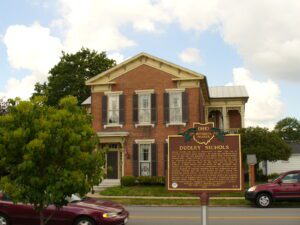
Dudley Nichols was born in Wapakoneta in 1895, the son of Dr. Grant and Mary Mean Nichols. He spent his childhood in a home on this site and graduated from Blume High School before leaving Ohio. After working as a journalist in New York City, he relocated to Hollywood to become a screenwriter for such films as Stagecoach, For Whom the Bell Tolls, and The Bells of St. Marys. In 1936 Nichols won an Oscar in the category Best Adapted Screenplay. He refused recognition for his work on The Informer because of strained relations with the Hollywood establishment. Nichols was the first person to ever refuse the prestigious award saying, “As one of the founders of the Screen Writers’ Guild, which was conceived in revolt against the Academy, and born out of disappointment with the way it functioned against employed talent-I deeply regret I am unable to accept the award.”