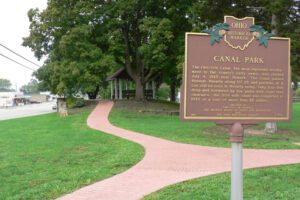
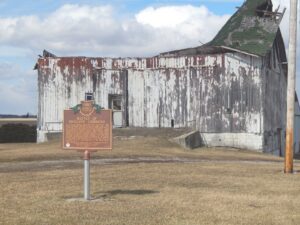
The Ohio-Erie Canal, the most important development in the county’s early years, was started July 4, 1825 near Newark. The canal passed through Waverly along US 23 and portions of it can still be seen in Waverly today. Only four feet deep and bordered by tow paths with eight feet clearance, the 309 mile canal was completed in 1833 at a cost of more than $7 million.
Its location and the tides of war established Gallipolis, then a town of some 3,000, as a point of strategic military importance to the Union upon the outbreak of the conflict in 1861. It was destined during the next four years to play a role without counterpart in Ohio. Here through this troop concentration area passed thousands of soldiers to the great campaigns. Here the traditional peacetime activity of the town, long a depot of supplies for the Kanawha Valley, was turned to military purposes for maintaining armies in the field. Here riverside warehouses held vast military stores to be transported by steamboat. Here newly-mustered troops set up Camp Carrington in a wheat field on the upper side of town. Here the women of Gallipolis helped minister to thousands of wounded and sick in an army hospital
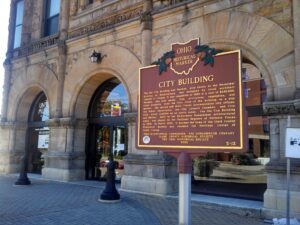
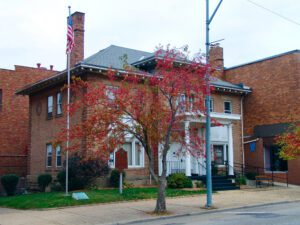
The Old City Building and Market, also known as the Municipal Building or Marketplace, was designed by local architect Charles A. Cregar. It was completed in 1890 at a cost of $250,000. Vendors, who sold meats, fish, provisions, vegetables, and other products, used the first floor of the building as a city market. The second and third floors accommodated city offices, the police department, the City Council Chamber, and City Hall, which doubled as an opera house. The Old City Building and Market, built in the Richardson Romanesque architectural style, was placed on the National Register of Historic Places in 1973. In March 2001, it became the home of the Clark County Historical Society and renamed the Heritage Center of Clark County.
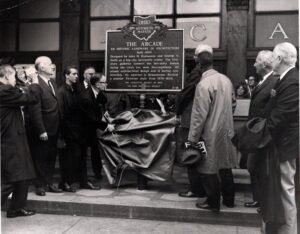
A Historic Landmark in Architecture Built 1890. Designed by John M. Eisenmann and George H. Smith as a big-city mercantile center. The five-story galleries connect the ten-story towers facing the city’s two main thoroughfares. Of unique architectural design and of daring construction, its exterior is Romanesque Revival, a popular Victorian style from 1875-1900.
The first Scottish Rite body of Free Masonry west of the Alleghenies was formed in Cambridge, Ohio, in 1852 by Killian H. Van Rensselaer, an honorary 33rd Degree Mason. He lived in this city from 1851 to 1867. Van Rensselaer was superintendent of construction of the present railroad tunnel west of Cambridge. He died in Cincinnati in 1881 at the age of 80.
In Greenwood Cemetery, at the end of Greenwood Road
Racine
, OH
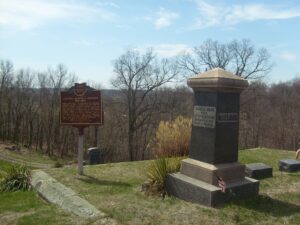
Born at Oak Grove, prospected in the California goldfields in 1849. During the Civil War he raised a militia company at Racine, and was later promoted Captain of Co. K, 18th O.V.I. After the war, he served on the Racine Village council, Sheriff of Meigs County, and was a member of the Ohio General Assembly. He was Secretary-Treasurer of the Ohio Commission for the Chichamauga Battleground National Park, and served 14 years as Postmaster of the U.S. House of Representatives.
The Northwest Ordinance of 1787 defined the boundary of the northern and southern tier of states to be carved out of the Northwest Territory, as a line drawn east from the southernmost tip of Lake Michigan until it intersects Lake Erie. Controversy over the exact location of that line led to the 1834-1837 boundary dispute between the State of Ohio and Michigan Territory. Passions ran high as everyone on both sides of the boundary knew that a great port city (Toledo) would emerge in the disputed territory. President Andrew Jackson settled the dispute in 1836 when he signed an act that recognized the current border between Ohio and Michigan, giving Michigan 9,000 square miles of Upper Peninsula land and awarding the disputed strip of approximately 470 square miles to Ohio. Michigan then joined the nation as a state the following year.
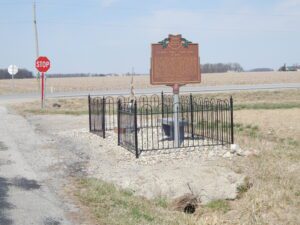
One of Ohio’s greatest manhunts ended here on the morning of July 23, 1948. Robert M. Daniels and John C. West, parolees from the state prison in Mansfield, had gone on a killing spree that left six people dead. Driving west on U.S. Route 224 in a stolen auto transport truck, the pair approached this intersection and encountered a roadblock. It was manned by Van Wert County Sheriff Roy Shaffer, Frank Friemoth, the county game warden, and Sergeant Leonard Conn of the Van Wert city police. West was driving the truck; Daniels was asleep in a car overhead. As Sheriff Shaffer climbed onto the truck and apprehended Daniels, West leaped from the cab and shot Conn in the chest and Friemoth in the arm. Conn returned fire and killed West. The officers survived their wounds. Daniels was convicted, sentenced to die, and electrocuted at the Ohio Penitentiary in Columbus on January 3, 1949. This marker pays tribute to all law enforcement officers who risk their lives to protect the citizens of their communities.