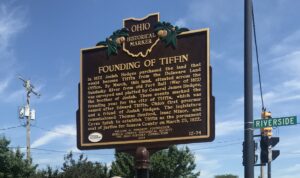
In 1822 Josiah Hedges purchased the land that would become Tiffin from the Delaware Land Office. By March, this land, situated across the Sandusky River from old Fort Ball (War of 1812) was surveyed and platted by General James Hedges, the brother of Josiah. These events marked the founding year for the city of Tiffin, which was named after Edward Tiffin, Ohio’s first governor and a friend of Josiah Hedges. The legislature commissioned Thomas Henford, Isaac Minor and Cyrus Spink to establish Tiffin as the permanent seat of justice for Seneca County on March 25, 1822.
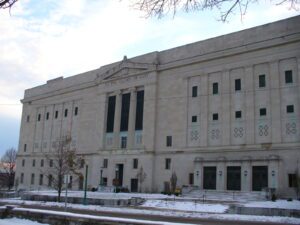
The first Masonic Lodge in Dayton was founded in 1808, located in the first Montgomery County Courthouse. Various other locations were home to Masons in Dayton, but by World War I, rapid growth of the Masonic community called for the creation of a new Lodge building. Masons of the time, including civic and business leaders of Dayton, conceived the idea of a new Masonic Center located on the hill at Belmonte Park North and Riverview Avenue. Ground was broken and construction of the $2.5 million Masonic Temple began on July 20, 1925. Through contributions from the Masonic community, the tremendous task of raising a majority of the building cost, $1.5 million, was accomplished in merely ten days in 1924. It is doubtful that the Temple could be duplicated given the fact that the large quantities of marble and mahogany and cherry woods used in construction would be difficult to procure today.
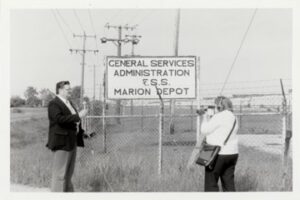
Early in 1942, during World War II, the U. S. Army Corps of Engineers acquired 640 acres along two miles of U. S. Route 30 South (now State Route 309) from ten landowners. By June 11 of that year, the farm families were removed and construction of The Marion Engineer Depot (MED) began, costing $4 million. The first military encampment in Marion County, the 333rd Engineering Regiment, arrived in May and established its camp in a wheat field. They lived in tents while constructing streets and railroad tracks around the Depot. MED was dedicated on December 7, 1942. During the war, food, munitions, equipment, and other military supplies flowed in and out of MED and heavy machinery was renovated. Peak employment came in July 1944 with 1,487 civilian and 47 military personnel on site. (Continued on other side)
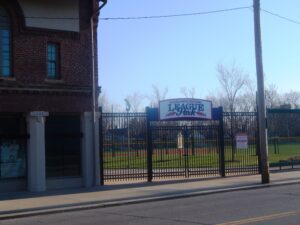
League Park opened on May 1, 1891, with the legendary Cy Young pitching for the Cleveland Spiders in their win over the Cincinnati Redlegs. The park remained the home of Cleveland’s professional baseball and football teams until 1946. In 1920 the Cleveland Indians’ Elmer Smith hit the first grand slam home run, and Bill Wamby executed the only unassisted triple play, in World Series history. Babe Ruth hit his 500th home run over the park’s short right field wall in 1929. With the park as home field, the Cleveland Buckeyes won the Negro World Series in 1945.
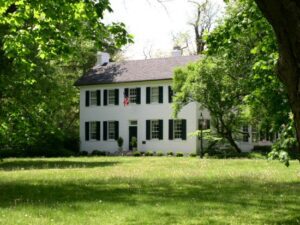
John Anderson Ward had this Federal style house constructed from 1823-1825 on land inherited from his father, Urbana’s founder Colonel William Ward. The Colonel’s will stipulated that a local mason use 26,500 bricks to build the house and be paid $80.00. The original house is thought to have had four rooms, two rooms each on the first and second floors and both divided by central hallways. John and his wife Eleanor Ward reared seven children in the house, two of whom became nationally recognized artists, John Quincy Adams Ward and Edgar Melville Ward. The farmstead, consisting of 172 acres, was also the site of a huge feast held in honor of General William Henry Harrison’s visit to Champaign County during his 1840 presidential campaign. Twelve 300 foot-long tables were spread across the lawn where thousands of people from the surrounding countryside dined on barbecued beef and lamb and drank barrels of cider.
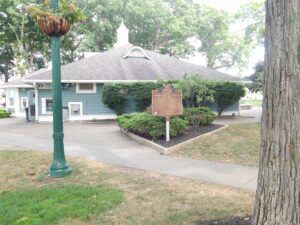
Entrepreneur and philanthropist Joseph (Jose) de Rivera was born in Barcelona, Spain, and built an import business in New York City. In 1854, he bought six Lake Erie Islands and had South Bass Island surveyed and subdivided into ten-acre lots. De Rivera traveled between New York and South Bass Island, initially turning Put-in-Bay into a sheep farm. He encouraged settlement on the island and its wine industry by helping German immigrants purchase land to plant vineyards. He donated five acres for this waterfront park, the site for the first school, and the land for the first church. To promote travel to the island, de Rivera opened the island’s largest cave as a tourist attraction. He is buried in the island’s cemetery, which is on land he donated for that purpose.
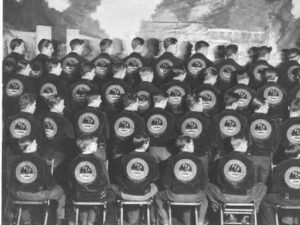
The blue corduroy jacket worn by members is a widely recognized symbol of the National FFA Organization, formerly Future Farmers of America. In 1933, Dr. J.H. “Gus” Lintner, a Fredericktown teacher and advisor to the local FFA chapter, commissioned a jacket for its members to wear to FFA’s national convention in Kansas City, Missouri. Impressed by the design, the organization adopted the jacket as part of FFA’s Official Dress. Millions of members have worn it since. Founded in 1928 to promote agricultural education, FFA continues its mission in 2018 in all 50 U.S. states and two territories.
E side of Intersection of Symmes Road and Marl Road
Wright Patterson AFB
, OH
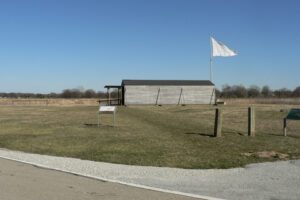
Huffman Prairie Flying Field, a unit of the Dayton Heritage National Historical Park, is the site where Wilbur and Orville Wright flew and perfected the world’s first practical airplane, the 1905 Wright Flyer III, after their first flights in Kitty Hawk, North Carolina in 1903. The Wright brothers mastered the principles of controlled, powered flight at Huffman Prairie during 1904 and 1905. From 1910 to 1915, they operated the Wright School of Aviation here, training many of the world’s first pilots, including many military pilots.