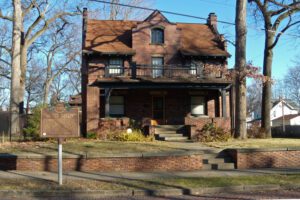
Akron, an industrial boomtown in the early twentieth century, grew in population nearly fivefold between 1900 and 1920. As the city industrialized, middle class residents sought homes on West Hill, away from the smoke and soot of heavy industry on the East Side. The Hall Park Allotment Historic District in West Hill represents a notable early twentieth century neighborhood. Developed by Philander Hall between 1902 and 1919 during the height of Akron’s “rubber boom,” it consists of several houses representing the picturesque styles of the period, including the American Foursquare, Craftsman, Colonial, and Medieval Revival Styles. With its gently curving brick streets, hilly topography, and mature trees, the Hall Park Allotment Historic District evokes the feeling of a distinct period of time in Akron’s history and constitutes a neighborhood of distinctive historical character and architectural merit.
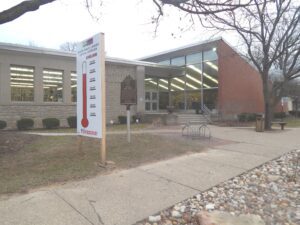
The American Sheet and Tin Plate Company founded the first Dover Public Library for the benefit of its employees at the corner of Front Street and Factory Street in 1902. Five years later, the library moved to a residence on Cherry and Fifth Streets. In 1916 the city dismantled “the old Downey residence” and built a high school in its place, with the public library occupying the basement. In 1934, the library moved to a converted residence at 417 North Walnut Street. Over time, however, the building became inadequate to house this beloved institution. In 1953 the city of Dover passed a bond issue to build a new library for the community. The new building, located at this site, opened in 1955.
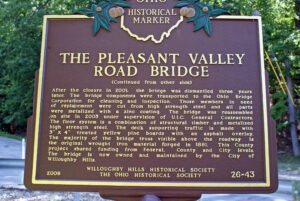
This single lane Pleasant Valley Road Bridge was constructed in 1881 by the Wrought Iron Bridge Company of Canton, Ohio, and is a 163 foot-long Whipple Truss (double intersection Pratt through truss). It replaced a wooden bridge that portaged the west branch of the Chagrin River a few hundred yards downstream. The structure, one of less than ten of its kind remaining in the state of Ohio, and possibly the longest in Lake County, was built to sustain the Euclid-Chardon Road traffic on U.S. Route 6. Known as the Grand Army of the Republic Highway, G.A.R., this major thoroughfare served this purpose until 1952 when a new high level bridge bypass was constructed to the south. The Truss bridge, pleasing to the eye with the artwork and name plates atop the overhead portals, was designed to enhance the bridge’s appearance within the valley. (Continued on other side)
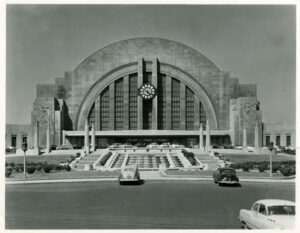
Cincinnati Museum Center at Union Terminal, 1301 Western Avenue
Cincinnati
, OH
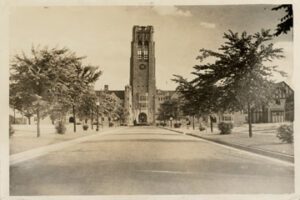
The Cincinnati Union Terminal opened in March 1933 and integrated rail travel in the city, which previously operated from five separate passenger terminals. Built when rail travel was already in decline, Union Terminal stopped operating as a passenger railroad station in 1972. Only during WWII was the terminal used to capacity with as many as 34,000 people travelling through the building daily in 1944. As part of preservation efforts, 14 mosaics depicting Cincinnati industry of the 1930s by Winold Reiss were saved from the concourse and moved to the Greater Cincinnati Airport. The restored Union Terminal became a Museum Center in November 1990 with the opening of the renovated Cincinnati Museum of Natural History and new Cincinnati History Museum. Cincinnati Union Terminal has been described as one of the most outstanding examples of Art Deco train stations in the nation and was listed on National Register of Historic Places in 1972.
The Toledo University of Arts and Trades was established in 1872 with an endowment of 160 acres of land from Jesup W. Scott, local pioneer, publisher, and real estate broker. Scott envisioned Toledo as the “Future Great City of the World” and wanted an institution to train young people to fulfill their roles in the city’s bright future.
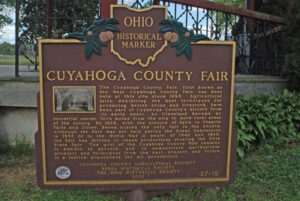
The Cuyahoga County Fair, first known as the West Cuyahoga County Fair, has been held at this site since 1895. Agricultural fairs, exhibiting the best techniques for producing better crops and livestock, have been part of Cuyahoga County’s history from its early years. As Cleveland became an industrial center, fairs moved from the city to more rural areas of the county. By 1928, with the closure of fairs in Chagrin Falls and Dover, Berea hosted the only fair in the county. Although the Fair was not held during the Great Depression in 1932 or in the World War II years of 1942 and 1943, the Fair has thrived to reach proportions rivaling the Ohio State Fair. The goal of the Cuyahoga County Fair remains to exhibit, to educate, and to demonstrate agribusiness products and techniques from the past, present, and future in a festive atmosphere for all generations.
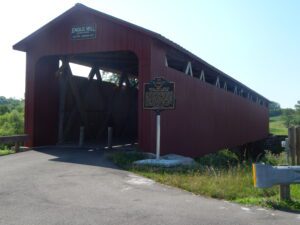
Built in 1877 and spanning 136 feet, the Engle Mill Road Covered Bridge carried vehicular traffic until 2003. The bridge is named after the nearby Levi Engle Mill. It is one of a few dozen Smith Truss bridges in the United States. The Smith Bridge Company manufactured the bridge using the Smith Truss patent, invented by founder, Robert W. Smith. The company originated in Tippecanoe City, Ohio and relocated to Toledo, where it was purchased by the Toledo Bridge Company in 1890. Smith died in 1898 at the age of 63, leaving a legacy of unique bridges.
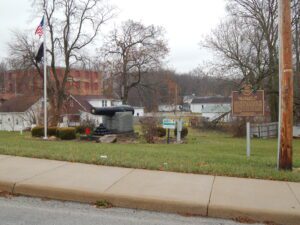
The roots of Huntersville began when John and Elizabeth Hilliard purchased this former Shawnee tribal land in 1797 from Ohio’s largest land speculator Judge John Symmes. When Symmes defaulted on his payments, the Hilliards found themselves repurchasing their own land from the federal government. These uncertain land claims defeated their 1799 attempt to found “Hilliardstown.” David Hunter purchased the abandoned village site in 1833. He re-surveyed the land in 1838 creating an eighteen lot, two street village that he named Huntersville. The village incorporated in 1848, but was annexed by the neighboring city of Piqua in 1893. At the time Huntersville had a population of over 760, its own school system, a volunteer fire department, gas lights, and an assortment of saloons, boarding houses, and grocery stores.