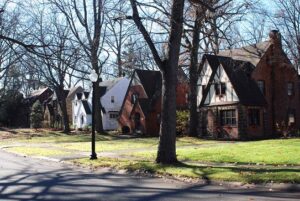
Situated in the township of Boardman and developed in the 1920s, Newport Village was one of Youngstown’s earliest automobile accessible suburban developments. The twenty four and a half acre district is comprised of Jennette Drive, Chester Drive, seven lots on Overhill Road, and a majority of the area on Market Street’s west side. Gently curving streets with both Tudor and Colonial architecture blend into the natural landscape of the area and Mill Creek Park. Newport Village became part of the National Register of Historic Places in 2006.
Garbry Conference Center and Learning Center, US 36
Piqua
, OH
J. Scott Garbry, a 1986 inductee into the Ohio Conservation Hall of Fame, had a lifelong commitment and passion for conservation, historic preservation, and education. His gift of land and artifacts to the Upper Valley JVS led to the creation of the Willowbrook Environmental Education Center and Garbry Museum. He was also instrumental in providing land for the site of the Piqua High School and for Garbry Woods of the Miami County Park District. These gifts make it possible to appreciate and experience Ohio’s natural and historic heritage.
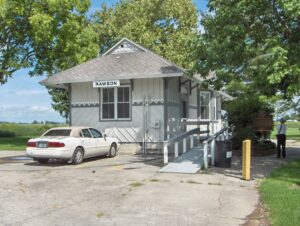
The original town plat of Rawson was filed on February 3, 1855, consisting of fifty-five lots in sections 13 and 14 of Union Township, Hancock County on the Frederick Keller and George J. Kelly farms. Several residential and business structures were built in anticipation of completion of a railroad rumored to pass from Fremont through the “Rawson” area on its way to the western boundary of Ohio. Farmers Keller and Kelly named their village Rawson after L.Q. Rawson, President of the railroad company, hoping that the name would encourage him to build through their area. Financial troubles delayed construction causing a standstill in Rawson. Seventeen years later the first locomotive arrived in Rawson, spurring new construction. At that time the railroad was called the Lake Erie and Louisville; in 1879 it was changed to the Lake Erie and Western and in 1922 became part of the Nickel Plate Railroad. (Continued on other side)
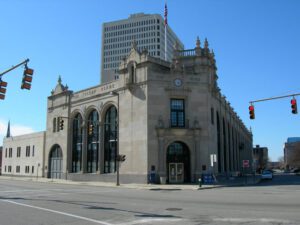
The Toledo Blade is the city’s oldest continuing business. The newspaper was first published on December 19, 1835, during the Ohio-Michigan boundary dispute known as the “Toledo War.” The name is derived from that conflict and the famous swords of Toledo, Spain. A copy of the first edition and two gift swords from that Spanish city are displayed inside the Blade Building.
201 Martin Luther King Drive (formerly: 201 Cass Avenue)
Marion
, OH
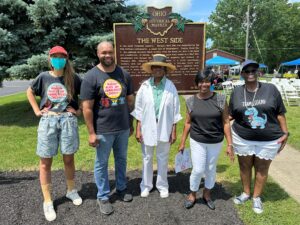
In the early twentieth century, Marion’s West Side was dominated by the Erie Railroad switchyards, a major hub of employment. During World War I, the railroad recruited Black workers from the South for jobs in its yards and roundhouses. In Marion, these workers made their homes in a West Side encampment that became the target of white suspicion and violence. In February 1919, following the unsolved murder of a white roundhouse worker’s wife and a separate alleged assault, a 300-man lynch mob smashed windows and occupied the West Side. All Black residents were ordered to leave the city by 6:00 pm the next day. Despite pleas to Governor Cox, at least 200 Black residents were forced to flee Marion. Marion’s anti-Black violence foreshadowed the nationwide “Red Summer” of 1919.
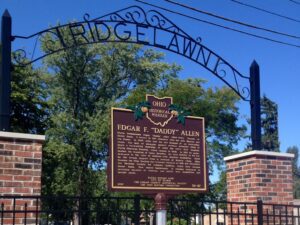
Elyria businessman Edgar “Daddy” Allen (1862 — 1937), founder of Easter Seals, is buried in this cemetery with his wife Blanche and son Homer. In 1907 Allen lost his son because of an interurban crash. The lack of adequate medical services prompted Allen to begin a fundraising campaign to build the city’s first hospital, Elyria Memorial Hospital, which opened in 1908. In 1915 he spearheaded the founding of Gates Hospital, the first facility in the U.S. dedicated to the care of children with physical disabilities. Aided by the strong support from a network of Rotary Clubs, Allen founded the Ohio Society for Crippled Children in 1919 and thereafter the National Society for Crippled Children, which later became Easter Seals. Now named Easterseals, it remains dedicated to providing services to children and adults with disabilities and special needs.
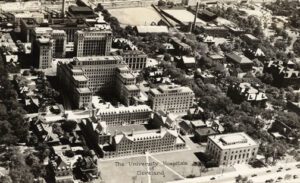
Named for the streetcar turnaround once located at Euclid Avenue and East 107th Street, University Circle is a 600-acre district that is home to many of Cleveland’s major cultural, educational, medical, and service institutions. The area was first settled in 1799 by tavernkeeper Nathaniel Doan and became known as Doan’s Corners. In 1882, Western Reserve College moved here from Hudson, followed in 1885 by the Case School of Applied Science from downtown Cleveland. These two colleges federated in 1967 to become Case Western Reserve University. (continued on other side)
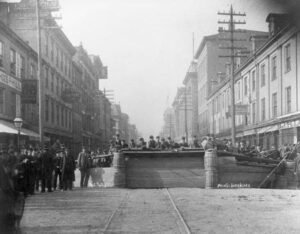
In March 1884, public confidence of Cincinnati law enforcement was extremely low. The public believed that murderers and other serious offenders were not brought to justice promptly or received little punishment. Civil unrest was brought to a boil when a seventeen-year-old was sentenced to only twenty years for manslaughter after brutally murdering his employer. On March 28, thousands of citizens stormed the county jail and courthouse. The riots lasted three days requiring forces from the Sheriff’s Office, city police, and local and state militia to restore order. Fifty-four people were killed and more than 200 wounded. The courthouse and jail suffered enormous damage, and valuable records were destroyed from the assault and fire. The riot gained international notoriety and helped pave the way for removal of political favoritism and a larger police force.